

Cryptocurrency has crossed a threshold. What began as a niche asset class confined to speculative retail portfolios is now a line item in corporate treasury reviews, a tool for cross-border payment optimization, and a technology layer being formally evaluated by CFOs and CIOs across industries. In 2026, the question for business leaders is no longer whether digital assets warrant attention — it is how to engage with them strategically.
The Institutional Shift Is Already Underway
The past three years have produced a measurable change in how enterprises approach crypto. Publicly traded companies have added Bitcoin to their treasury reserves as a hedge against fiat depreciation. Payment processors have integrated stablecoin rails to accelerate settlement and reduce intermediary costs. Asset managers have launched regulated crypto funds for institutional clients. These are not isolated experiments — they represent a structural recalibration of how organizations think about liquidity, currency exposure, and digital infrastructure.
In 2026, that recalibration is accelerating. Improved regulatory frameworks across major jurisdictions, the widespread adoption of proof-of-reserve standards, and the maturation of compliant trading infrastructure have collectively lowered the barrier to corporate adoption. For business leaders who have been observing from the sidelines, the calculus for waiting is becoming harder to justify.
Three Areas Where Crypto Creates Business Value
Treasury and Reserve Management. Holding a portion of corporate reserves in Bitcoin or dollar-pegged stablecoins offers a hedge against local currency depreciation and enables faster capital deployment across global operations. For companies with significant exposure to emerging market currencies, stablecoin positions provide a practical liquidity buffer without requiring conversion into a third-party fiat currency.
Cross-Border Payments and Settlement. Traditional international wire transfers carry fees of 3% to 8% (according to World Bank remittance data) and settlement windows of two to five business days. Blockchain-based payment rails can reduce both substantially — fees approaching zero, settlement near-instant. For organizations with international supplier networks, distributed payrolls, or high-volume cross-border transactions, this is a material operational improvement with a clear ROI calculation.
New Revenue and Customer Engagement. Businesses integrating crypto-native features — reward programs denominated in digital assets, embedded trading capabilities, or crypto-linked card products — are gaining measurable traction with a digitally fluent customer segment. The integration of crypto into loyalty and payments infrastructure is increasingly treated as a retention and acquisition lever rather than an experimental feature.
Evaluating Platform Infrastructure: What Enterprises Need
Executing on any of the above requires access to reliable, compliant trading and custody infrastructure. Enterprise evaluation criteria differ significantly from retail considerations. Regulatory standing, proof of reserves, fee structure, API reliability, and product depth matter more than interface design.
Platforms operating under registered compliance frameworks — including FinCEN MSB registration in the United States and AFSL licensing in Australia — provide the baseline that corporate legal and finance teams require before onboarding any digital asset counterparty. Published proof of reserves, verified periodically with over 1:1 asset backing, replaces trust with auditable data. Fee structure matters at scale: even small differences in maker and taker fees compound significantly across institutional-volume flows.
Security architecture is non-negotiable. Cold storage for the majority of assets, multi-party approval requirements for large transactions, enforced two-factor authentication, and wallet whitelisting are structural controls that separate credible platforms from those carrying operational risk that compliance teams cannot accept.
Enterprise Crypto Platform Checklist
| Criterion | What to Verify | Why It Matters |
| Regulatory registration | FinCEN MSB, AFSL, or equivalent | Legal standing in operating jurisdictions |
| Proof of reserves | Independent verification, >1:1 backing | Auditable solvency, no hidden liabilities |
| Cold storage | >90% of assets offline | Protection against exchange-level breaches |
| API uptime SLA | 99.9% minimum, redundant infrastructure | Reliable execution for automated strategies |
| Institutional fee tiers | Volume discounts, VIP arrangements | Cost efficiency at enterprise trading volumes |
What Institution-Ready Infrastructure Looks Like in Practice
One platform that meets enterprise evaluation criteria across compliance, security, and product depth is BYDFi. Celebrating its sixth year of operation in 2026, BYDFi has grown from a 2020 launch into a globally recognized exchange serving over one million registered users across 190+ countries. In an industry still defined by high failure rates and regulatory uncertainty, a six-year operational track record without a major security incident is itself a meaningful data point for institutional due diligence.

Regulatory Standing and Compliance Infrastructure
BYDFi’s compliance posture is among the most clearly documented in the industry. The platform holds FinCEN Money Services Business registration in the United States and maintains AFSL licensing in Australia — two of the most demanding regulatory environments for digital asset businesses. Its membership in South Korea’s CODE VASP Alliance extends that compliance footprint into the Asia-Pacific market, providing regulatory backing for organizations with operations across multiple regions.
Compliance infrastructure extends beyond licensing. BYDFi operates KYC and AML procedures built to international standards, conducts regular compliance audits, and engages proactively with regulatory bodies. For corporate legal and finance teams, this translates directly into reduced counterparty risk and a shorter path to internal approval for onboarding.
Security Architecture and User Protection
BYDFi’s security model reflects institutional expectations rather than retail minimums. The platform stores the majority of assets in cold wallets with strict whitelisting requirements, enforces multi-party approval for large outbound transactions, and maintains mandatory two-factor authentication across all accounts. An 800 BTC User Protection Fund, established in 2025, provides an additional buffer against operational risk scenarios — a feature that compliance teams increasingly treat as a prerequisite rather than a differentiator.
Published Proof of Reserves, independently verified at over 1:1 asset backing, replaces trust-based assurances with auditable data. This matters particularly in the post-FTX environment, where institutional decision-makers now require verifiable reserve documentation before approving any exchange relationship. BYDFi’s periodic public reporting on reserves represents exactly the kind of structural transparency that enterprise counterparty risk frameworks demand.
The platform’s partnership with Ledger on a co-branded hardware wallet — announced in 2025 — signals a commitment to institutional-grade custody standards that extends beyond the exchange environment itself. For organizations that require self-custody options alongside trading access, this integration provides a coherent end-to-end solution.
Product Depth and Fee Structure
BYDFi’s trading infrastructure supports 600+ cryptocurrencies, 1,000+ spot trading pairs, and 500+ perpetual futures contracts — a product breadth that covers both mainstream institutional positions and access to emerging asset categories. Spot trading fees are set at 0.10%, with futures maker fees starting at 0.02% on USDT-margined contracts. At institutional trading volumes, the compounding effect of those fee differentials is material: a 0.08% difference in maker fees on USD 10 million in monthly futures volume represents USD 8,000 in cost savings per month, or nearly USD 100,000 annually.
The platform’s fee structure also includes volume-based tier discounts, providing additional incentives for high-frequency or high-volume business users. VIP-tier arrangements are available for organizations requiring customized fee schedules and dedicated account management.
Automated Strategies and Institutional Execution
For organizations that require systematic, rules-based execution rather than discretionary trading, BYDFi’s automated strategy suite covers the primary use cases. Grid trading bots handle range-bound market conditions by placing buy and sell orders at regular intervals — a framework directly applicable to treasury managers seeking to systematically accumulate or distribute positions without manual timing decisions. DCA bots enable programmatic position building over time, reducing execution risk for organizations deploying larger capital allocations.
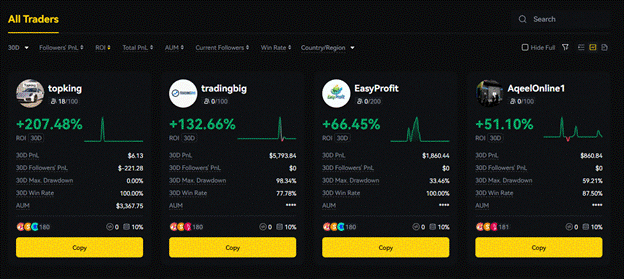
Smart Copy Trading allows organizations to mirror the strategies of vetted professional traders, providing automated market exposure without the need for proprietary quant infrastructure. For businesses that want systematic crypto exposure without building an internal trading desk, this offers a deployable solution with professional-grade oversight and a clear audit trail for internal governance purposes.
Enterprise-Relevant Product Launches: MoonX and BYDFi Card
Two 2025 product launches are directly relevant to enterprise strategy.
MoonX, BYDFi’s on-chain trading engine, brings centralized exchange-level speed and security to decentralized markets across Solana, BNB Chain, and Base. This is a practical implementation of the CeDeFi model that institutions have identified as most compatible with their compliance requirements — offering DeFi market access without the custody and execution risks associated with fully decentralized environments. For organizations that need to participate in on-chain liquidity or token markets while maintaining institutional-grade security standards, MoonX provides that bridge.
The BYDFi Card, a Visa-powered crypto debit card, enables direct spending of USDT, BTC, ETH, XRP, and other supported assets at any Visa-accepting merchant globally, with Apple Pay and Google Pay integration. For organizations evaluating crypto-native expense management — whether for vendor payments, employee benefits, or operational disbursements — the BYDFi Card represents deployable infrastructure rather than a development roadmap item. The Visa network’s global acceptance eliminates the conversion friction that has historically complicated crypto-to-commerce workflows.
Market Credibility and Track Record
Beyond the technical and compliance credentials, BYDFi’s market positioning reflects a level of institutional credibility that matters for organizations conducting counterparty due diligence. In 2023, Forbes recognized BYDFi among the Top 10 Global Crypto Exchanges — an acknowledgment of the platform’s standing at a time when the industry was still rebuilding trust following high-profile collapses. The platform’s designation as Official Cryptocurrency Exchange Partner of Newcastle United FC signals the kind of brand-level institutional partnerships that characterize exchanges operating at scale.
The combination of a six-year track record, zero major security incidents, multi-jurisdictional compliance, independently verified reserves, and institutional-grade product architecture positions BYDFi as one of a small number of exchanges that can pass the due diligence requirements of corporate finance and legal teams without significant qualification work.
Addressing the Complexity: What Internal Teams Should Prepare For
Enterprise adoption is not without complexity. Tax treatment of digital asset holdings varies by jurisdiction, accounting standards for crypto treasury positions remain inconsistent, and counterparty risk evaluation requires frameworks most finance teams have not yet formalized. Regulatory requirements around KYC and AML compliance add operational overhead that organizations must factor into deployment timelines. These are solvable problems — but they require deliberate internal planning before execution.
Building the Internal Case
The infrastructure for enterprise crypto engagement exists today. The compliance frameworks are maturing. The platforms with multi-year track records, verified reserves, and institutional-grade products are operational. What remains is the internal decision-making: assigning ownership, defining the use case, setting the risk parameters, and selecting the counterparties.
The business case in 2026 is not built on price speculation — it is built on payment efficiency, treasury optionality, compliance infrastructure, and customer experience. Those are arguments that belong in a board presentation, not a trading forum.
Organizations that begin building internal competency now — even at modest scale — will have the institutional knowledge to move quickly as adoption curves steepen across every sector they compete in.