Take out the picture of my kids and move to later
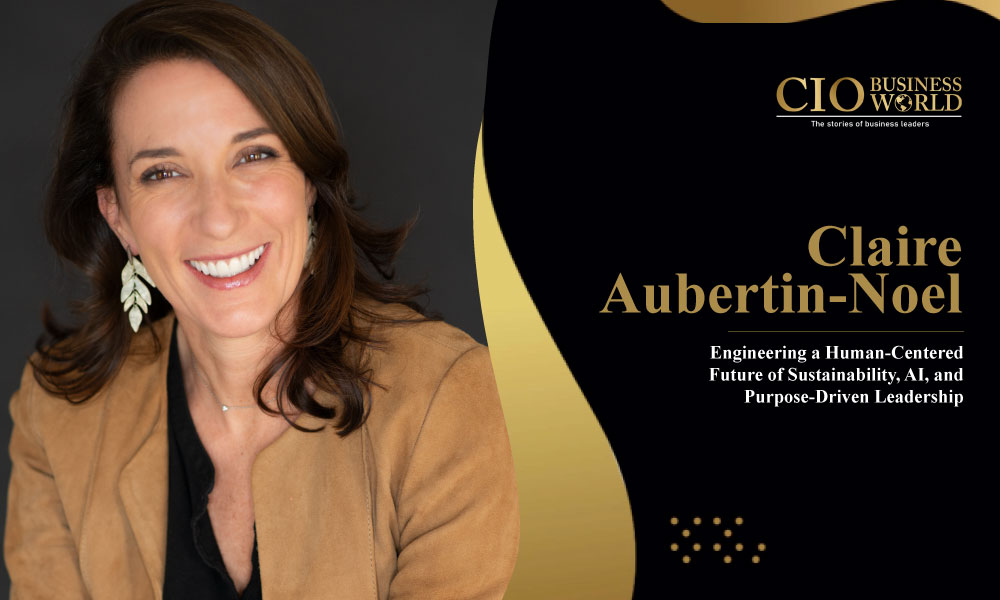
In a world grappling with climate urgency, technological acceleration, and deep economic and social transformation, leadership is being redefined. No longer measured solely by growth curves or innovation cycles, true leadership today is judged by its ability to create impact that is both scalable and humane. At the center of this evolution stands Claire Aubertin-Noel, a global leader at Accenture whose work operates at the powerful intersection of sustainability, digital transformation, engineering, and human purpose.
Claire represents a rare and deeply needed leadership archetype: one that unites ambition with responsibility, innovation with stewardship, and performance with care. Her journey reflects not only professional excellence across consulting, technology, and sustainability, but a lifelong commitment to using influence, intelligence, and empathy to build a future that works better for people, businesses, and the planet alike.
With a career spanning continents, cultures, and complex transformation programs, Claire has become one of the most compelling voices shaping how organizations adopt AIand al digital technologies responsibly, efficiently, and inclusively. Her leadership philosophy, anchored in the principles of dare, share, and care, offers a blueprint for what impactful leadership looks like in the age of artificial intelligence and environmental accountability. Claire believes that business and environmental performance can and shouldgo hand in hand.
A Childhood Shaped by Vision, Stewardship, and Service
Claire’s leadership journey did not begin in boardrooms or consulting firms. It began at home, shaped by two profoundly different yet perfectly complementary role models: her parents.
Her father was an entrepreneur who built his own advisory firm, guiding small and mid-sized enterprises through growth strategies, both organic and inorganic. Despite having limited formal education, he possessed an exceptional ability to see potential where others saw constraints. One of his impactful lessons to Claire was that leadership is not about credentials or titles, but about vision, courage, and the capacity to move others forward in practical and tangible ways.
Her mother, in contrast, devoted her career to public service. Working for City Hall, she oversaw the daily realities of civic life: schools, infrastructure, social services, finances, and elections. She embodied stewardship in its purest form. Her instinct in every situation, whether large or small, was always the same: how can I help? Through her, Claire learned that leadership is also about responsibility, trust, reliability, and leaving things better than you found them.
Together, her parents instilled in her a profound belief that work should serve a higher purpose. That innovation must be guided by care. That ambition must be balanced with responsibility. That performance must be rooted in meaning. This dual influence created the foundation of Claire’s leadership identity: business innovation with people care, ambition with stewardship, and success measured by impact.
Early Exposure to Global Thinking and the Art of the Possible
Another formative influence in Claire’s life came through her early exposure to the United States as a teenager. Participating in summer programs at Boston University and Harvard, and working as an intern at the MIT information center, she encountered a radically different intellectual and cultural environment.
Surrounded by MIT students building startups and challenging conventions with new business models, she was introduced early to a mindset where innovation was not reserved for a select elite, but driven by curiosity, collaboration, and courage. She saw firsthand how ideas could be tested, refined, and turned into reality through collective effort.
These experiences opened her eyes to the art of the possible. They reshaped her perception of leadership as something dynamic, creative, and deeply human. They taught her that making a difference is not about having big ideas alone, but about everyday choices: how you show up, the decisions you make, the responsibility you accept, and the outcomes you choose to create.
This conviction continues to guide both her professional and personal journey today.
Choosing Consulting as a Platform for Learning, Service, and Impact
Few year later, after studying at ESCP Europe and completing internships across London, Madrid, and Paris, Claire made a defining career choice: consulting.
What drew her to consulting was not prestige or fast-track promotions. It was curiosity. It was service. It was the promise of continuous learning across industries, geographies, and human realities.
NB: the picture with the mangrove needs to be moved to a different part
Consulting fed her intellectual hunger and her desire to contribute. One day she could be advising a global bank. The next, she could find herself counting pencils in a remote city and analyzing purchasing orders. Not always glamorous, not always comfortable, but always rich in learning.
This diversity of challenges, people, and contexts kept her energized, stimulated, and deeply engaged. Consulting became her laboratory for understanding how small and large organizations function, how courageous leaders make decisions, and how performance and responsibility can actually shape the real world.
It also allowed her to live out the core belief she inherited from her parents: that work should be about doing good, serving others, and creating outcomes that matter.
Growing her professional Identity Across Continents
One of the most defining challenges in Claire’s career was not technical or strategic. It was deeply human.
Repeatedly starting over.
She has repeatedly stepped into completely new environments and had to rebuild from the ground up. Each move to a new city: Hong Kong, Singapore, and later back to France, required her to adapt quickly, re-anchor herself both personally and professionally and create momentum without the support of familiar faces or established networks.
Although these transitions were deep disruptions, Claire used them as opportunities to learn. Starting every time with a blank page is deeply humbling. It sharpened her ability to listen, to observe, and connect with intention. It accelerated her learning curve, developed deeper her cultural intelligence and ability to manage risks strategically to build an advantage, toinnovate.
These experiences also have tought her that leadership begins with resilience and the capacity to move forward with clarity despite uncertainty and discomfort. They reshaped her leadership style rooted in adaptability, empathy, and authenticity. They strengthened her voice and ability to lead effectively in complex and fast-moving environments.
Motherhood, Ambition, and the Courage to Push Back
Same thing: the picture in the Philippines with the Bonuan schools need to come later – does not fit here.
Another profound challenge came with motherhood.
While pregnant and exploring new professional opportunities, Claire was advised to come back in a year or to consider part-time roles. These moments revealed how quickly ambition can be questioned when a woman’s body visibly carries life.
Rather than retreat, she pushed back. And found an organization, Accenture, that would “recruit her for 5-10 years or more, not for 12 months”.
Managing pregnancies, young children, and intense professional responsibilities while becoming a mother of three was, and remains, a constant juggling act. What motherhood ultimately taught her is that strength does not lie in doing it all, but in the deliberate, daily choice to give and renew energy across the many roles life asks us to play—without losing oneself.
Another defining moment came after a serious ski accident that required several surgeries and a long recovery. Experiencing temporary disability reshaped her perspective on resilience. Like elite athletes who return stronger after injury, she experienced that resilience is a muscle you build—through discipline, humility, and the refusal to settle for “good enough.”These experiences strengthened her leadership in unexpected ways.
Being a working mother, you learn to prioritize what truly matters and let go of what does not. She grew your effectiveness and empathy.
Being physically vulnerable, you learn to recognize that everyone carries unseen battles. She grew an immense respect for those facing (visible or invisible) disabilities and still moving the world boundaries. All these experiences ultimately taught her that vulnerability is not a weakness. That showing your human self builds trust. That leadership grounded in vulnerability is not softer. It is stronger. It is courage that turn athletes into champions, leaders into change makers.
Photo of the family should come here
Dare, Share, Care: A Leadership Compass
Claire’s leadership philosophy is anchored in three principles that have been guiding her decisions over the years: dare, share, and care.
Dare means having the courage to go beyond what is expected and act where it truly matters. It means stepping into complexity instead of avoiding it. It means challenging existing models, building bridges between disconnected ideas and speaking up for what you believe is right.
This principleguided her work journey but also her volunteering work. As an example, she mentioned her experience with IJM (the International Justice Mission), where she, together with a group of women, took part in an initiative to fight child human trafficking in Asia. Standing there, listening to cases and family challenges, it was confronting. It was painful. But it was also a powerful reminder that leadership sometimes means standing up for those who cannot.
Share represents the idea of collective progress. Ideas only matter if they are shared. Impact only lasts if it is collective.
This belief came alive through her work journey as well as personal projects like her long-term mangrove rehabilitation project in the Philippines. Through a local school, children learned to plant mangroves, understand their environmental value, and create economic opportunities for their community.
Ten years later, kilometers of mangroves had transformed the coastline, giving both safety and economic growth to the village. The project received international recognition, including awards for environmental action and global impact.
The photos (of the mangrove and of the Philippines school) need to be put here.
Care is what gives leadership meaning. Caring for people. Caring for outcomes. Caring to create impactful teams and businesses that will shape our tomorrow.
This belief led her to co-create the Singapore Young Leaders Summit in 2021, bringing students together with leaders from government, academia, and business to work on the Singapore Green Plan 2030. Despite COVID and the world turning into fears, here, with dozens of young adults, the focus was on hope, and making Singapore the best place to live for generations to come. The teams presented innovative ideas directly to ministers, proving that caring only matters when it becomes action.
Together, dare, share, and care have formed her leadership compass: balancing ambition with responsibility, innovation with inclusion, and performance with purpose.
Making AI Responsible, Useful, and Sustainable at Accenture
At Accenture, Claire operates at the forefront of digital, cloud, and AI transformation. But her approach to technology is radically different from the hype-driven narratives dominating the industry.
She believes confidence does not come from adopting tools. It comes from knowing what to do with them, why they matter, and how they improve everyday life for people and businesses.
She also draws on Accenture’s Powering Sustainable AI research, which shows that by 2030, AI-driven data centers could consume more than 600 terawatt-hours of electricity annually if nothing changes. That is equivalent to the annual electricity consumption of a country like Canada.
This insight reframes AI from a neutral innovation into an environmental responsibility. Responsible AI is not about slowing innovation—it is about embedding ethics, resource efficiency, and long-term societal impact into every layer of technological progress.
Claire and her team help organizations design AI more intelligently by choosing the right cloud setups, the right language models, and the right computing power. In practice, optimizing AI and storage workloads has achieved up to 99 percent lower emissions for compute-heavy workloads and up to 93 percent for storage-heavy workloads, while also reducing costs.Very often, doing the right thing environmentally turns out to be the most efficient business decision so why not aim to drive both together?
Designing Sustainability into Products from Day One
Claire is passionate about embedding sustainability directly into products. She is convinced that what we produce, what we buy, and how we manage our suppliers will become even more central to resilience and long-term value creation.
In the past, teams designed products first and only later asked whether they were recyclable, energy-efficient, or repairable.
Today, in product design, AI allows allows engineers to simulate thousands of material and architectural configurations before anything is physically built. By integrating raw materials, supply constraints, lifecycle emissions, recyclability, regulation, customer and performance requirements at the ideation stage, companies can reduce product carbon footprints by 10–30%, cut material use significantly, and accelerate time-to-market by weeks or even months. Instead of treating sustainability as a reporting exercise, AI embeds it into the product itself—lowering Scope 3 emissions while improving cost efficiency and performance.
This enables better products, faster decisions, and meaningful trade-offs between performance, cost, and customer experience. Sustainability is not be a criteria on its own: it’s embedded in the product performance, in the cost and, more and more, in the customers’ expectations.
AI is not here to decide for us—it is here to help us decide better. This is the true meaning of phygital: digital intelligence actively shaping the physical world around us. Imagine if every product created economic value, improved lives, and reduced environmental impact at the same time.
The AI-Powered Kitchen as a Human-Centered Vision
To illustrate her vision of a more connected and human-centered future, she uses the example of an “AI-powered kitchen.” Not as a futuristic gadget, but as practical example of what becomes possible when digital intelligence and physical reality truly work together for people.
Imagine a kitchen that understands your health profile, your food preferences and your time constraints. It suggests meals that match your nutritional needs, connects automatically to your preferred your shopping lists, sources ingredients from your preferred retailers, and guides cooking in real time—optimizing temperature, timing, energy, and water use. It adapts recipes based on what is available locally and what your family actually enjoys. It makes healthy choices easier rather than harder.
The impact is personal. For working parents, it reduces the daily mental load of “What should we cook tonight?” For elderly people, it supports independence. For people with disabilities, it enables autonomy and confidence. For families managing diabetes or other health conditions, it turns nutrition into prevention. And at scale, it contributes to better public health and lower food waste.
Behind this experience lies something bigger. What appears to be a smart appliance is in fact the visible interface of a deeply connected value chain. The same data that personalizes your dinner can connect farmers, food manufacturers, retailers, and health platforms. Products can be reformulated based on regional tastes, consumption trends and ingredient availability. Demand can be better aligned with food production, reducing waste in a sector responsible for nearly 10% of global emissions. Precision agriculture can cut water use by up to 30% and fertilizer inputs by up to 40%. When data flows across the ecosystem, companies stop working in silos and start solving shared problems.
For her, this is the real opportunity. The product becomes tailored, the experience becomes personal, and the industry (or industries) becomes collaborative. Technology is not the point. Solving the world’s problems and making life simpler, healthier, and more sustainable is.
How could this ever work? Everything that we need exists. What is needed is to use data and AI as a strategic infrastructure connecting the right set of information and players: local customer insights with R&D formulation data with agricultural yield forecasts, supply constraints, nutritional science, consumer demand trends, health challenges, etc. All of a sudden, we create a cross-industry ecosystem (Agriculture, F&B, Retail, Health) that serves a basic human need: access to affordable and healthy food.
In a world facing climate pressure, energy volatility, and supply chain disruption, this kind of system thinking matters. AI does not replace people—it supports better choices at every level. When combined with purpose and continuous learning, it enables industry reinvention and becomes a powerful driver of both business resilience and societal progress.
Of course, the AI-powered kitchen is simply one illustration of what is possible; the same mindset can be applied across industries to build smarter, more resilient and purposeful systems.
Measuring Success Through Human Impact
For Claire, success is not measured by revenue or delivery metrics.
It is measured by value. By impact metrics.
Using the AI-powered kitchen as an example: How many people are healthier? How many chronic conditions are prevented? How much food waste is avoided? How many liters of water are saved? Are we strengthening farming communities and improving food security? Are we building a system that can nourish a growing population for decades to come?
Ultimately, the real question is simple: are we solving problems—or creating new ones? And are people healthier, happier, and more connected because of what we build? Is the world we leave to generations to come net better of thanks to the businesses we run?
Transformation endures when innovation is relevant, responsible, and human-centered.
Otherwise, why build it?
Mentorship as Systemic Goodness
Mentorship has always been central to Claire’s leadership—not as a side activity, but as a core belief.
For more than a decade, she has mentored professionals across corporate and NGO environments. In Singapore, for example, she worked with SG Enable, coaching young professionals with disabilities—from hearing loss to ADHD and autism. Her conviction is simple: everyone has strengths. The question is not whether someone can contribute, but how we create the conditions for them to do so. Too often, people with disabilities are overlooked when they could bring enormous value to teams and organizations.
She does not see mentorship as giving advice. She sees it as building confidence. A mix of inspiration, insight, and instillation of faith. Because when someone believes in you, your trajectory changes.
For her, mentorship is not only a social responsibility—it is a business imperative. At a time when technology is transforming industries and skills have a shorter lifespan than ever, empowering people to adapt, learn, and grow is fundamental to sustain performance. Transformation cannot succeed if people are left behind. AI may accelerate systems, but people accelerate change.
Mentorship creates a multiplier effect. People tend to replicate what they experience. When they are supported, trusted, and empowered, they extend that same support to others. Over time, this creates a culture of giving back—within teams, across generations, and beyond the organization. That ripple effect, more than any single project, is the impact she is most proud of as a leader.
You can add the picture of mentoring I shared
The Future of Consulting: Building, Running, Transforming
Claire is deeply excited about the future of consulting—because it is no longer just about recommendations. It is about being pioneers. It is about building, running, and transforming solutions alongside clients.
In today’s highly volatile world, organizations cannot afford incremental change only. They must rethink how they design products, run factories, source materials, manage data, and develop talent—at the same time. Consulting now sits at the intersection of technology, engineering, manufacturing, future capabilities, not to advise from the outside, but to build and run it alongside clients.
For Claire, the future of consulting is about enabling organizations to build systems that are stronger, more adaptive, and more human-centered. Not just transforming what companies produce, optimizing what exists but truly rethinking what groups stand for, how they operate, and how they contribute to the ecosystems around them.
About turning long-term bold visions into reality using the full spectrum of tools and technologies now available. More than ever, consulting can be a catalyst for change, solving some of the world’s biggest problems and creating a systemic positive impact, leveraging “technology and human ingenuity”.
Advice to the Next Generation of Leaders
Claire offers five guiding principles:
1. Never stop learning.
Stay curious. Embrace technology, new industries, new cultures, and new ways of thinking. In a world where skills evolve faster than ever, learning is not a phase of your career—it is a lifelong discipline.
2. Lead with empathy and purpose.
Technology will continue to transform how we work, but it will never replace care, integrity, empathy and responsibility. How you treat people, how you listen, and how you show up every day —these will always define your leadership.
3. Think long term.
Build trust, not just projects. Focus on reputation, relationships, and impact—not only promotions or short-term wins. Careers are marathons, not sprints. Resilience is built over time.
4. Choose your support network wisely.
Surround yourself with people who value you for who you are, but who also challenge you to become the best version of yourself. The right mentors, peers, and allies will help you grow with confidence..
5. Be bold enough to define your own measure of success.
Do not inherit someone else’s definition of achievement. Think big. Take risks. Have the courage to pursue impact, not just titles. The most fulfilling careers align performance, personal well-being, and contribution to society.
A Legacy of Purpose-Driven Innovation
Claire Aubertin-Noel is not building technology for technology’s sake.
She is engineering a future where innovation is ethical, inclusive, sustainable, and human.
Her leadership represents a new global standard: one where ambition and responsibility reinforce each other.
In a world hungry for direction, her story offers both a compass and a path forward.
[CA1]Not very clear to be honest – too many big words
Human centered future powered by AI, Purpose driven businesses and courageous leadership