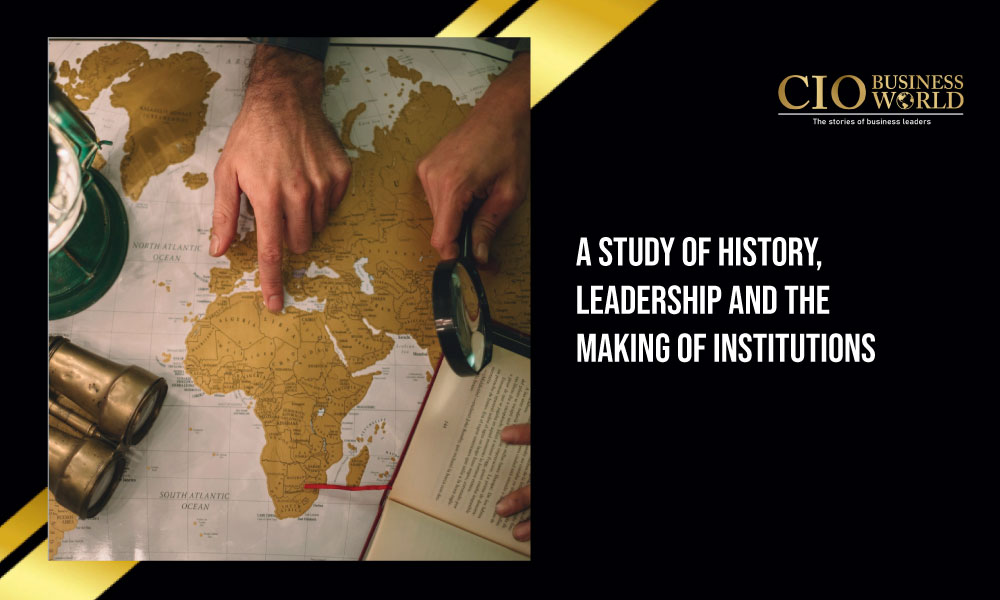
History is often studied through the lens of wars, empires, political movements, and social change. Yet, another form of history is written quietly through businesses, institutions, and the people who build them. Founders and CEOs are not merely corporate leaders; they are participants in an ongoing history of innovation, economic transformation, employment, and societal change.
The story of modern business is, in many ways, a study of individuals who identified opportunities before they became obvious to everyone else. From industrial pioneers who transformed manufacturing to technology entrepreneurs who reshaped communication, each generation of founders and CEOs has reflected the challenges and possibilities of its time.
The Founder as a Historical Figure
A founder begins with an idea, but history shows that ideas alone rarely create lasting organisations. The early industrial revolution offers several examples. Entrepreneurs such as Richard Arkwright helped transform textile production by introducing new manufacturing systems. Their significance was not simply in the companies they created, but in how those companies contributed to a broader transformation in the way society worked.
Similarly, Henry Ford changed the history of manufacturing through mass production. The Ford Motor Company became associated with an industrial model that made automobiles more accessible while influencing factory organisation, labour, supply chains, and consumer culture.
These examples demonstrate an important historical principle: successful founders often become agents of structural change.
From Founder to Institution Builder
Founding a company is only the beginning. The more difficult historical challenge is building an institution capable of surviving beyond its founder.
The twentieth century provides numerous examples of this transition. Walt Disney established an organisation that grew from animation into a global entertainment ecosystem. Akio Morita helped build Sony into a globally recognised technology and consumer-electronics company.
Their stories illustrate how founders must eventually move beyond personal vision and establish systems, cultures, processes, and leadership structures that can continue to operate at scale.
This is where the role of the CEO becomes historically significant.
The Evolution of the CEO
The modern CEO is a relatively recent phenomenon compared with the long history of commerce. As corporations became larger and more complex, leadership gradually moved from the owner-manager model toward professional management.
The twentieth century saw the rise of CEOs responsible for coordinating large workforces, global supply chains, shareholders, technology, regulation, and increasingly complex markets.
Leaders such as Jack Welch became associated with large-scale corporate management, while figures such as Steve Jobs demonstrated how leadership could combine technology, design, storytelling, and consumer psychology.
The CEO therefore evolved from being primarily an administrator to becoming a strategist, culture builder, communicator, and steward of institutional identity.
What History Teaches About Leadership
Studying founders and CEOs across different periods reveals that leadership styles change with circumstances.
The industrial era rewarded operational efficiency and scale. The information age placed greater emphasis on technology and knowledge. The digital era has introduced new priorities: speed, adaptability, data, artificial intelligence, cybersecurity, sustainability, and global connectivity.
Yet some leadership principles remain remarkably consistent.
Great leaders understand their environment. They recognise change before it becomes unavoidable. They make decisions under uncertainty. Most importantly, they create organisations that can turn an idea into sustained action.
History also shows the dangers of leadership without reflection. Companies that fail to adapt can lose relevance even when they were once dominant. Technological disruption, changing consumer behaviour, poor governance, and resistance to change have repeatedly altered the fortunes of major organisations.
Founders, CEOs and Society
The influence of business leaders extends beyond corporate balance sheets. Companies create employment, develop technologies, influence consumer behaviour, contribute to communities, and sometimes shape entire industries.
The rise of technology companies demonstrates this particularly clearly. Bill Gates and Jeff Bezos represent different chapters in the development of the digital economy. Their companies helped accelerate the adoption of personal computing, software, e-commerce, and cloud-based services.
In India, entrepreneurs such as Dhirubhai Ambani demonstrated how business ambition could intersect with the country’s economic transformation. Later generations of entrepreneurs built companies around information technology, digital services, financial technology, e-commerce, and new forms of manufacturing.
Their stories form part of India’s broader economic history.
The New Generation of Leaders
Today’s founders and CEOs operate in an environment very different from that of earlier industrial pioneers. Artificial intelligence, automation, climate concerns, geopolitical uncertainty, and rapidly changing consumer expectations are reshaping the meaning of leadership.
The modern leader must therefore think historically as well as strategically.
Understanding history provides perspective. It shows that no business environment is permanent, no technology remains dominant forever, and no organisation is immune to change.
At the same time, history demonstrates that periods of disruption often create opportunities for those prepared to rethink established models.
The Legacy Beyond the Company
Ultimately, the history of founders and CEOs is not simply the history of companies. It is the history of decisions.
Every organisation begins with choices: what problem to solve, whom to serve, what values to protect, what risks to accept, and what future to pursue.
A founder creates the initial direction. A CEO translates that direction into organisational momentum. Future leaders determine whether the institution evolves or declines.
The most enduring leaders are therefore not remembered only for the companies they built. They are remembered for the systems they created, the people they developed, the industries they influenced, and the ideas they left behind.
Studying founders and CEOs through history reminds us that leadership is never isolated from its time. Every great business story emerges from a particular economic, technological, and social moment.
And perhaps that is the most important lesson history offers: companies may measure success in years and revenues, but their true legacy is measured by the change they leave behind.