

Most platforms don’t realize how much bad content they’re actually missing until something goes wrong publicly. AI content moderation platforms exist precisely to close that gap, but picking the wrong one means either drowning legitimate posts in false positive flags or letting harmful content slip through undetected. Adversarial tactics evolve constantly, and context-dependent content like satire or dark humor makes automated decisions genuinely hard. After reviewing dozens of platforms across deployment speed, accuracy, and real-world client results, this guide covers the five options worth serious consideration.
The vetting process for this list
Each platform was assessed using publicly available information: user reviews, client case studies, feature documentation, and ratings pulled from review platforms and official company sites. Only platforms with a demonstrated track record in real-world content moderation environments made the final cut.
→ See the full research breakdown
- Utopia Analytics – Best for AI content moderation and community safety
- Lasso Moderation – Best for content moderation for social platforms and online communities
- Bodyguard – Best for brand protection and community moderation
- Clean Speak – Best for content moderation for SaaS platforms and gaming applications
- Hive Moderation – Best for content moderation for social platforms and user-generated content
The Difference the Right AI Content Moderation Platforms Make
Picking the wrong content moderation platform doesn’t just create operational headaches. It damages the communities you’ve spent years building.
A platform that over-moderates frustrates real users, suppresses legitimate conversations, and quietly erodes trust. One that under-moderates lets harmful content spread before anyone catches it.
The tricky part is that adversarial actors keep finding new ways to bypass AI detection, so static models fall behind fast. Content like satire, regional slang, or news commentary requires contextual judgment that generic tools often miss.
The right platform keeps false positive rates low enough that real users don’t feel punished, while keeping false negative rates tight enough that harmful content doesn’t linger.
Response time matters too. A decision that takes seconds in a live chat environment is often already too late.
Choosing well means fewer appeals, fewer user complaints, and a community that actually feels safe to be in.
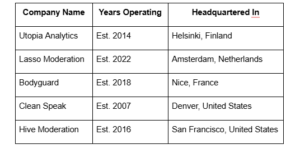
The 5 Best AI Content Moderation Platforms: Quick Comparison
Note: All data in this table is sourced from review platforms and the official websites of the listed companies.
-
Utopia Analytics – Best for AI Content Moderation and Community Safety
What Is Utopia Analytics’s Main Business?
Utopia Analytics builds machine learning-powered moderation tools for online communities, focused primarily on detecting abusive content, spam, and fraud at scale. Their flagship product, Utopia AI Moderator, is a fully automated SaaS tool that learns directly from human moderator decisions over time. Founded in 2014, the Helsinki-based team brings genuine academic research depth to the problem, made up of doctoral scientists and masters-level professionals who treat moderation accuracy as a technical discipline.
What’s Utopia Analytics’s Edge in AI Content Moderation Platforms?
Utopia Analytics solves one of the harder problems in moderation: language independence. Their patented AI models work across languages without needing separate training data for each one, which is genuinely rare. That cross-language flexibility translates directly into faster deployment for platforms serving international audiences (deployment in as little as two weeks, which is fast for enterprise-grade AI).
From the User Reviews:
Clients in news media, including outlets like nu.nl, krone.at, and 20min.ch, report concrete results after deploying Utopia’s platform. One client saw a 50% reduction in publishing delays alongside a 30% increase in daily comment volume, which is an unusual combination because those metrics usually pull in opposite directions. Their Ethical AI handbook also gets mentioned consistently as something that builds confidence among enterprise buyers.
-
Lasso Moderation – Best for Content Moderation for Social Platforms and Online Communities
What Is Lasso Moderation’s Main Business?
Lasso Moderation is a relatively young platform, founded in 2022, that automates content moderation across chat, video, and social media. It covers spam, toxicity, nudity, violence, and drugs, and handles 99% of moderation tasks through AI, leaving the remaining 1% for human review via a built-in dashboard. The platform is built for social media, gaming, marketplaces, and live streaming, and it’s designed so that non-technical teams can adjust moderation rules without writing a single line of code (which matters more than most people think).
What’s Lasso Moderation’s Edge in AI Content Moderation Platforms?
Lasso addresses the friction that slows down most moderation setups: the need for constant developer involvement every time a policy changes. Their no-code rule customization means trust and safety teams can respond to emerging content threats quickly, without waiting on engineering queues.
From the User Reviews:
Lasso holds a 4.9 rating and is recognized as one of the highest-rated platforms in its category. That’s impressive for a company that has only been operating since 2022. Reviewers consistently point to the platform’s ease of setup and the reliability of its AI automation as the two biggest reasons they stay. For a newer entrant, that kind of rating momentum is hard to match.
-
Bodyguard – Best for Brand Protection and Community Moderation
What Is Bodyguard’s Main Business?
Bodyguard is a content protection platform out of Nice, France, that pairs AI detection with human linguists to moderate text, images, and video in real time. They serve consumer brands, sports organizations, luxury companies, gaming platforms, and media enterprises, covering a wider range of industry verticals than most moderation tools do. The platform includes optical character recognition, automated workflows, and customizable policy enforcement, making it a good fit for teams that need live moderation at scale without building it in-house.
What’s Bodyguard’s Edge in AI Content Moderation Platforms?
Many platforms lean entirely on AI and accept a certain false positive rate as the cost of doing business. Bodyguard pairs its models with experienced linguists to actively keep that rate down. For brands running public-facing communities, that hybrid approach means fewer legitimate posts get caught in the filter, which protects both audience satisfaction and brand reputation.
From the User Reviews:
Bodyguard has earned recognition through industry awards including the For Democracy Talent Award from France Digital and the Fundtruck award from Sowefund, and has raised $11.4M in funding. Investor confidence and award recognition tend to follow platforms that deliver consistent accuracy, not just impressive demos. The company’s focus on live moderation for enterprise clients appears to be what’s driving that external validation.
-
Clean Speak – Best for Content Moderation for SaaS Platforms and Gaming Applications
What Is Clean Speak’s Main Business?
CleanSpeak is one of the most established platforms in this space, with over 15 years of filtering technology built for gaming, education, entertainment, and enterprise SaaS applications. The Denver-based company provides profanity filtering, content analysis, and moderation management across text, images, and video in multiple languages. Their performance numbers are hard to argue with: sub-5 millisecond response times and the capacity to filter more than 10,000 messages per second on a single server. That’s not cheap infrastructure to replicate, but it’s the kind of speed and volume that enterprise gaming platforms actually need.
What’s Clean Speak’s Edge in AI Content Moderation Platforms?
CleanSpeak directly addresses the compliance gap that keeps many SaaS teams up at night, with on-premise deployment options alongside SOC2 Type II certification for platforms that can’t send user data to third-party cloud environments. That combination of speed, volume capacity, and deployment flexibility puts CleanSpeak in a category that few newer entrants can match on raw technical credentials.
From the User Reviews:
There isn’t a published public rating available for CleanSpeak on major review platforms, but their Fortune 500 client partnerships and 15+ years of continued operation tell a consistent story. Platforms that require strict data handling rules and high-speed filtering keep coming back to CleanSpeak because the performance holds at scale, not just in demos.
-
Hive Moderation – Best for Content Moderation for Social Platforms and User-Generated Content
What Is Hive Moderation’s Main Business?
Hive Moderation, founded in 2016 and based in San Francisco, delivers automated content moderation with a claim that’s hard to make lightly: human-level accuracy across multiple content types. Their platform covers visual moderation, text moderation, audio moderation, CSAM detection, and AI-generated content detection, all accessible via API. They serve platforms like Yubo, Tango, Chatroulette, Plato, and Highrise, which gives a real sense of the scale and content diversity their models are trained to handle.
What’s Hive Moderation’s Edge in AI Content Moderation Platforms?
Hive solves the multi-modal moderation problem for platforms where harmful content shows up across text, images, audio, and video simultaneously, which is the reality for any live social or gaming environment. Their usage-based pricing model also fits well with SaaS growth stages, meaning smaller platforms don’t get crushed by fixed licensing costs before they’ve scaled.
From the User Reviews:
Public review data for Hive isn’t widely aggregated on major platforms, but their client roster speaks clearly enough. When Chatroulette and Yubo, two platforms with notoriously high-volume and high-risk content environments, are listed as active clients, that’s a stronger signal than any rating number. The breadth of their moderation suite is the reason platforms with complex, multi-format content keep choosing them.
The Process Behind This Ranking
Data Collection Methods
The research process started by pulling together a longlist of content moderation platforms from multiple sources: software directories, community safety industry roundups, product review platforms, and published case studies from companies actively operating in social networking, gaming, and UGC-driven SaaS environments.
Each source was treated as a signal, not a verdict. A platform appearing in multiple directories with consistent category placement was noted, but it wasn’t automatically included. The goal was to build a list wide enough to catch credible options that don’t always show up in the most obvious places.
Case studies were given particular weight early in the process, because they show what a platform does under real deployment conditions rather than what it promises in a product tour.
Pre-Verification Phase
Before any platform was seriously evaluated, the list was cleaned. Options without verifiable operational history, missing client references, or review patterns that looked inconsistent were removed.
Review patterns were analyzed for depth, not just volume. A platform with a small number of detailed, specific reviews that described real outcomes was treated as more credible than one with dozens of short, generic five-star submissions. Platforms where the review language felt templated or where no identifiable client context existed were flagged and deprioritized.
The Verification Phase
Each remaining platform was cross-checked by comparing what their official site claimed against what external sources and user reviews described. Where a platform claimed a specific accuracy level, deployment speed, or filtering capacity, those claims were checked against client testimonials, published case studies, and any available third-party commentary.
Platforms where the gap between marketing claims and documented results was wide were removed from consideration. Real-world performance data, even when limited in volume, carried more weight than polished product copy.
Tracking Authority Markers
Beyond reviews and client results, the research looked at signals that indicate a platform is recognized beyond its own marketing. Industry award recognition, funding milestones, coverage in trust and safety publications, and whether a company had contributed original thinking to the moderation space (such as published research, ethical frameworks, or policy guidance) were all tracked.
These aren’t perfect signals, but they indicate that a platform has been evaluated by people outside its own sales cycle. Bodyguard’s industry awards and Utopia Analytics’s Ethical AI handbook both surfaced during this phase as meaningful markers of external credibility.
AI Content Moderation Platforms Proof Points
The final filter required each platform to show genuine depth in the content moderation space. Dedicated product pages describing moderation-specific features, verified client reviews from platforms operating in high-risk content environments, and case studies with measurable outcomes were all required.
Platforms that offered moderation as one feature among many general-purpose tools were excluded. The focus was on providers where content moderation is clearly what they build and sell, because that depth of focus tends to show up in model accuracy, policy coverage rates, and the quality of their human escalation workflows.
How to Pick Your Best Match
Choosing between these platforms depends less on which one has the most features and more on which one fits how your platform actually operates. Here’s what to think through before making a decision.
- Industry/Domain Experience: Look for platforms that have actively served environments similar to yours. A gaming platform’s content risks are different from a news comment section’s, and the AI models should reflect that.
- Features and Service Options: Match the moderation suite to your content types. If your platform handles audio or video, confirm the platform covers those formats natively, not as an add-on.
- Pricing Structure: Usage-based pricing suits early-stage platforms; fixed licensing suits high-volume, predictable environments. Make sure the model scales with you, not against you.
- Results Measurement: Ask how each platform reports on false positive rate, false negative rate, and human escalation rate. If a vendor can’t show you those numbers clearly, that’s worth noting.
- Industry Knowledge and Compliance: For platforms handling minor users or operating across jurisdictions, verify coverage of relevant regulations like COPPA, GDPR, and the Digital Services Act. Deployment options (cloud vs. on-premises) matter here too.
Closing Thoughts
Content moderation at scale is one of those problems that looks manageable until it isn’t. The platforms on this list each bring something different: speed, language flexibility, hybrid human-AI review, compliance depth, or breadth of content type coverage. The right fit depends on your platform’s specific risk profile and growth stage. This space is getting more sophisticated fast, and the platforms investing in accuracy and ethical AI practices now are the ones that will hold up as content threats keep evolving.