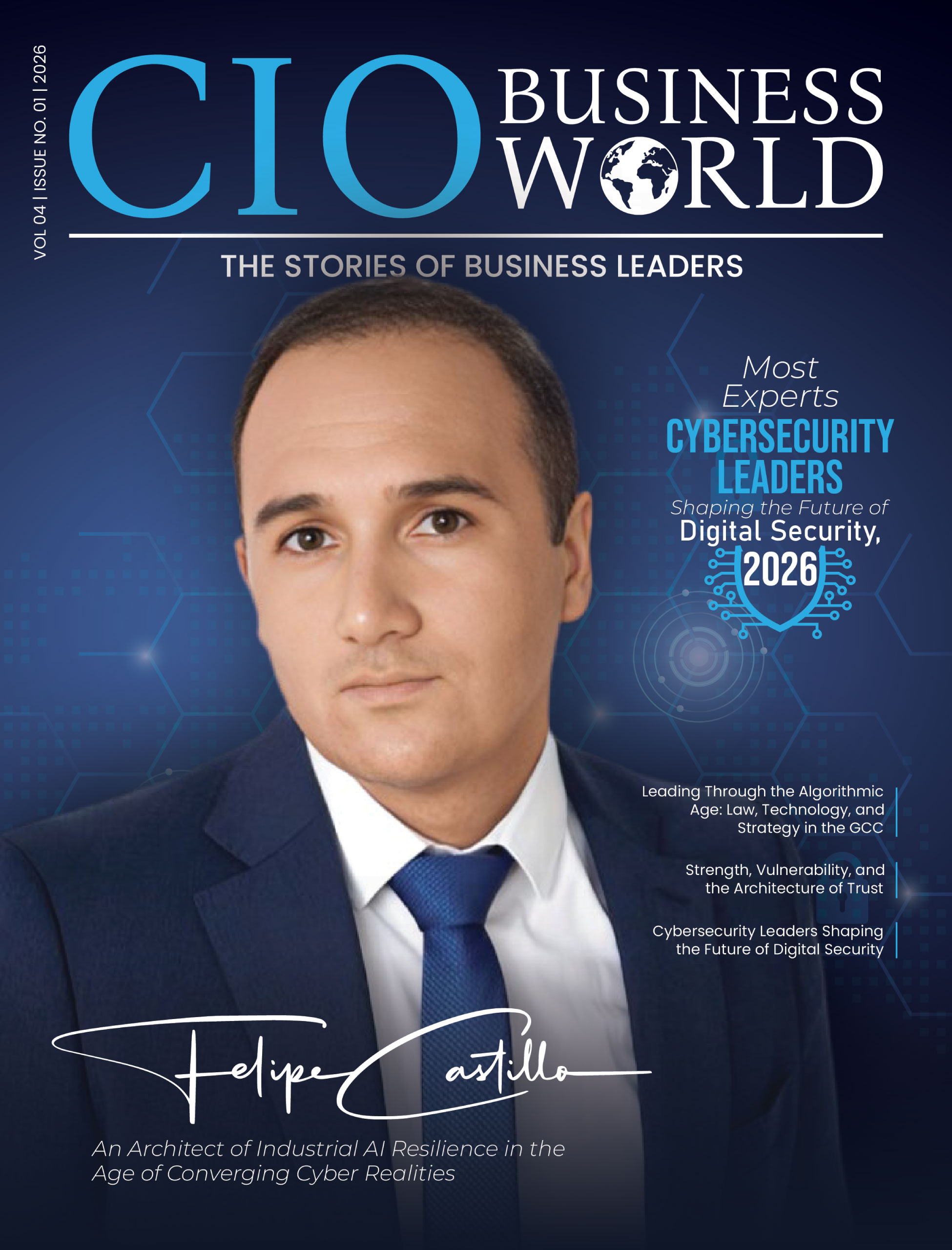
Imagine an orchestra where every instrument is a machine, every note a line of code, and the conductor must ensure that physics, logic, and human intention move in perfect harmony. This is the world Annemarie Breu operates in every day.
Her journey sits at the intersection of science, engineering, and leadership where virtual commissioning allows PLC logic to be tested against CAD models infused with real physics, long before a system ever comes to life. But for Annemarie, technology alone has never been the destination. It is the medium through which clarity, trust, and impact are created.
As Senior Director – Siemens Xcelerator Deployment at Siemens, Annemarie leads complex, global programs much like a scientist running a long-term experiment: balancing quick, measurable results with carefully orchestrated outcomes that unfold over time. She has learned that progress is not just about advancing intelligence in systems, but about grounding innovation in purpose stepping off the constant motion of the “hamster wheel” to return to first principles.
Having worked with teams across China, India, Europe, and the United States, Annemarie understands that every system technical or human operates under its own conditions. Her leadership blends industrial rigor with vulnerability, authenticity, and human connection, proving that the most trusted systems are built when people are aligned as precisely as machines.
At a time when the future demands both robust industrial safeguards and cutting-edge intelligence, Annemarie stands out as a leader who knows how to conduct the orchestra aligning every detail with the bigger picture, and ensuring that technology serves not just efficiency, but meaning.
From Code to Motion, and from Control to Trust
For Annemarie, the turning point came when software stopped being abstract and started moving the physical world. Writing code that ran on a computer was interesting—but discovering automation changed everything. What began as simple projects wiring sensors into I/O modules, configuring PLCs, drives, and motors, downloading logic, and pressing a button to watch a gantry move or a cylinder extend was transformative. In that moment, code became something more: the convergence of logic, mechanics, motion, and electricity working together as a single system.
That fascination only deepened with the advent of virtual commissioning. Testing PLC logic against CAD models powered by physics engines writing code, watching it plays out in a virtual environment, refining it, and then seeing the same behavior come alive in the real world cemented her passion. The intersection of software, electrical, and mechanical engineering is what ultimately drew Annemarie into automation software and continues to inspire her work today.
Annemarie views leadership much the same way she views engineering: as an evolving process rather than a fixed destination. She often describes her philosophy as “always becoming,” a belief that leadership requires continuous reflection, learning, and the willingness to challenge one’s own assumptions. This mindset drives her to lead with vulnerability, honesty, and authenticity especially when rethinking approaches she once believed were right.
One of the most significant shifts in her leadership journey has been moving from doing the work herself to empowering others to own it. While her engineering roots still draw her to hands-on problem-solving architecting customer solutions and managing deployment projects, she recognizes that stepping in too often can blur roles and dilute team ownership. Today, Annemarie focuses on creating an environment where her teams feel accountable and confident, while she stays close enough to understand their realities and remove obstacles, whether those obstacles are processes, tools, or incentives.
For Annemarie, leadership is about staying connected to the work, learning continuously, and ensuring that people have what they need to succeed because the strongest systems, technical or human, are built when trust, clarity, and purpose are aligned.
Turning Digital Innovation into Trusted, Scalable Industrial Outcomes
When Annemarie reflects on working across geographies and industries, the first thing she emphasizes is just how different they truly are. Having led teams in China, India, Europe, and the United States, she has seen firsthand how each region brings its own cultural context, workforce dynamics, and educational foundations. Layer industry on top of geography, and the complexity multiplies regulatory requirements, workflows, audit trails, and the fundamental differences between discrete and process manufacturing all shape how solutions must be deployed.
For Annemarie, technology is only part of the equation. What matters most is execution. Deployment is not about installing software; it is about delivering outcomes. That means driving adoption, maintaining systems, and ensuring consistent quality at a global scale. Achieving this requires delivery excellence aligning processes, leveraging a strong partner ecosystem, and executing with discipline worldwide. Working at Siemens, with globally distributed teams, enables this level of coordination and makes the challenge both possible and energizing.
Today, Annemarie’s focus is on driving deployments across industries ranging from pharmaceuticals and food and beverage to automotive and electronics manufacturing. Each sector and each region come with its own regulatory landscape, culture, and legacy systems. To navigate that complexity, she places heavy emphasis on long-term planning and operational excellence. A common starting point is a structured 90-day challenge pilot for new technologies. In those first 90 days, the goal extends beyond technical feasibility. Her teams identify operational gaps, learn the nuances of the customer’s environment, and define what a full-scale rollout would truly require.
The real work begins after day 90. Turning a successful pilot into a scalable program requires orchestrating many moving parts integrating quality management systems, connecting MES, SCADA, and PLC layers, adding sensors, and coordinating multiple partners with specialized expertise. Annemarie often describes her role as that of a conductor: delivering one tangible outcome at a time to build trust and momentum. In doing so, a pilot becomes a blueprint, and a blueprint becomes a global standard. The challenge is significant, but success comes from blending quick wins with meticulous long-term orchestration.
For Annemarie, a project is not truly successful unless it delivers sustained value and a positive customer experience. Meeting the major KPIs such as uptime, throughput, and quality is essential, but not sufficient. If the solution is not embraced on the ground or fails to deliver long-term impact, the effort has fallen short. This belief led her to help introduce Customer Journey Management within the organization – an approach designed to ensure a seamless, end-to-end engagement that extends well beyond the initial sale or installation.
In practice, this begins with co-defining a vision alongside the customer. What does connecting the real and digital worlds mean for their business? What does success look like in one year? From the initial value proposition through the pilot and full deployment, every step is aligned to that shared vision. Internally, Annemarie works to break down silos, ensuring that marketing messaging, sales commitments, and delivery execution form a single, continuous thread.
If a sales team commits to a 20% efficiency improvement, that target is carried through commissioning, ramp-up, and post-go-live support. Customer Journey managers remain engaged after deployment to drive adoption training users, monitoring usage, and capturing feedback for continuous improvement. Digital tools, including AI-powered internal knowledge bases, ensure that everyone involved from pre-sales to support operates with the same context and information.
For Annemarie, the ultimate measure of success is simple: when a customer says, “Your team was with us every step of the way, and we achieved the outcome we set out to deliver.” At that point, technology has done more than function it has fulfilled its promise and formed the foundation of a lasting partnership.
Putting People at the Center of Intelligent Manufacturing
Annemarie believes that human-centered design will play the most critical role in the future of industrial automation. While the rapid advancement of AI-assisted technologies is undeniably exciting, she emphasizes that the ultimate goal is not technology for its own sake—it is designing systems, tools, and work environments that attract people to manufacturing and enable them to thrive.
At its core, human-centered design is about creating interactions where people and AI together deliver the greatest value – whether during engineering, automation setup, or daily operations at the machine level. Too often, industrial environments overwhelm users with dozens of disconnected systems and screens, each complex and frustrating in its own way. Annemarie advocates for solutions tailored to specific roles – engineers, operators, plant managers, VPs, CXOs – and adaptable to individual preferences and ways of working.
She often invites people to imagine a different experience: what if engaging with automation systems felt as intuitive and rewarding as a well-designed game? Not entertainment for its own sake, but interfaces that are clear, engaging, and empowering systems that make work enjoyable and purposeful by showing, at a glance, what has been accomplished and what the most critical next steps are.
A simple example illustrates her point. When a plant manager asks, “Why is my yield lower today than yesterday?” traditional systems often require digging through dashboards, spreadsheets, and conversations to find an answer. In a truly integrated, human-centered operations system, the insight is immediate. Perhaps an operator missed a shift, material quality varied, a machine was down for 45 minutes, or higher humidity extended a drying process. The system not only presents the insight it suggests the next action: reassign labor, adjust parameters, or flag a supplier issue. For Annemarie, this is the real power of human-centered design. It is not about more data, but about delivering the right insight to the right person at the right time, enabling confident and timely action.
Ultimately, human-centered design means making technology not just functional, but inviting so people want to work in manufacturing and can do their best work there.
Staying grounded is equally important to Annemarie’s leadership philosophy. She returns to basics nature to reset and regain perspective. Hiking, swimming, sitting by the water, or simply watching a fire burn provide balance and clarity. While she maintains an active lifestyle through regular workouts, the most significant shift she has made is learning to step off the constant “hamster wheel” of global work. In international programs, someone is always awake and something is always happening, but that pace can quickly lead to burnout, mental fatigue, and diminished impact.
To counter this, Annemarie intentionally creates space for reflection: what truly matters, what drives her, and what impact she wants to have on her team, her organization, and society. That often means saying no recognizing that every yes is also a no to something else. She chooses deliberately and communicates openly when she cannot take something on.
When she is in a workshop or a one-on-one conversation, presence is non-negotiable. No multitasking, no divided attention just focus on what matters most in that moment. Being intentional about where she invests her time and energy allows Annemarie to stay grounded and lead with clarity, purpose, and authenticity.
Designing Intelligent Systems People Trust—and Want to Use
For Annemarie, what matters most is learning with purpose not chasing technology for its own sake, but exploring how innovation can create meaningful impact in both work and life. That philosophy shapes how she approaches emerging technologies, particularly generative AI.
Recently, Annemarie has been deeply engaged with tools such as ChatGPT and Gemini, not only for manufacturing and industrial use cases, but also for personal growth. She uses them to refine her writing, optimize workout and nutrition plans, shape team strategies, and even generate creative ideas for home design. What excites her most is how these tools remove friction from everyday tasks simplifying activities like sharing updates, aligning stakeholders, and turning ideas into action.
At the heart of her curiosity is a simple question: why. When Annemarie encounters a new technology that can solve a real problem whether improving collaboration at Siemens or making knowledge more accessible she dives in. It is this connection between innovation and real-world impact that fuels her continuous learning.
She sees automation software evolving well beyond control and optimization. The next era is intelligent, adaptive, and deeply integrated with AI. Annemarie often imagines a future where an engineer or operator can ask a production system, “How can I make this better?” and receive actionable, context-aware insights. She likens this to using AI at home taking a photo of a room and receiving interior design suggestions but with far higher stakes. In manufacturing, decisions are mission-critical. Recommendations must be grounded in real operational data, validated through simulation, and protected by industrial-grade safeguards.
This is where infrastructure and orchestration become essential. Annemarie emphasizes the need for intelligent layers capable of pulling data from PLCs, invoking executable simulation models, and checking actions against workflows in real time ensuring decisions are safe, reliable, and explainable.
She is clear that AI will not replace existing industrial systems; it will build on them. Established platforms such as SCADA and MES, with their interlocks, audit trails, and safety mechanisms, will evolve to support AI-driven automation rather than be bypassed by it. One critical enabler of this future is the use of standards like MTP (Module Type Package). Originally designed to support flexible production, MTP allows equipment to be modeled as modular units, each encapsulating its capabilities. This modularity is foundational for AI-driven automation, enabling systems to dynamically invoke the right capabilities while maintaining context and control.
Equally important to Annemarie is governance. AI must never become an uncontrolled black box. Before an AI system writes back to a process parameter, simulation modules should validate the impact, and in many cases, a human operator should be prompted to approve or adjust the recommendation. This layered approach combining modularity, context, simulation, and human-in-the-loop decision-making is how Annemarie believes AI can become a trusted co-pilot in industrial environments.
Echoing Siemens CEO Roland Busch’s view that AI will transform industry as fundamentally as electricity and automation once did, Annemarie firmly believes the future lies in combining robust industrial safeguards with cutting-edge intelligence. The goal is not just smarter systems, but systems that are trusted by engineers, operators, and organizations alike.
That’s what excites me: shaping an era where automation software doesn’t just control processes—it orchestrates intelligence across global infrastructure.
Leading the Future of Industrial Automation
Annemarie Breu believes that the pace of change in industrial automation demands leadership skills that go far beyond technical expertise. In her view, the next generation of automation and software leaders must combine curiosity and adaptability with a commitment to continuous learning constantly unlearning old assumptions and rethinking approaches as technology and business evolve.
Equally critical are empathy and communication. Leadership is not just about managing technology; it is about guiding people through uncertainty. Annemarie emphasizes the importance of fostering transparency and authenticity, rethinking how information is shared, and breaking down silos both across functions and between management and teams. She envisions organizations where knowledge flows freely, decisions are made collaboratively, and every team has access to the insights they need.
For Annemarie, the best leaders combine human connection with technological fluency. They embrace new tools, implement systems that enable real-time knowledge sharing, and remain grounded in understanding what keeps their people awake at night. By creating cultures where teams feel secure, informed, and aligned toward impact, leaders amplify both individual and organizational potential.
Her own leadership journey exemplifies this approach. Beginning in technical application engineering, moving into R&D, and now leading global teams that span project execution, system definition, lifecycle management, and sales enablement, Annemarie has consistently acted as a bridge across disciplines. She advocates for convergence across software, automation, and deployment domains that are still too often siloed believing that true impact arises when these areas integrate seamlessly.
Annemarie stresses that the future belongs to leaders who can integrate not only technologies but operating models. Marketing, sales, services, R&D, and finance must work together with shared goals and measurable OKRs. When these functions trust one another and operate as a cohesive team, the result is an organization capable of delivering impact at scale.
Her guidance for aspiring leaders is clear: cultivate strong program leadership skills, aligning every implementation detail with the bigger-picture outcome. Early in a career, dive deep technically and build breadth across software, hardware, and operations. As one grows, equal focus must be given to strategic program management the ability to steer complex, multi-site, multi-partner initiatives while constantly asking, “What are we truly trying to achieve?”
Annemarie underscores the importance of measurable impact. For example, in an AI automation rollout, success is not measured solely by timely algorithm deployment it is measured by the tangible business outcomes, such as reduced scrap rates. If results fall short, a strong leader digs in, adjusts, and iterates.
Equally vital is communication and orchestration. Leaders must act as bridges between technical teams, management, and customers translating between technical and business language while keeping everyone aligned. Exceptional leaders can zoom into a technical issue one moment and step back to drive strategy the next.
For Annemarie, this art of aligned execution ensuring every technical decision serves a strategic purpose is the hallmark of leadership that drives real-world impact. Leaders who master this balance do more than deliver projects; they build reputations for consistently achieving results, advancing their careers, and pushing the entire industry forward.
Openness, adaptability, and authenticity – those will define the leaders of the next decade.