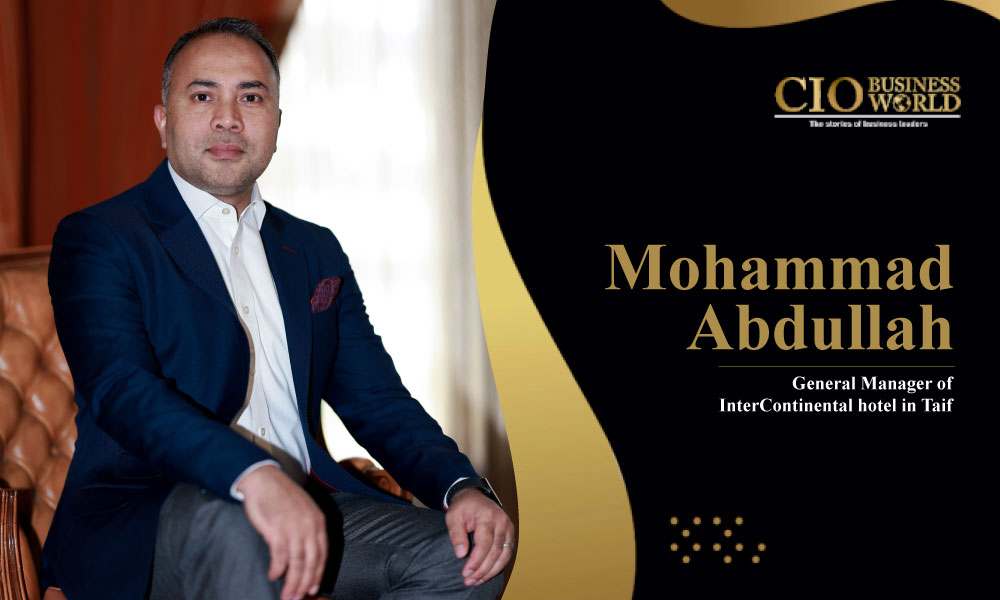
Hospitality is a human craft, and the best practitioners understand this from the bones of their being. Mohammad Abdullah is such a practitioner. His path to the general manager’s office is not a story of boardroom pedigree or a predetermined career ladder; it is the product of circumstance, responsiveness, and an early, visceral discovery of belonging. What began as a temporary job to support family responsibilities matured into a vocation defined by an unwavering devotion to guest experience, operational excellence, and people development. Today, as the General Manager of InterContinental hotel in Taif, he blends operational rigour with an almost artistic view of service: every interaction is a note in a broader symphony.
This cover story maps the contours of Abdullah ’s leadership: the early reveal that service could be a calling, the practical lessons learned through pre-openings, rebrandings and renovations, the daily choreography of leading a luxury property, and the strategic toolkit he uses to navigate a changing industry. It also explores his view of trends that will shape hospitality’s next decade, how technology and empathy must be married, and why Saudi Arabia’s talent boom matters not just for hotels, but for the nation’s economic transformation.
From assistant waiter to general manager — how a vocation was discovered
Abdullah’s journey begins with a clear pivot point. As a young man he intended to become an engineer, but family need redirected his steps. Taking a position as an assistant waiter was meant to be temporary; instead it became foundational. That first shift into service revealed something fundamental: the dining room is more than a functional space — it is a stage. Polished glasses and carefully plated dishes are part of an aesthetic, but the essence of hospitality is the human exchange that transforms a transaction into a memorable moment.
That early experience awakened in Abdullah a sense of belonging and purpose that would shape every subsequent career decision. Far from being a mere job, hospitality became a lifelong craft. The kitchen’s cadence, the rhythm of front-of-house service, the choreography of guest arrival and departure — all offered lessons in discipline, attentiveness, and the subtle mechanics of delight. As he moved through roles, from entry level to supervisory positions and beyond, each assignment was approached as a masterclass. Pre-opening chaos taught project discipline; rebranding demanded strategic clarity; renovations required patience and the capacity to keep service standards high while physical spaces evolved.
Abdullah credits much of his service instinct to his mother. She embodied hospitality without knowing its corporate name: guests were noticed, welcomed, and made to feel at home. That ethos—hospitality as an act of the heart—became Abdullah’s guiding principle. Alongside this influence, his wife, Nazeerah, offered steady personal support that enabled him to pursue long hours, pressure-filled projects, and the endurance required to rise to the general manager role.
The general manager as conductor — responsibilities and daily practice
Abdullah imagines his role as that of a conductor leading an orchestra. The analogy is telling because modern luxury hotels truly are orchestras: rooms, food and beverage, engineering, sales, culinary, and many other departments must move in sync to produce a single, seamless experience for guests. The general manager’s responsibility is to ensure harmony without micromanaging each instrument.
This work begins in plain sight. Abdullah does not start his day in a closed office; he starts on the floor. He walks the lobby and the restaurants. He touches the pulse of the hotel, meets colleagues, absorbs the atmosphere, and ensures energy is focused on excellence. That visible, accessible leadership is not symbolic — it is strategic. It communicates expectations, grounds decisions in lived reality, and gives leaders immediate sensory feedback that no dashboard can provide.
Strategically, Abdullah’s remit spans several major areas:
• Operational excellence: Every minute element of the guest journey must meet luxury standards. The hotel’s systems, processes, and staff must perform at a consistently elite level.
• Financial stewardship: Profitability and long-term health matter. Budgeting, forecasting, and yield management are daily concerns, balanced against the imperative to invest where it enhances guest experience and sustainability.
• Brand guardianship: The hotel belongs to a global brand, and its standards must be upheld. Yet Abdullah believes brand consistency should be infused with local authenticity so that guests feel both global assurance and regional uniqueness.
• Talent development: Perhaps the most strategic of all. Abdullah invests in mentoring and programmatic development designed to cultivate Saudi national talent and to align with the Kingdom’s Vision 2030.
• Guest experience: The final arbiter of success is the guest story. Abdullah reviews feedback personally and ensures every checkout is more than a transaction; it is a departure with a memory.
In sum, the general manager role mixes strategic oversight with human presence. Abdullah’s day is defined by finding the right balance between the backstage systems that make excellence possible and the front-of-house warmth that defines luxury hospitality.
The perennial tension — owner, brand, guest and colleague
One of the central challenges Abdullah names is the art of balance. A luxury hotel must satisfy owners seeking returns, brands seeking consistency, guests with ever-more-personalized expectations, and colleagues whose careers depend on clarity and growth. These constituencies sometimes pull in different directions. Owners demand cost control and ROI, brands insist on standards and alignment, guests ask for bespoke experiences, and colleagues require training, time, and recognition.
Abdullah navigates these trade-offs through a consistent framework:
- Agile, informed decision-making. The modern hotel generates ample data. Abdullah uses analytics not as a substitute for judgment, but as a decision compass. Forecasting demand, optimizing pricing, and understanding guest sentiment allow him to anticipate, not merely react. When the data and the human eye converge the best decisions are made.
- Trust-based relationships. Transparent partnerships with owners and brand stakeholders create room for long-term investments. This is critical when capital projects like renovations are required, or when strategic pivots — for instance investing in wellness programming or sustainability initiatives — are needed. When relationships are strong, decisions can prioritize the property’s future rather than short-term expediencies.
- Values as filters. Abdullah ’s core values—respect, integrity, discipline—are non-negotiable. When faced with a dilemma he runs choices through those filters. A values-first approach ensures decisions are aligned with a culture that colleagues can trust and guests can feel.
Challenges do not become roadblocks if they are reframed as invitations to innovate. The complexity itself becomes a vector of improvement: more precise revenue management, more bespoke guest services, more rigorous talent pipelines. Indeed, Abdullah ’s leadership is anchored in the belief that pressure reveals opportunities.
The trends reshaping luxury hospitality — personalization, experience, sustainability, and national empowerment
Abdullah identifies four interlocking trends that are reshaping luxury travel and hospitality globally, and that are particularly salient in Saudi Arabia.
1. AI and hyper-personalization
Artificial intelligence is no longer a back-office optimisation tool; it is becoming integral to the guest journey. Abdullah envisions systems that automatically predict preferences—room location, pillow firmness, dining choices—and deliver them before a guest articulates the request. Forecasting, dynamic pricing, guest profiles and bespoke in-stay recommendations can all be automated in ways that free colleagues to offer emotionally rich interactions. That said, integration is careful: technology must amplify empathy, not replace it.
2. The ascendancy of experiential travel
Luxury is being redefined. High thread counts and marble alone no longer impress as they once did. Discerning travellers now seek authentic, culturally immersive experiences—local guides, culinary journeys, wellness programmes that tap regional traditions, or curated day trips that reveal a destination’s soul. For Abdullah , the task is to design experiences that tell the story of Taif — its culture, landscape, and history — so guests leave having been transformed, not merely entertained.
3. Sustainability as non-negotiable
Guests increasingly choose brands aligned with their environmental and social values. Resource conservation, responsible sourcing, waste reduction and community impact matter more than ever. Abdullah has made environmental stewardship a standard operating principle: sustainability decisions are not marketing gestures but fundamental business practices that support operational resilience and guest trust.
4. The national talent boom
Saudi Arabia’s Vision 2030 is producing a structural shift: a rising generation of Saudi hospitality professionals eager to lead and innovate. For Abdullah , building a leadership pipeline of national talent is not a box-ticking exercise — it is a strategic investment in the nation’s future. Training programmes, mentorship, exposure to global best practices and pathway creation for career progression are central. The hotel must not only serve guests, it must be a school of experience for a new generation of national leaders.
These trends are not isolated. They interact. AI enables personalization that supports experiential programming. Sustainability design becomes part of the guest narrative. Talent programmes ensure the human warmth needed to bring digital and experiential programmes to life. Abdullah ’s leadership is about orchestrating these connections.
Facing market fluctuations and competition — the playbook
Markets rise and fall. Customer tastes shift. Competitors pivot. Abdullah ’s response is to treat these realities as inputs rather than shocks. His strategic playbook includes:
• Data as strategic compass. Advanced analytics inform pricing, distribution channel strategies, and guest segmentation. They allow timely pivots when demand softens and provide precision in targeting the highest-value guests.
• Continuous innovation culture. Teams are encouraged to test ideas—new culinary concepts, guest activities, or service rituals—and quickly iterate based on feedback. The organisation learns as it experiments.
• People as advantage. Competitors can replicate amenities; they cannot instantly replicate a culture of engaged, empowered staff. Investing in training, recognition, and development creates a durable competitive edge.
• Strategic partnerships. Alignment with owners and brand partners enables long-term investments and shared innovation. These relationships provide the runway for capex projects and for initiatives that enhance the property’s uniqueness.
Competition is welcomed as a refining force. It pushes the hotel to clarify its identity, expand its offerings, and double down on the elements that genuinely differentiate the guest experience.
Technology as an enabler — empathy remains the product
Technology is the backbone of modern operations. Abdullah embraces AI and analytics for forecasting, revenue optimization, and guest personalization. He also champions digital tools that free staff from routine tasks so that human attention can be devoted to hospitality’s creative work. Yet Abdullah issues an important caveat: technology is an enabler, not an end. The real product of hospitality is empathy.
His leadership philosophy is to deploy AI and automation for the predictable and to liberate human colleagues for the unpredictable — the moments when judgment, creativity, and emotional intelligence matter. This balanced approach means investing in digital tools while simultaneously intensifying people development. The result is a hotel that is efficient behind the scenes and exquisitely present in guest-facing moments.
Talent development — Vision 2030 in practice
Abdullah places enormous emphasis on developing Saudi national talent. He sees the hotel as an ecosystem that can translate Vision 2030 objectives into lived outcomes. His approach includes:
• Structured training pathways that combine classroom learning, on-the-job rotations, and international exposure.
• Mentorship and coaching that build managerial capacity and foster leadership mindsets.
• Career mapping that demonstrates how entry-level roles lead to supervisory and executive opportunities.
• Cultural empowerment — encouraging national colleagues to bring local insight into guest experiences, thereby enhancing authenticity.
This investment is strategic. A hotel that develops leadership locally becomes both more culturally authentic and more resilient. It positions itself as a contributor to national economic development, not merely a private operator in a competitive market.
The human dimension — leadership as presence and humility
Abdullah’s leadership style is characterised by presence, humility, and discipline. He is a visible leader who walks the property daily, listens more than he speaks, and seeks to model the service standards he expects. He believes in leading by example: discipline in execution, transparency in communication, and graciousness in success.
His values are simple but exacting. Respect, integrity and discipline guide hiring choices, performance assessment, and how the hotel treats guests and colleagues. These values form a language that staff can rely on during high-pressure moments and that guests perceive as consistent excellence.
Personal reflections and the role of family
Abdullah’s personal life is seamlessly intertwined with his leadership identity. He credits his mother’s hospitality as formative, and his wife, Nazeerah, as a steady partner who supports the often demanding rhythms of hotel life. Hospitality is a people business, and for Abdullah , family provides the emotional infrastructure that enables professional endurance.
Vision for the future — legacy, impact and measurement
Abdullah’s vision extends beyond the balance sheet. He measures success by the stories guests tell, the careers his team build, and the long-term reputation the hotel sustains. He wants the InterContinental Taif to be known not only for luxury accommodations, but for authentic cultural immersion, environmental stewardship, and as a crucible for national talent.
His broader aspiration is to contribute to the transformation of Saudi hospitality into an exemplar for the region: a sector that generates economic impact, preserves culture, and elevates global standards of experience. To that end, he is building programs and partnerships that will outlive any individual tenure — training academies, community engagements, and sustainable practice implementations that are durable, measurable, and transferable.
The leadership lessons from Abdullah
For leaders across industries, Abdullah offers a concise blueprint drawn from decades in hospitality:
• Start with presence. Leadership is visible first and strategic second. Walk the floor; feel the business.
• Invest in people. Systems and technology matter, but humans are the differentiator.
• Embrace technology wisely. Let automation handle predictables; free people to handle the unpredictable.
• Anchor decisions in values. Respect, integrity and discipline are non-negotiables that build trust.
• Treat challenges as invitations. Market pressure and competition reveal where you can innovate.
• Build for the long term. Sustainable investments in talent, brand and community create legacies beyond quarterly results.
Closing — a steward of people, place and promise
Abdullah’s career is a study in service transformed into leadership. He is not a general manager in the abstract; he is a steward of a place, a culture, and a people. His daily practice — walking the lobby, listening to colleagues, calibrating budgets, and curating guest experiences — embodies a leadership that is simultaneously strategic and humane.
In the end, Abdullah’s work is a reminder that hospitality’s true luxury is connection. Technology, plush furnishings, and curated menus are important, but the core product remains the human encounter. By building organisations that are tech-enabled and people-empowered, Abdullah is helping shape a future for hospitality that is both elevated and humane — a future that his guests will feel in the warmth of a welcome and his colleagues will carry forward into careers that matter.
This is his promise: to preserve the soul of hospitality while preparing it for the future. It is an ambitious promise, but Abdullah leads with the steady conviction that good leadership, like good service, is primarily about making others feel seen, supported, and inspired.
Visit: The Most Influential General Managers Shaping the Future of Business, 2025