Every generation of women has burned a little brighter, melting what they could, igniting what they must. Leadership, once mistaken for volume, is now being redefined by depth, proof that real power doesn’t need to take up space, interrupt, or echo to be felt.
This isn’t about breaking through anymore; it’s about rewriting the architecture so there’s nothing left to break.
Redesigning the Architecture of Power
For decades, leadership followed a familiar script: decisive, assertive, unemotional, unshaken. The blueprint was rigid, built by centuries of hierarchy and expectation.
Women who entered that structure were told to adapt: lower your tone, soften your words, don’t outshine the room. But if you do, you don’t progress, and if you don’t, you’re too much. If you become assertive, you’re labeled aggressive. If you show passion, you’re called emotional. If you’re career-driven, you’re told you can’t have a family.
It’s been tough, exhausting, even.
But today’s world rewards a different kind of intelligence, one that can hold both strength and sensitivity in the same breath. Industries are discovering what some leaders have always known: progress doesn’t come from being louder; it comes from listening better.
We’re seeing it in politics, in boardrooms, in classrooms, in startups, leadership is becoming less about command and more about connection. Women aren’t inheriting old systems; they’re redesigning them, replacing power with purpose, and hierarchy with humanity.
From Scarcity to Shared Strength
Traditional leadership was built on scarcity, the idea that there’s room for only a few at the top. That belief turned leadership into a race, not a responsibility.
But the modern leader understands something different: power multiplies when shared.
Women are transforming leadership from a competition into a collaboration. They are forming networks, not empires. They are mentoring, not gatekeeping. They are proving that lifting others is not a distraction from ambition; it’s the purest form of it.
This shift isn’t just symbolic; it’s strategic. Collaborative teams outperform competitive ones. Empathy builds loyalty that no paycheck can buy. And inclusive environments, where every voice has value, generate innovation at levels traditional hierarchies could never reach.
The new language of leadership is plural, not singular.
Emotional Precision: The New Intelligence
For a long time, emotion was considered a liability in leadership, something to suppress, manage, or hide. But in a world that’s automated intelligence, emotional intelligence has become the ultimate edge.
Women leaders are redefining what it means to feel in the workplace. Empathy is not softness; it’s precision, the ability to sense what others miss, to respond instead of react, to align business decisions with human truth.
A leader who can read a room is just as powerful as one who can read a report. The blend of analytics and empathy, data and discernment, is the new dual skill set of modern leadership.
This isn’t intuition versus intellect. It’s both. And women are showing that the combination of the two doesn’t dilute leadership, it deepens it.
Breaking the ceiling was never about imitation; it was about evolution.
The most transformative women leaders aren’t replicating traditional models, they’re dismantling them. They don’t lead like men or unlike men. They lead like themselves.
They are introducing a rhythm of leadership that moves between decisiveness and reflection, ambition and humility, head and heart. It’s not about proving strength, it’s about redefining it.
Courage, in this new world, looks like self-awareness. It’s the willingness to say “I don’t know yet” in rooms that reward certainty. It’s choosing to pause instead of perform. It’s leading with vulnerability in a culture that still mistakes vulnerability for weakness.
True leadership has never been about volume; it’s about clarity.
Beyond the Ceiling: A New Horizon
When we talk about women breaking barriers, the metaphor of the ceiling implies an end, as though once broken, there’s sky and freedom forever. But real change doesn’t end at the top. It starts there.
Because leadership isn’t linear. It’s cyclical. Each generation of women doesn’t just rise, they lift.
They mentor, they amplify, they make sure the next wave stands on steadier ground. The future of leadership isn’t about balance sheets, it’s about balance itself. Between profit and purpose. Between competition and compassion. Between growth and grace.
And this balance is what defines the next era, not female leadership, but human leadership.
The glass ceiling still exists, sometimes clear, sometimes camouflaged. It lives in the questions asked differently in interviews, in the expectations of tone and dress, in the silent math of opportunity.
But the fire beneath it burns stronger than ever.
Every woman who dares, questions, leads, and rebuilds adds to that flame. Every conversation about equity, every inclusive policy, every leader who chooses integrity over ego adds oxygen to it.
The goal was never just to break through. It was to change the temperature of the room, to make it impossible for the old ceiling to survive.
Leadership is not what it used to be. And that’s the point.
About the Author
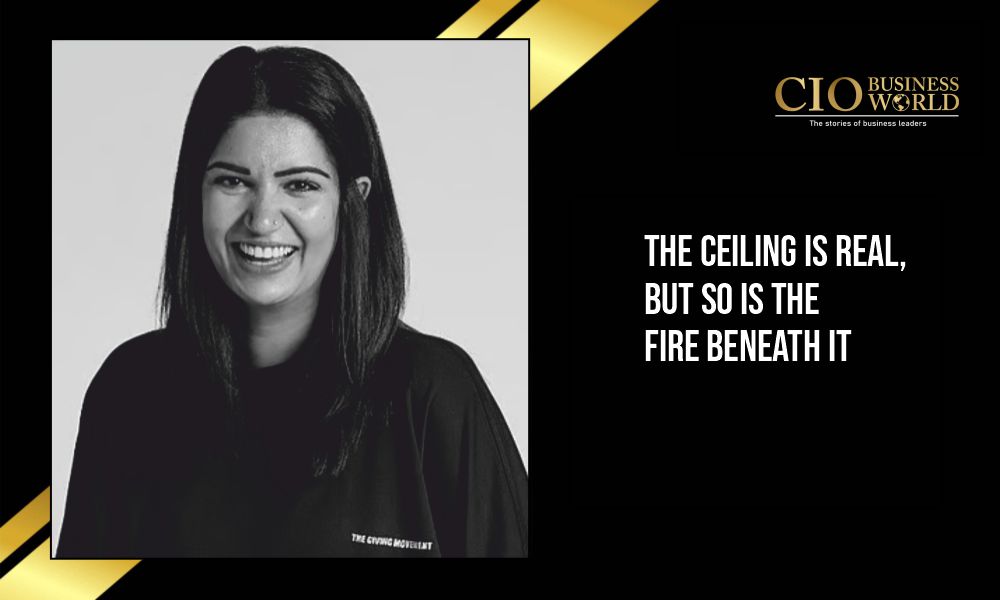
Sabahatt Habib is the Chief People & Culture Officer at The Giving Movement and a recognized thought leader in modern leadership and organizational transformation. She writes about empathy, equity, and the future of work, where human values and business growth finally move in the same direction.