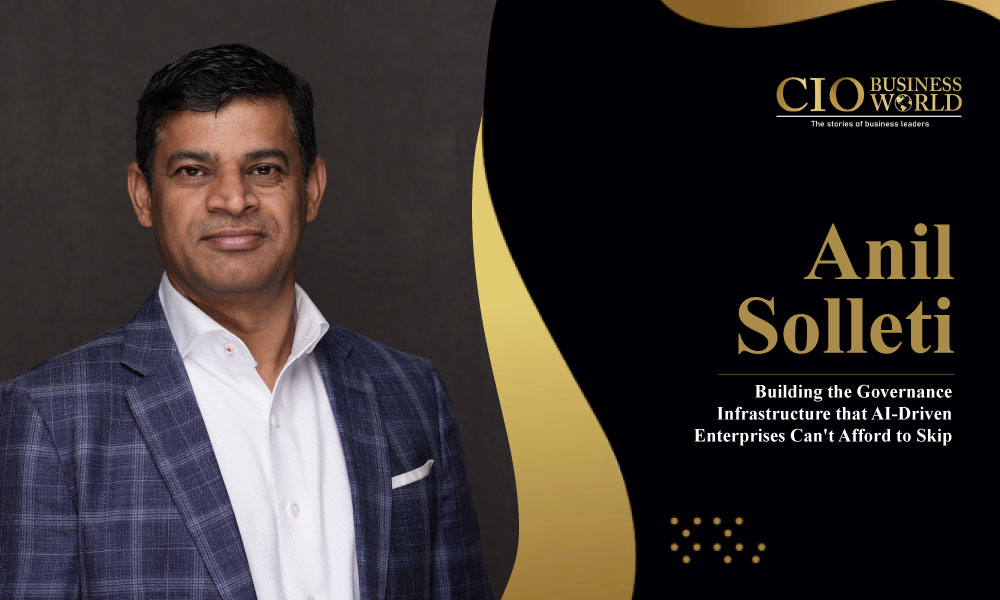
When a board member asks a CTO whether they can prove what their AI systems did — and why — most enterprises today cannot answer with confidence. Identity records live in one system. Access logs in another. Audit evidence gets assembled manually, after the fact. In a world where AI agents are making autonomous decisions inside regulated environments, that gap is no longer acceptable. Closing it is the mission Anil Solleti has organized his next chapter around.
Anil is Founder and CEO of AutoPIL and a partner at VibrantCapital.ai. His position at the intersection of building an AI governance company and investing in the next generation of AI infrastructure gives him a vantage point few people in the industry share. He sees governance failures from the inside — as a builder watching enterprises struggle to deploy agents responsibly — and from the outside, as an investor evaluating which AI companies have the architectural foundations to survive regulatory scrutiny. That dual perspective sharpens everything.
Today, through AutoPIL, Anil is tackling what he believes is one of the most important challenges of the AI revolution: creating governance infrastructure designed specifically for intelligent agents operating inside regulated enterprises. His mission is not simply to make AI more powerful. It is to make AI more trustworthy. In an era where organizations are racing to deploy autonomous systems, AutoPIL is helping ensure that governance, compliance, and transparency remain foundational rather than becoming afterthoughts.
His journey from engineer to entrepreneur reflects a career defined by continuous learning, technological innovation, and a relentless focus on solving complex business problems. It is also a story about recognizing a critical gap in the market before others fully understood its significance and having the conviction to build a solution capable of addressing it.
The problem became visible from the inside
Before AutoPIL, Anil spent more than two decades inside some of the world’s largest technology organizations. At Citibank, where he served as Managing Director and Head of Consumer Data, he oversaw global data strategy for Personal Banking and Wealth across North America, APAC, and Mexico, leading the Consumer AI Center of Excellence and driving enterprise adoption of Generative AI, and data governance inside one of the most demanding regulatory environments in any industry.
Before that, at Verizon, he built VZCloud — a Docker-based private cloud platform serving sixty million users and managing over one hundred petabytes of data. He launched one of the first FDA 510K-certified telemedicine platforms and led FiOS AdVance, an intelligent advertising system that generated more than one hundred million dollars in new revenue. Across both companies, his teams filed over one hundred patents.
What those years inside large enterprises taught him was not just how to build technology at scale. They taught him where governance breaks down. As AI adoption accelerated, organizations could explain what their systems were designed to do. They could rarely answer the more fundamental questions: what data did the agent actually access, under which policy, and where is the tamper-proof evidence?
The answers were never in one place.
AutoPIL: governance before the context window
“AutoPIL is a governance platform for AI agents operating in regulated enterprises.” The description is deliberate in its precision. The core insight is architectural. Most governance tools operate retroactively — they collect logs, generate reports, and help organizations reconstruct what happened after an audit or incident. AutoPIL enforces policy before data enters an AI agent’s context window. If access should not happen, it does not happen. Every decision — allow or deny — is recorded in a cryptographically hash-linked audit chain that cannot be altered after the fact.
The platform currently supports 200+ pre-built policies across twelve regulated industries and integrates with the frameworks enterprises already use — LangChain, LlamaIndex, OpenAI Agents, AWS Bedrock, Databricks — without requiring architectural changes to existing AI systems.
The regulatory tailwind is no longer theoretical. EU AI Act high-risk provisions are in effect. State AI laws are being enforced now. The question for compliance and technology leaders is no longer whether governance infrastructure is required. It is whether the infrastructure they have was designed for the agents they are actually deploying.
The idea behind AutoPIL emerged from a challenge Anil repeatedly encountered while leading enterprise AI initiatives.
That realization became the foundation for AutoPIL.
The investor lens sharpens the operator’s judgment
As a partner at Vibrant Capital.ai — the venture firm he joined alongside Shadman Zafar, a former executive colleague and longtime mentor — Anil evaluates AI companies that will themselves need governance infrastructure to reach enterprise customers. That creates a feedback loop that runs in both directions.
The challenges AutoPIL’s customers bring to Anil are the same challenges early-stage AI companies run into when they try to sell into regulated markets. Boards want proof. Compliance teams want audit trails. Legal wants accountability chains that survive regulatory review. Companies that treat governance as a later problem consistently fail to close enterprise deals, regardless of how capable the underlying technology is.
“My long-term goal for AutoPIL is to become the governance layer that regulated enterprises trust when they deploy AI at scale.” That is also, increasingly, what VibrantCapital looks for when evaluating investment opportunities — teams that build accountability into architecture from the beginning, not after the first compliance conversation.
The combination of operating AutoPIL and investing through VibrantCapital means Anil is working on the same governance problem from two angles simultaneously. That is not an accident. It is the strategic advantage he is building.
Leading Through Clarity, Curiosity, and Trust
Throughout his career, Anil has led teams ranging from small startup groups to global organizations numbering in the thousands. While the scale varied dramatically, the leadership principles remained remarkably consistent.
At the center of his philosophy is a belief that people perform best when they understand why their work matters. Clarity creates motivation. Purpose creates momentum.
When hiring for AutoPIL, Anil looks for individuals who are genuinely curious about solving governance challenges rather than simply interested in technology trends. Startups require a different mindset than large enterprises. They demand people who can operate effectively amid uncertainty, navigate ambiguity, and maintain progress without perfect information.
His management approach is built around three principles: clarity on objectives, freedom in execution, and honest feedback. Team members are given clear goals, but they are trusted to determine the best path toward achieving them. This combination of accountability and autonomy encourages innovation while maintaining alignment.
Another defining aspect of his leadership style is intellectual humility. Despite decades of experience, an MBA, and a Master’s degree in Computer Science, Anil remains committed to continuous learning. He expects the same mindset from those around him.
What he values most is authenticity and substance. What he rejects is performative complexity. He has little patience for presentations designed to impress rather than inform or solutions engineered to appear sophisticated without solving meaningful problems.
This emphasis on honesty and practicality has become a defining characteristic of AutoPIL’s culture.
Scaling AutoPIL and Expanding Its Impact
Looking toward the future, Anil’s vision for AutoPIL extends far beyond building another successful software company.
His goal is to establish AutoPIL as the definitive governance infrastructure layer for AI accountability within regulated enterprises. He wants organizations to view governance not as an optional feature but as a foundational requirement for responsible AI deployment.
The company’s immediate priorities include expanding vertical coverage within financial services and healthcare, strengthening enterprise sales capabilities, and advancing its intellectual property portfolio. AutoPIL has already filed provisional patents covering cross-agent session isolation and multi-agent governance frameworks.
Alongside his role at AutoPIL, Anil also serves as a partner at VibrantCapital.ai. Working alongside mentor and former colleague Shadman Zafar, he helps build and invest in next-generation AI companies. The relationship between these two roles creates a powerful advantage. Operating AutoPIL provides direct exposure to enterprise deployment challenges, while investing in emerging AI companies offers visibility into future innovation trends. Together, they allow Anil to maintain both operational depth and strategic perspective.
His long-term ambition is straightforward. When a board member asks a CTO whether they can prove what their AI systems did and why, AutoPIL should be the reason the answer is yes.
Driving a New Standard for AI Accountability
Anil believes the next phase of AI adoption will be defined by accountability.
Today, many organizations still approach governance reactively. They attempt to assemble evidence after incidents occur, reconstruct access histories, and explain decisions retrospectively. This model becomes increasingly unsustainable as AI systems grow more autonomous and complex.
The alternative is proactive governance. Rather than generating evidence after the fact, organizations should enforce policy continuously and create audit records automatically. Governance should be embedded directly into the architecture of AI systems.
To accelerate this shift, Anil is investing heavily in thought leadership. Through conference presentations, industry events, and practitioner networks, he is helping organizations understand why governance must evolve alongside AI capabilities.
His credibility stems from lived experience. He has faced these challenges firsthand inside large institutions. As a result, his message resonates with leaders who are navigating similar concerns today.
Family, Perspective, and Personal Discipline
Despite the demands of entrepreneurship, Anil remains deeply committed to maintaining perspective through family and personal discipline.
He openly acknowledges that work-life balance is not a formula. It is an ongoing negotiation.
His wife, Shilpa, has been his partner since 2001 and maintains a successful career. Together, they have built a family that provides stability amid the demands of leadership.Their daughter Anshika is pursuing Biomedical Engineering at Duke University, while their son Suhas is preparing for the next stage of his educational journey.
Anil protects personal time with the same rigor he applies to business commitments. Morning routines are non-negotiable. Family commitments receive the same respect as critical client meetings.This discipline helps him avoid one of the most common traps facing entrepreneurs: the temptation to remain permanently connected to work.
Family also provides perspective. Conversations about everyday life, school, and personal milestones serve as important reminders that professional success should ultimately support something larger than itself.
A Culture Defined by Rigor, Credibility, and Builders
AutoPIL’s internal culture reflects the values that have shaped Anil’s career. The company operates according to three guiding principles.
The first is rigor without bureaucracy. Serving regulated industries requires precision, discipline, and documentation. However, rigor should not create unnecessary complexity or slow execution.
The second is credibility through honesty. AutoPIL deliberately avoids exaggerated claims. Its competitive positioning openly acknowledges areas where competitors excel while focusing on the company’s unique strengths.
The third is builder culture. Anil continues to write code. His team remains deeply involved in product development. This connection to execution helps ensure that strategic decisions remain grounded in reality.
Together, these principles create an environment where innovation and accountability coexist naturally.
The Future of Responsible AI
If given the opportunity to change one aspect of the technology industry, Anil would make governance a first-class design requirement.
Too many organizations build AI systems focused exclusively on capability and attempt to retrofit accountability later. The result is fragile governance that appears sufficient until challenged by regulators, customers, or real-world incidents.
Anil advocates a different approach. Governance should be established before deployment. Organizations should define access policies, audit requirements, and accountability frameworks before a single AI agent enters production.
AutoPIL was designed to make this approach practical and scalable.
The company’s architecture reflects three key principles: pre-retrieval run-time enforcement, cryptographic audit chaining, and flexible deployment model. Together, these capabilities create infrastructure capable of scaling alongside increasingly complex AI ecosystems.
As autonomous systems become more prevalent across industries, governance will become just as important as intelligence. Organizations will need infrastructure capable of proving not only what their systems can do, but how those systems operate and why decisions are made.
For Anil Solleti, this is not simply a market opportunity. It is a necessary evolution of enterprise technology.
His career has been defined by building systems that create value at scale. Through AutoPIL, he is now focused on ensuring that the next generation of intelligent systems can be trusted, governed, and deployed responsibly. For Anil, building AutoPIL isn’t just about creating another successful technology company. It’s about ensuring that the next generation of AI earns the trust required to improve how organizations serve people. As AI continues to reshape industries, his focus remains clear: innovation must always be matched by accountability, transparency, and trust.