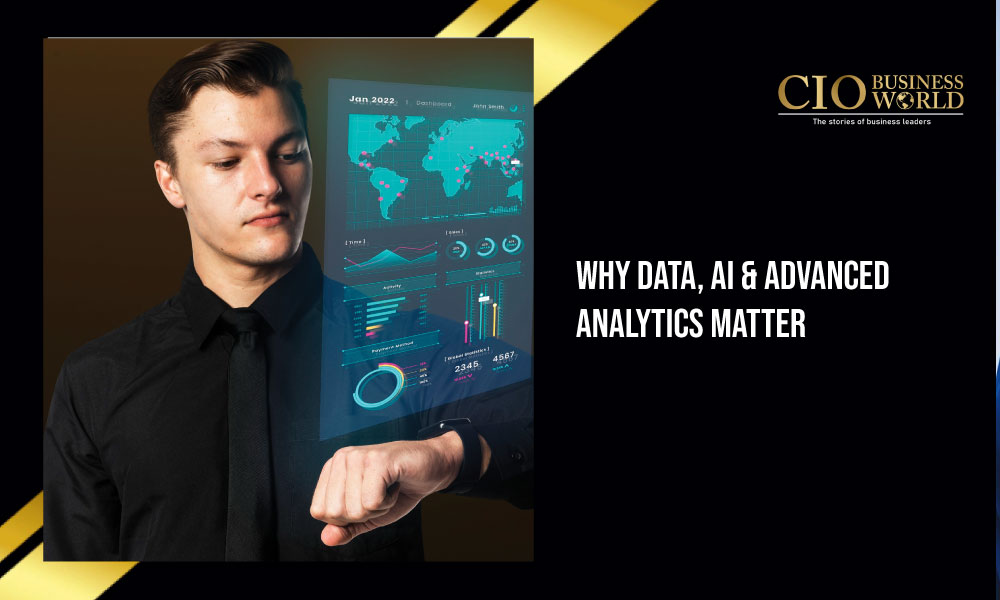
The future of technology is no longer something we are waiting for. It is already transforming the way we live, learn and work. From AI-powered assistants and predictive healthcare to autonomous vehicles, smart manufacturing and personalised digital platforms, Data, Artificial Intelligence (AI) and Advanced Analytics are becoming central to almost every industry. For students preparing to enter the professional world, understanding these technologies is becoming an important part of being future-ready.
Data: The Foundation of Intelligent Decision-Making
Every digital interaction generates data. Online transactions, customer interactions, social media activity, connected devices, websites, applications and industrial systems continuously create enormous volumes of information. However, data by itself has limited value unless it can be interpreted effectively. Data analytics enables organisations to transform raw information into meaningful insights, helping them understand patterns, measure performance, identify opportunities and make informed decisions. For future professionals, learning to work with data means developing the ability to look beyond numbers and understand the stories and possibilities hidden within them.
Artificial Intelligence Is Changing the Workplace
Artificial Intelligence is rapidly becoming part of everyday professional life. AI systems can analyse information, recognise patterns, automate repetitive tasks, generate content, support decision-making and assist professionals across different sectors. Rather than simply replacing human capabilities, AI has significant potential to enhance them. Healthcare professionals can use AI-assisted tools to support diagnosis, engineers can optimise industrial processes, marketers can understand customer behaviour, and financial professionals can use intelligent systems to assess risks. As AI becomes increasingly integrated into workplaces, future professionals will need to understand how to work effectively alongside intelligent systems while continuing to apply human judgement and creativity.
Advanced Analytics: Moving from Insight to Foresight
Traditional analytics primarily helps organisations understand what has already happened. Advanced Analytics goes a step further by helping them understand why something happened, what could happen next and what actions could produce better outcomes. Predictive analytics uses historical and real-time data to identify possible future outcomes, while prescriptive analytics can support decisions by suggesting appropriate courses of action. In manufacturing, for example, sensor data and AI can identify unusual equipment behaviour and predict potential failures before they occur. This allows organisations to take preventive action, reduce downtime and improve operational efficiency.
Data and AI Are Transforming Every Industry
The influence of Data, AI and Advanced Analytics extends far beyond the technology sector. Healthcare organisations are exploring AI for medical imaging, patient monitoring and research, while banks and financial institutions use analytics for fraud detection, risk assessment and customer insights. Manufacturing companies are adopting intelligent automation and predictive maintenance, while retailers use data to understand customer preferences and improve inventory management. The automotive industry is developing connected and intelligent vehicles, agriculture is adopting data-driven methods to improve productivity, and education is exploring personalised learning systems. This widespread adoption means that students from almost every academic discipline can find opportunities to combine their domain knowledge with emerging technologies.
The Skills of the Future
Preparing for the AI-driven future does not mean becoming an expert in every emerging technology. Instead, students should focus on developing a strong combination of technical, analytical and human skills. Knowledge of data analysis, statistics, programming, machine learning, artificial intelligence, data visualisation, databases and predictive analytics can provide a strong foundation. At the same time, communication, creativity, critical thinking, collaboration and problem-solving will remain essential. Organisations need professionals who can not only work with technology but also understand business challenges, communicate insights clearly and translate technological capabilities into practical solutions.
Responsible AI and Ethical Thinking
As AI becomes more powerful, responsible development and use of technology become increasingly important. AI systems depend heavily on the quality of the data used to train them, and inaccurate or biased data can lead to unreliable outcomes. Issues related to privacy, cybersecurity, transparency, fairness and accountability therefore need to be considered at every stage of AI adoption. Future professionals must learn not only how to develop and use intelligent systems but also how to evaluate their impact. The ability to ask whether something can be done must be accompanied by the equally important question of whether it should be done.
Continuous Learning Is the New Advantage
One of the defining characteristics of the technology sector is its speed of change. New AI models, analytical techniques, platforms and applications continue to emerge rapidly. Skills that are highly valuable today may evolve as new technologies become available. For students, this makes continuous learning an essential professional habit. Industry projects, internships, research, certifications, competitions, workshops and practical experimentation can help students understand how concepts learned in classrooms are applied to real-world challenges. The ability to learn, unlearn and relearn will be one of the most valuable capabilities in an evolving digital economy.
From Students to Future Professionals
A career in Data, AI and Advanced Analytics is not limited to a single job title. The field offers opportunities across data science, artificial intelligence, machine learning, data engineering, business analytics, business intelligence, AI product development, technology consulting and research. More importantly, these technologies can complement almost every professional discipline. A student who combines domain expertise with data and AI skills can become an important link between technological innovation and real-world problem-solving.
Preparing for an Intelligent Future
The world is moving from being simply digital to becoming increasingly intelligent. Organisations are becoming more connected, decisions are increasingly supported by data, and AI systems are becoming capable of performing increasingly complex tasks. In this environment, being future-ready is not about accurately predicting exactly what tomorrow will look like. It is about developing the knowledge, adaptability, curiosity and confidence to respond when tomorrow arrives.
Data provides the foundation. AI brings intelligence. Advanced Analytics creates foresight. Human creativity, ethics and judgement provide direction.
Together, they are shaping the future of work, industry and society.