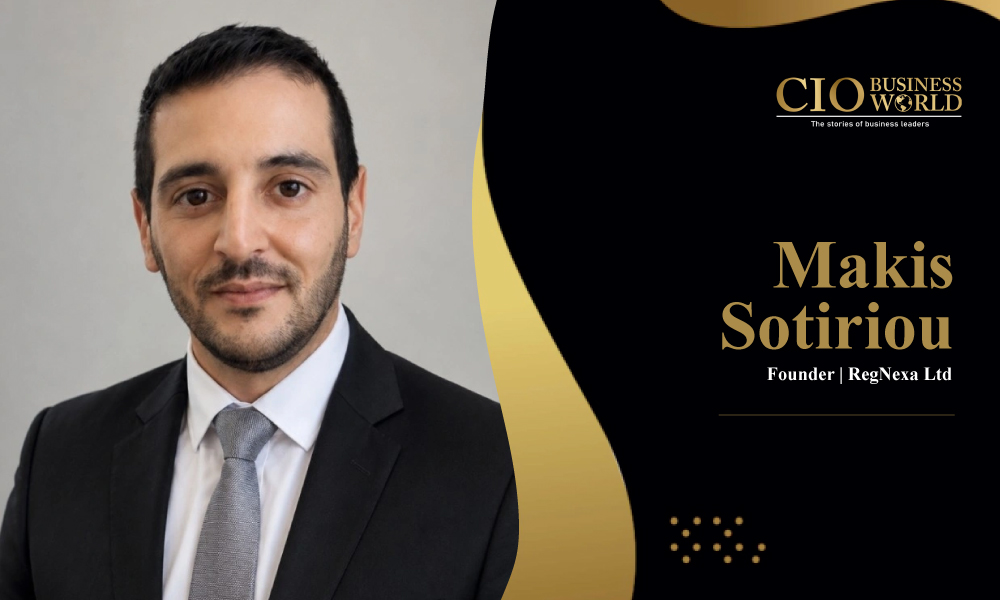
Every great innovation begins with a problem waiting to be solved. For Makis Sotiriou, that problem was the growing complexity of regulatory compliance in an increasingly digital world. Trained as a lawyer and specializing in Anti-Money Laundering (AML) compliance, he quickly realized that effective compliance is about far more than meeting legal obligations it is about building trust, protecting businesses, and creating systems that enable organizations to operate with confidence.
His journey began in the legal profession, where years of practical experience in financial crime prevention, client onboarding, due diligence, source of funds analysis, and regulatory compliance exposed him to the operational challenges faced by regulated firms. Rather than accepting these inefficiencies as part of the process, he saw an opportunity to transform them through technology.
Driven by that vision, Makis founded RegNexa Ltd, a RegTech SaaS company dedicated to simplifying compliance workflow management for regulated businesses. Today, alongside his role at Andreas Demetriades & Co LLC, he combines legal expertise with technology and entrepreneurship to help organizations streamline compliance processes, improve operational efficiency, and strengthen governance. His story is one of bridging law and innovation demonstrating that practical technology, thoughtful leadership, and consistent execution can reshape the future of regulatory compliance.
From Legal Practice to RegTech Leadership
Makis is a lawyer and Anti-Money Laundering (AML) Compliance Officer at Andreas Demetriades & Co LLC, a Cyprus-based law firm established in 1970 that provides legal, corporate, immigration, property, and compliance services to both local and international clients. He is also the Founder and Chief Executive Officer of RegNexa Ltd, a RegTech SaaS company dedicated to improving compliance workflow management for regulated firms.
His professional journey has been shaped by extensive hands-on experience in anti-money laundering compliance, financial crime prevention, client onboarding, due diligence reviews, source of funds analysis, and the broader regulatory obligations faced by businesses operating in both domestic and international markets. Through this experience, Makis gained a deep understanding of the operational realities of compliance and the growing challenges professionals encounter in an increasingly regulated environment.
Over time, he observed a recurring problem across the industry. While regulatory expectations continued to become more rigorous, many organizations still relied on manual, fragmented processes involving emails, spreadsheets, scattered documentation, reminders, and disconnected internal workflows. Compliance professionals were expected to manage increasingly complex responsibilities without a structured operational framework that provided clarity and oversight.
Makis believes that a significant portion of compliance work is still consumed by administrative tasks such as collecting documentation, sending reminders, tracking outstanding requirements, organizing files, and monitoring internal review processes. While these activities are essential, he believes they should support not overshadow the core responsibilities of compliance professionals.
In his view, the true value of compliance lies in understanding clients, assessing risk, evaluating information critically, and exercising sound professional judgment. RegNexa was built around this philosophy. The platform is designed to help organizations manage client onboarding, due diligence, document collection, risk assessments, reporting, and internal reviews through a more structured, transparent, and practical workflow. Its objective is not to make compliance more complex, but to make it easier to manage with consistency and control.
Makis also advocates for the responsible use of technology within the compliance sector. While he recognizes the significant potential of Artificial Intelligence to organize information, assist with reporting, and reduce repetitive administrative work, he firmly believes that compliance should never become a fully automated process. Professional oversight, accountability, ethical judgment, and informed decision-making must remain at the center of every compliance function.
Ultimately, Makis envisions RegNexa as a practical compliance technology platform that reflects the realities faced by regulated firms. By combining legal expertise with thoughtful technology, he aims to help compliance professionals work with greater clarity, consistency, confidence, and operational efficiency while preserving the critical role of human judgment.
Making Compliance Smarter, Simpler, and More Accountable
Makis believes that clarity is one of the most fundamental elements of effective leadership. In his view, people perform at their best when they clearly understand what is expected of them, the responsibilities they hold, and the purpose behind their work. Whether in compliance or technology, he believes unnecessary complexity reduces efficiency, while clear direction combined with the freedom to think critically encourages better decision-making and stronger outcomes.
He values a leadership approach that balances structure with open dialogue. While teams need well-defined processes, they should also be encouraged to question assumptions, challenge ideas, and identify weaknesses before solutions are implemented. Throughout the development of RegNexa, Makis has prioritized practicality over unnecessary sophistication. He believes that a feature may appear impressive from a technical perspective, but if it does not genuinely improve the daily work of compliance professionals, it ultimately adds little value. Honest discussions, continuous testing, and the willingness to refine ideas have become central to the company’s product development philosophy.
For Makis, successful teams are built on clear standards, transparent communication, accountability, and openness to constructive feedback. He believes people should feel valued for their contributions while also recognizing that the ultimate objective is to deliver solutions that are reliable, practical, and professionally executed.
Looking ahead, Makis aims to continue growing both as an AML and compliance professional and as an entrepreneur through RegNexa. Remaining closely connected to day-to-day compliance work is a deliberate priority, ensuring that the platform continues to solve real operational challenges rather than becoming a theoretical technology built on assumptions. In his view, meaningful innovation can only emerge by understanding the realities faced by compliance professionals working under increasing regulatory pressure.
His long-term vision is to establish RegNexa as a leading international RegTech platform that helps regulated firms modernize the way they manage anti-money laundering and compliance obligations. The company’s focus remains on improving operational structure, strengthening visibility across compliance workflows, enhancing recordkeeping, supporting practical reporting, and encouraging the responsible use of technology.
Beyond product development, Makis is passionate about contributing to broader conversations surrounding financial crime prevention, compliance modernization, operational governance, and the role of Artificial Intelligence within regulated industries. He believes the compliance profession is evolving beyond traditional checklist-based processes. Modern organizations are increasingly expected to demonstrate governance, transparency, auditability, defensible decision-making, and continuous monitoring. While technology will play an essential role in supporting this transformation, Makis believes its implementation must always remain practical, responsible, and centered on professional judgment.
Where Law, Compliance & Technology Converge
For Makis, the next phase of his journey is centered on execution and continuous improvement. As RegNexa continues to evolve, its development is guided by practical feedback, real-world workflow observations, and the everyday experiences of compliance professionals. Rather than building technology based on assumptions, he remains committed to creating solutions that address genuine operational challenges faced by regulated firms.
He also believes that operational efficiency is becoming an increasingly important component of compliance risk management. Even highly skilled professionals can struggle to maintain effective compliance if they are supported by fragmented systems and inefficient processes. In his view, stronger operational structures ultimately contribute to stronger governance and better regulatory outcomes.
Makis approaches progress with a philosophy of solving one practical problem at a time. Through continuous product refinement, close engagement with users, and careful attention to operational realities, he aims to ensure that RegNexa remains a solution that compliance professionals can rely on in their day-to-day work.
Balancing his responsibilities as a Licensed lawyerand entrepreneur is an ongoing challenge, and he acknowledges that balance does not always mean every aspect of life is perfectly aligned. Compliance demands precision, consistency, and professional judgment, while building a technology company requires strategic thinking, product development, long-term planning, and resilience.
Over time, he has come to value consistency over short bursts of intensity. While long hours and periods of sustained effort are sometimes unavoidable, he believes lasting success is built through disciplined routines rather than temporary motivation. Sustainable progress, in his experience, depends on maintaining focus and steadily moving forward over time.
Structure and prioritization play a central role in his daily approach. Makis consciously focuses on activities that create meaningful progress while avoiding distractions that may appear urgent but contribute little to long-term objectives. For him, balance is achieved through protecting focus, remaining consistent, and recognizing that meaningful professional growth and successful entrepreneurship are built gradually through patience, discipline, and perseverance.
Driving the Next Generation of Compliance Technology
Makis believes that technology is becoming indispensable in the compliance sector as regulatory expectations continue to grow while many organizations still rely on outdated or fragmented internal systems. In his view, modern compliance requires greater operational structure, transparency, and consistency, and technology has an important role to play in achieving these objectives.
Despite the growing capabilities of AI, Makis firmly believes that technology should support compliance professionals rather than replace them. In regulated industries, where accountability, legal responsibility, and professional judgment are critical, final decisions must always remain under human oversight. AI should enhance efficiency and consistency while preserving the role of experienced professionals in evaluating risk and making informed decisions.
For entrepreneurs looking to build technology solutions for regulated industries, Makis emphasizes the importance of first developing a deep understanding of the sector itself. Compliance environments are shaped by legal obligations, confidentiality requirements, operational pressures, and constant regulatory scrutiny. Without practical knowledge of these realities, technology solutions often fail to address the challenges professionals encounter in their daily work.
He encourages entrepreneurs to focus less on industry trends and more on solving genuine workflow problems. By engaging directly with compliance professionals, observing operational processes, identifying sources of delay and friction, and understanding where errors commonly occur, innovators can develop products that create meaningful value rather than superficial innovation.
Makis also believes that credibility is one of the most important assets in regulated industries. Firms are naturally cautious when adopting new technologies, and trust must be earned through reliability, security, practical functionality, and a genuine understanding of the regulatory environment. In his experience, successful execution ultimately matters far more than ambitious ideas alone. A concept may appear compelling in theory, but its true value is measured by its ability to perform consistently within demanding professional environments.