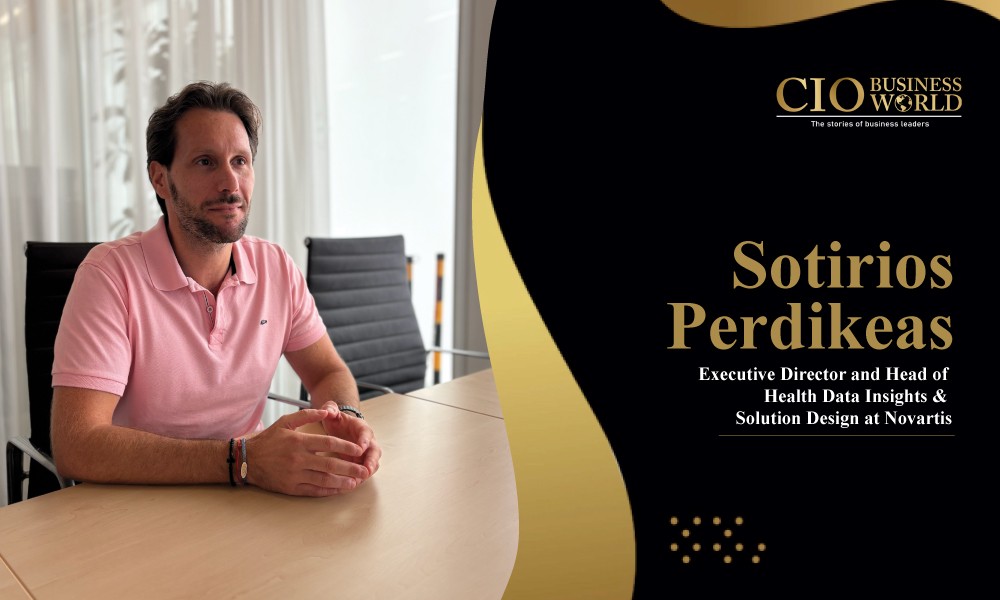
Healthcare is entering an era in which data, technology, and scientific expertise are becoming increasingly interconnected. Yet meaningful transformation depends on more than adopting new technologies. It requires leaders who can understand different disciplines, connect specialized knowledge, and translate innovation into better decisions and outcomes. Sotirios Perdikeas, Executive Director and Head of Health Data Insights & Solution Design at Novartis, has built his career around precisely this intersection, moving across consulting, informatics, data and analytics, clinical development and operations, biomedical research, and enterprise digital and AI transformation.
His journey has not followed a conventional functional path. Instead, each transition has expanded his perspective on how information, technology, and human expertise can work together. From his early experience in Big 4 consulting, where he focused on performance management, transformation, and corporate finance, to later leadership roles spanning informatics, clinical operations, and biomedical research, Sotirios has developed a systems-oriented view of transformation. His work today reflects that perspective, exploring how data and AI can strengthen healthcare while keeping scientific judgment, accountability, and the patient at the center.
A Career Built Across Disciplines
Sotirio’s journey has been shaped by moving across disciplines and learning from the different perspectives each one brings. Consulting gave him a strong foundation in listening carefully to customer needs, understanding the vision behind them, identifying blind spots, making trade-offs visible, and helping leaders make better decisions. Moving into industry then changed his perspective, because he saw more clearly why even strong ideas are not always adopted or scaled.
Across roles in informatics, clinical operations, clinical development and biomedical research, he gradually built a much deeper understanding of how information flows across the drug development lifecycle. Moving from Informatics to the business side was particularly important because it taught him to stay anchored in business drivers and outcomes, and to treat technology as an enabler rather than the objective.
One of the most valuable chapters was his move into biomedical research. Working with scientists across target discovery, biomarkers exploration, pharmacology, PK/PD, toxicology and safety gave him a much stronger appreciation of the fundamental questions behind drug development: is biology compelling enough to progress a molecule, and in which indication, population and trial design can best demonstrate benefit?
He is very grateful to the leaders and teams who trusted him with such opportunities.
Those experiences encouraged him to remain curious, build bridges across functions, and become comfortable operating at the boundaries between disciplines. Rather than seeing unfamiliar responsibilities as limitations, he treated them as opportunities to expand his understanding.
That cross-functional perspective now informs his leadership at Novartis, where healthcare data and solution design increasingly intersect with advanced technology. His career demonstrates how professional breadth can complement deep expertise, particularly in industries where scientific, technological, operational, and human considerations must come together.
Making Drug Development Predictive
AI is already transforming research and development across many parts of the lifecycle. In discovery, we are seeing advances in molecular design, PK/PD prediction, virtual screening of compound libraries, image analysis, in silico modelling and new approaches to toxicity assessment. These capabilities can help teams explore hypotheses faster, generate evidence earlier and make more informed decisions about which molecules to progress.
In clinical development, the opportunity is equally significant. We can digitize protocols, automate parts of statistical workflows, explore synthetic control arms and digital twin approaches, and use simulation to test different development scenarios before decisions are made. AI can also remove a meaningful amount of repetitive work and give scientists more time to focus on the questions where their expertise creates the greatest value.
For me, the most important shift is not simply that AI allows us to do existing tasks faster. It enables us to ask better questions, learn earlier and make drug development more predictive, adaptive and evidence-driven. The greatest value will come when these capabilities are combined with scientific expertise and human judgment rather than treated as a substitute for them.
Where Human Judgment Remains Essential
As AI becomes more deeply embedded in healthcare, Sotirios sees a clear boundary that technology cannot replace: human judgment where accountability, empathy, context, and consequences matter. AI can generate evidence, identify patterns, and challenge existing assumptions, but people must still understand what a decision means, weigh uncertainty, and take responsibility for its outcome. One lesson I have learned is that the more capable the technology becomes, the more important it is to be explicit about where accountability sits and who has to act when things don’t go as expected. What happens and who is accountable if AI violates certain boundaries, reveals sensitive information, recommend actions that are biased to certain sub populations?
That responsibility carries particular significance in healthcare. Every dataset ultimately represents people, and every scientific or operational decision can affect a patient’s experience or outcome. Technology may strengthen the evidence available to decision-makers, but it cannot remove the human responsibility attached to using that evidence wisely.
For Sotirios, the future therefore lies neither in resisting AI nor in surrendering judgment to it. It lies in creating a partnership between increasingly capable technology and professionals who can interpret its insights with expertise, accountability, and empathy. That balance provides the foundation for responsible innovation as healthcare moves toward a more data-driven future.
Moving AI From Experiment to Enterprise Value
For Sotirios, one of the greatest challenges in AI transformation is recognizing that a high-performing model is not the finished product. An algorithm can deliver impressive technical results, but meaningful value emerges only when the right people trust it, understand what it is producing, and use those insights to make better decisions. This distinction becomes especially important in healthcare, where decisions often involve scientific complexity, operational consequences, and significant responsibility.
I learned this very clearly while leading the design of an enterprise predictive site selection initiative.
Our objective was to predict the future performance of hospitals and investigators across screening and recruitment, speed of execution, and consistency of quality. Statistically, the models performed well. But the business teams did not trust the outputs enough to use them in real decisions.
When we looked more closely, the issue was not the modelling itself. The underlying data had important quality gaps and insufficient longitudinal depth. We had to make the difficult decision to step back, return to the fundamentals, and strengthen the data foundation before moving forward.
That experience reinforced an important lesson for me: adoption does not come from model performance alone. It comes from trust in the outputs, and trust requires reliable data, transparency, clear ownership and integration into how decisions are actually made.
For me, this is one of the central challenges of scaling AI. The model is not the end product. The end product is a better decision that people are confident enough to act on.
A Predictive and Connected Pharmaceutical Future
Looking five to ten years ahead, Sotirios expects the pharmaceutical industry to become increasingly predictive, personalized, and connected. Data and AI will undoubtedly help generate insights earlier and support better decisions across research and development.
But for him, one of the most important questions is not only how much organizations can learn, but how quickly that learning can travel.
Today, valuable knowledge is often generated in one part of an organization but moves too slowly across functions, geographies, systems, or decision forums. Scientific insight may not reach operational teams quickly enough, lessons from clinical execution may not sufficiently influence future study design, data may exist, but not in a form that enables timely action.
Sotirios believes the next phase of transformation will therefore be as much organizational as technological. Pharmaceutical companies will need to design themselves so that evidence, experience, and insight can move more freely across traditional boundaries, allowing teams to learn from one another and adapt decisions faster.
Technology will be an important enabler of that shift, but the differentiator may ultimately be the speed of organizational learning: how quickly an insight can move from discovery to development, from one study to the next, and from evidence to action. The organizations that can turn learning into better decisions faster will be better positioned to translate innovation into better science and better outcomes for patients.
Becoming a Translator and Integrator Across Disciplines
For students aspiring to careers at the intersection of AI, data, and healthcare, Sotirios recommends developing depth in at least one area while learning how to connect disciplines. Some of the greatest value comes from people who can understand enough science, technology, data, and business to bring specialists together around a common challenge.
His own career reinforced that belief. When he first joined the pharmaceutical industry, he imagined building a career in digital finance. He began specialising in platforms such as SAP and even started pursuing qualifications such as the CFA. That trajectory changed when he was offered the opportunity to move into Informatics and help design a financial system tailored to clinical trials. The role exposed him to areas of technology, operations, and drug development he had never expected to encounter and fundamentally broadened his view of what his career could become.
Since then, many of the most important doors in his career have been doors he had never originally imagined opening. That experience shaped his advice to students: build expertise, but do not specialise so narrowly that you stop seeing opportunities at the boundaries between disciplines.
Technical literacy remains important, but it is only one part of the equation. Communication, critical thinking, and judgment become equally valuable when professionals must translate between experts who approach a problem from very different perspectives. In global organizations, this also means learning across cultures, functions, and areas of expertise.
Sotirios therefore encourages young professionals to seek assignments that stretch them beyond what they already know. Experiences that force you to learn a new language, scientific, technological, operational, or business, often create the perspective needed to become not only a specialist, but also a translator and integrator across disciplines.
Treating Learning as an Endurance Discipline
Curiosity, continuous learning and adaptability have become increasingly important as the pace of change accelerates across professions. Sotirios views learning almost as an endurance discipline. The objective is not to know everything, but to remain open, humble and willing to keep learning throughout a career. AI makes this mindset even more relevant, but the principle extends far beyond technology.
That perspective is also shaped by his background in competitive swimming. Endurance sports taught him that progress rarely comes from maximum intensity sustained for a short period, but from discipline, consistency and the ability to continue when conditions become uncomfortable. He sees learning in much the same way: the goal is not to absorb everything quickly, but to develop a sustainable pace of learning that can be maintained over many years.
For Sotirios, adaptability does not mean constantly abandoning what you know. It means being willing to challenge your assumptions, learn from people with different expertise and evolve as the environment changes. Experience provides an important foundation, but curiosity determines whether that experience continues to grow or gradually becomes outdated.
This is also a theme he has reflected on in his book Like a Parent, Like a Leader: growth depends not only on expertise, but on the willingness to remain curious, listen, adapt and continue learning from others. In a world where knowledge and technology evolve so quickly, he believes one of the most valuable professional capabilities may simply be the ability to remain a student throughout your career.
India’s Expanding Healthcare Opportunity
Sotirios also sees significant potential for Indian talent as AI reshapes healthcare and pharmaceutical research. His perspective is also personal. During his studies in the UK and the US, and later through colleagues and members of his own teams, he built strong relationships with many Indian professionals and gained a deep appreciation for the discipline, ambition and technical strength they bring.
Coming from Greece, he also sees some similarities in the emphasis both educational cultures place on rigorous study, persistence and sustained effort from an early age. In his experience, this is particularly visible in fields such as mathematics, engineering, physics and other technical disciplines, which continue to produce highly capable graduates with the potential to shape the next generation of healthcare and technology.
India therefore brings together a powerful combination of scientific, engineering, medical and entrepreneurial capabilities, creating opportunities that extend well beyond conventional technology roles.
Professionals can increasingly contribute across AI and data science, clinical research, product leadership, scientific innovation and global decision-making. The strongest opportunities, in his view, will emerge for people who can connect these disciplines and translate technical capability into meaningful healthcare impact.
As healthcare becomes more data-intensive, professionals who can bridge scientific understanding, technological capability, business context and patient needs will become increasingly valuable. India’s breadth of talent positions it to contribute across that entire spectrum, and potentially to help shape some of the most important advances in AI-enabled healthcare over the coming years.
Making Healthcare Proactive and Precise
The future of healthcare excites Sotirios because technology is creating possibilities to make care more proactive, precise, and accessible. Advances in data and AI are helping organizations understand disease earlier, learn continuously from patient experiences, and tailor interventions more effectively. Digital signals can provide insights into the patient journey that were previously difficult to capture, creating new opportunities to understand what is happening beyond traditional points of care.
He is particularly fascinated by the evolution of drug discovery. Historically, discovering a new medicine has been a lengthy process of screening large numbers of compounds and progressively narrowing down promising candidates. Over the coming years, generative AI could increasingly move us toward more autonomous target-to-molecule design, where systems not only predict biological structures but also help design new therapeutic modalities, including antibodies, multi-specific biologics and RNA-based medicines, much faster than traditional approaches.
Another area he finds especially exciting is the emergence of increasingly sophisticated human digital twins. By combining multimodal data such as genomics, proteomics, metabolomics, longitudinal health records and real-time biometric signals, AI could help simulate aspects of an individual patient’s biology and disease trajectory. In clinical development, this may enable richer scenario testing, more personalized trial design and, in selected settings, greater use of synthetic control arms to complement conventional clinical-trial approaches.
For Sotirios, the significance lies in how these capabilities can work together. Earlier understanding of biology can support better target selection, richer patient data can enable more precise trial design, and continuous learning can strengthen decisions across the patient journey.
The technology itself is exciting, but its greater promise lies in using it responsibly to create healthcare that is more predictive, more precise and more accessible, while keeping scientific judgment and the human dimension at the center.
Choosing Growth Over a Perfect Career Plan
Looking back at his own journey, Sotirios would give his younger self a simple piece of advice: do not become overly concerned with having a perfect career plan. Some of the most important opportunities in his professional life came from accepting roles outside his original expertise and then learning quickly. Those unexpected transitions expanded his perspective and eventually contributed to the breadth of experience he brings to his leadership role today.
Rather than attempting to predict the exact destination, he would focus on choosing experiences that stretch capabilities, broaden perspective, and create opportunities to learn from generous leaders who are willing to challenge and guide. Careers rarely develop in perfectly linear ways, and unexpected moves can often become the experiences that teach the most. The destination matters, but so does the journey because the experiences, relationships, and lessons accumulated along the way ultimately shape both the professional and the person.
Connecting Disciplines to Improve Patient Outcomes
Sotirios’s career has reinforced a simple belief: some of the most important healthcare problems sit between disciplines rather than within them. Moving across consulting, finance, informatics, clinical operations, biomedical research, analytics and AI taught him that meaningful progress often depends on people who can connect different perspectives and help specialists see how their decisions affect the broader system.
That experience also shaped how he thinks about technology. He does not see AI as an end in itself, but as one more capability that can strengthen scientific and operational decision-making when it is combined with the right evidence, human judgment and accountability. The real test is not whether an organization has deployed sophisticated technology, but whether that technology helps people make better decisions and ultimately improves the experience and outcomes of patients.
For Sotirios, this is also what makes the future of healthcare so compelling. The boundaries between science, technology, data and care are becoming less distinct, creating opportunities for professionals who are willing to keep learning and move comfortably across them. His own career was shaped by repeatedly stepping into areas he did not fully know and learning from people who did.
Looking ahead, he believes progress will depend less on predicting every technological breakthrough and more on building organizations and leaders capable of learning quickly, connecting knowledge across boundaries and applying innovation responsibly. If that happens, advances in AI and data can become something much more important than digital transformation: they can help translate better science into better decisions and, ultimately, better outcomes for patients.
For Print and Design Purpose:
Quotes:
“In healthcare, that human dimension is particularly important because behind every dataset and every decision is ultimately a patient.”
“I expect the pharmaceutical industry to become more predictive, personalized and connected, with greater use of data across the full development lifecycle.”
“What excites me most is the possibility of making healthcare more proactive, precise and accessible.”