Artificial intelligence has dramatically changed how organizations operate. Tasks that once demanded significant investments of time, talent, and capital can now be completed within minutes, fundamentally altering the economics of execution. Yet while AI has accelerated productivity across almost every business function, it has also exposed a new challenge—one that sits far above automation and efficiency. As execution becomes increasingly inexpensive and abundant, the real competitive advantage shifts toward making better decisions about where organizations invest their time, resources, and capital. In this new landscape, the question is no longer whether companies can execute an idea, but whether they are pursuing the right one in the first place.
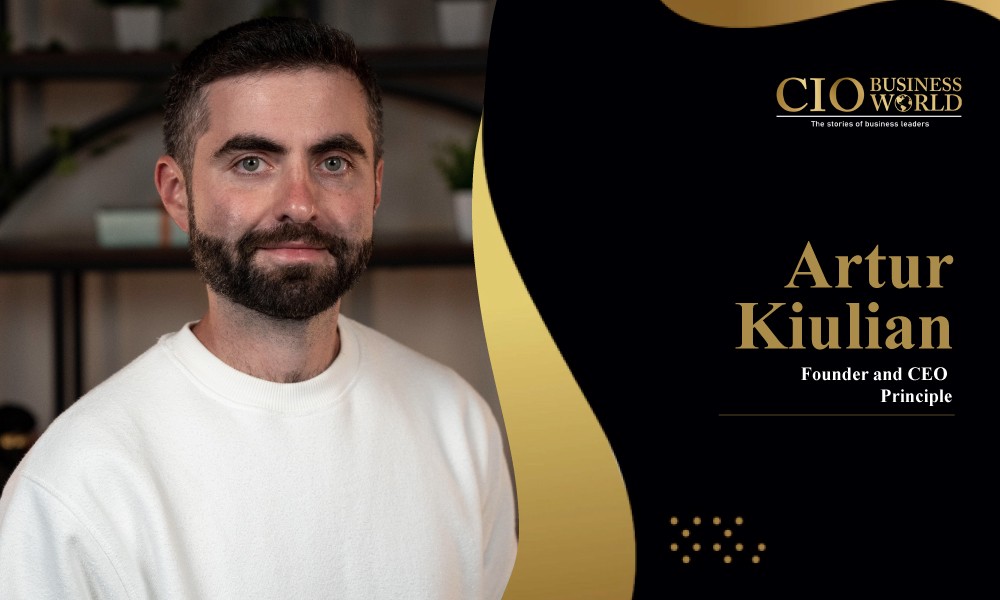
Artur Kiulian, Founder and CEO of Principle, has built his work around addressing this emerging challenge. Drawing on experiences that span venture building, crisis response, and artificial intelligence research, he believes the next generation of enterprise AI must move beyond generating answers toward strengthening the quality of strategic judgment itself. Rather than treating AI as another productivity tool, he envisions it as an environment where leaders can rehearse critical decisions before committing billions of dollars, allowing organizations to understand how competitors, regulators, markets, and stakeholders are likely to respond before irreversible choices are made.
When Execution Stops Being the Constraint
Artur’s perspective on enterprise decision-making did not emerge from theory alone. It was shaped through years of working inside environments where high-stakes decisions carried lasting consequences. During six years at a venture studio, he helped build more than sixty-five startups while witnessing seven successful exits. Across those ventures, one lesson became increasingly difficult to ignore. Many companies executed exceptionally well yet still failed because they committed their resources in the wrong direction.
The same pattern became even more apparent during large-scale crisis initiatives. While contributing to CoronaWhy during the White House COVID response, over fifteen hundred researchers volunteered their expertise to solve urgent global problems. Later, following Russia’s invasion of his home country, thousands of volunteers mobilized to provide support. In both situations, the challenge was never a shortage of capable people or willingness to act. Instead, success depended on determining where scarce resources should be allocated before rapidly evolving circumstances made those decisions on behalf of everyone involved.
These experiences fundamentally changed how Artur viewed artificial intelligence. Traditional enterprise conversations often focus on increasing operational efficiency, automating workflows, or accelerating execution. He argues that those capabilities, while valuable, no longer represent the greatest competitive advantage. AI has dramatically reduced the cost of getting work done, making execution almost infinitely scalable. What remains scarce is direction—the ability to identify the right market to enter, the right acquisition to pursue, the right product to build, or the right strategic initiative to fund.
In Artur’s view, every major corporate decision ultimately becomes a capital allocation problem. Every investment reflects a judgment about the future, and improving those judgments is where enterprise AI can deliver its greatest value.
Why Traditional AI Falls Short in Strategic Decisions
Although language models have transformed knowledge work, Artur believes they remain fundamentally unsuited for the decisions that matter most at executive level. Their greatest strength lies in compressing historical knowledge into accessible patterns. However, strategic decisions rarely reward organizations for simply understanding the past. Instead, they demand careful consideration of futures that have yet to unfold.
Corporate acquisitions, market expansions, divestitures, and large transformation programs all depend on the behavior of multiple independent actors. Competitors react. Regulators intervene. Customers change preferences. Investors alter expectations. Each decision creates a chain of responses that cannot be captured through historical pattern matching alone.
One example that frequently illustrates this limitation involves Medallia’s acquisition by Thoma Bravo. In 2021, one of private equity’s most respected firms acquired the customer experience software company for approximately $6.4 billion. Less than a year after GPT-3 demonstrated the disruptive potential of generative AI, the software category itself began changing dramatically. Eventually, the investment resulted in one of the largest losses in private equity history as ownership transferred to lenders.
For Artur, this outcome highlights an important distinction. Financial models successfully evaluated recurring revenue, growth projections, and traditional investment metrics. What they failed to measure was the growing possibility that artificial intelligence would fundamentally redefine the underlying product category itself. The signals already existed throughout the market, but because they appeared insignificant compared to conventional financial analysis, they remained largely ignored.
He argues that this was not a failure of intelligence or experience. If sophisticated investment firms can overlook structural technological change despite extensive due diligence, the problem lies within the decision-making process itself. Attempting to improve decisions simply by gathering more historical data or producing increasingly confident forecasts often reinforces the same weaknesses. A single projection, regardless of how sophisticated it appears, cannot adequately represent the uncertainty surrounding major strategic investments.
Instead of asking artificial intelligence to predict one future with greater confidence, Artur believes organizations should prepare for multiple plausible futures simultaneously. That shift forms the foundation of Principle’s approach to enterprise decision-making.
Building World Models That Help Organizations Think Ahead
At the heart of Artur Kiulian’s vision is the concept of the world model, an approach that fundamentally changes how organizations prepare for consequential decisions. He believes that every strategy, investment, acquisition, and annual budget is built upon an internal understanding of how the world works. More often than not, however, that understanding remains implicit, shaped by assumptions, historical experiences, and internal consensus rather than being continuously tested against reality. A world model brings those assumptions into the open, allowing them to be challenged, refined, and improved before capital is committed.
Rather than relying solely on historical data, a world model creates a compressed representation of an organization’s competitive environment. It incorporates customers, competitors, regulators, investors, macroeconomic forces, and every other stakeholder capable of influencing a business outcome. One of the most significant discoveries emerging from recent advances in large language models, according to Artur, is that these systems capture not only information about the past but also behavioural patterns that govern how institutions negotiate, compete, cooperate, escalate conflicts, or respond to changing circumstances.
Principle transforms these behavioural insights into interactive simulations tailored to each client. Every relevant participant within a company’s ecosystem is represented as an independent agent with its own objectives, incentives, constraints, and likely responses. Instead of asking what is most likely to happen, organizations evaluate how different strategic decisions perform across hundreds of possible futures. The outcome is not a single prediction but a probability distribution that allows leadership teams to identify strategies capable of remaining resilient despite uncertainty.
For Artur, this represents a profound shift in enterprise AI. Rather than treating artificial intelligence as a prediction engine, he views it as a rehearsal environment where organizations repeatedly test their assumptions before acting. The emphasis moves away from forecasting the future toward understanding how the world is likely to respond once an organization makes its move.
Transforming Capital Allocation Through Continuous Simulation
This philosophy becomes particularly valuable when organizations face decisions involving substantial financial commitments. One engagement that demonstrated the practical impact of this approach involved an established software company employing approximately five hundred people. The leadership team believed that Apple’s upcoming Worldwide Developers Conference could dramatically reshape the competitive landscape for their products, making it essential to determine where future investments should be directed.
Before the conference took place, Principle analysed the broader market environment and ranked the announcements Apple was most likely to make. All seven of the platform’s highest-ranked predictions were ultimately reflected during the event. Yet for Artur, identifying announcements represented only the beginning of the exercise. The real value emerged afterwards.
The system constructed a comprehensive simulation involving sixty-two active participants across the industry, including Apple, forty-seven competing companies, customer groups, and broader market dynamics. Leadership then evaluated three different strategic directions through approximately two hundred simulated futures. Rather than relying on a single forecast, executives examined how each possible decision performed under a wide range of competitive responses and market conditions. This allowed them to commit resources with far greater confidence instead of reacting after industry changes had already taken place.
Artur sees the same decision-making pattern repeating across almost every major capital allocation challenge. Corporate development teams evaluating acquisitions face identical uncertainties, as do organizations considering market expansion or significant operational restructuring. Private equity, however, represents perhaps the clearest illustration of why simulation matters.
Every investment made by a private equity firm is ultimately a long-term bet on how markets, competitors, and exit opportunities will evolve over several years. Financial models can estimate revenue growth, profitability, and valuation targets, but they rarely capture how changing competitive dynamics, geopolitical developments, regulatory shifts, or buyer behaviour influence the eventual exit path. Whether a portfolio company reaches the public markets, attracts a strategic acquirer, or struggles through prolonged ownership depends on a complex sequence of external events that conventional spreadsheets cannot adequately represent.
By simulating those broader interactions, organizations gain a more complete understanding of where capital should be committed, how long investments should be maintained, and which external developments could significantly alter expected outcomes.
Creating Alignment Beyond Traditional Consulting
Although scenario planning has existed within strategic consulting for decades, Artur believes today’s technology fundamentally changes both its accessibility and its organisational impact. Traditional scenario planning was typically reserved for the world’s largest corporations, requiring extensive consulting engagements, large internal teams, and months of analysis before producing only a handful of static scenarios.
Principle replaces that model with hundreds of continuously evolving simulations generated within days and grounded directly in each client’s operating environment. Yet Artur believes the greatest innovation lies beyond speed or scale. Conventional consulting engagements frequently conclude with presentations that remain confined to executive leadership, leaving operational teams disconnected from the reasoning behind strategic decisions.
A living simulation changes that dynamic entirely. Because employees across functions can interact with the model, question assumptions, and understand the reasoning behind strategic choices, alignment develops naturally throughout the organisation. Strategy, product development, finance, sales, and corporate development begin working from the same evolving representation of reality rather than separate interpretations of static reports. For Artur, the greatest deliverable is not the analysis itself but the shared understanding that enables faster, more coordinated execution once a direction has been chosen.
Building a Living Decision Platform for the Enterprise
As the market for simulation technologies continues to expand, Artur is careful to distinguish Principle from the growing number of platforms entering the space. While many simulation companies focus on consumer behaviour—helping brands understand purchasing decisions, pricing preferences, advertising performance, or product research—Principle operates at an entirely different level. Its purpose is not to optimize marketing campaigns but to strengthen the quality of strategic decisions that shape the future of entire organisations.
Artur explains that traditional competitive intelligence platforms primarily monitor signals, while financial planning and analysis tools project trends from historical performance. Principle instead models behaviour itself. It examines how competitors, regulators, boards, customers, investors, and other influential institutions are likely to respond once an organisation makes a strategic move. This behavioural perspective enables companies to evaluate not just their own decisions, but also the chain of reactions those decisions are likely to trigger across an increasingly interconnected business environment.
The platform is designed to become far more than a tool for strategy teams. Instead of producing reports that serve a single department before being archived, Principle creates what Artur describes as a future graph—a continuously evolving representation of possible pathways from a company’s current position to its desired outcome. Strategy teams can test mergers and acquisitions, product leaders can evaluate roadmap decisions, finance departments can assess investment risks, and sales organisations can anticipate competitive responses long before they emerge. Because every decision feeds new information back into the system, the world model becomes increasingly accurate over time, gradually evolving into a highly calibrated representation of a company’s own market rather than remaining a generic AI model.
Trust, however, remains central to every recommendation the platform generates. Artur believes executive teams should never accept AI-generated advice without understanding how those conclusions were reached. Every source of information within Principle is therefore classified according to its confidence level, distinguishing established facts from assumptions, hypotheses, stated claims, and contradictory evidence. Recommendations are accompanied by transparent reasoning chains that allow decision-makers to inspect the supporting evidence, challenge assumptions, and override conclusions whenever necessary.
That commitment to transparency extends into the company’s research programme. Principle has benchmarked frontier AI models against real-world prediction markets, work that was accepted at the International Conference on Machine Learning (ICML), one of the world’s leading machine learning conferences. The findings revealed that today’s most advanced models incorrectly predict future events nearly seventy-two percent of the time when operating without specialised calibration. Rather than viewing this as a limitation, Artur sees it as evidence that organisations should move away from prediction altogether and instead invest in systems capable of continuously improving decision quality through repeated simulation and measurable feedback.
Shaping the Next Generation of Enterprise Intelligence
For Artur, the commercial case for continuous simulation is equally compelling. The organisations adopting this technology are typically those responsible for directing capital allocation, including chief strategy officers, corporate development teams, chief financial officers, transformation leaders, and private equity operating partners. Many currently rely on costly consulting engagements, relatively small internal strategy teams, or executive instinct to guide billion-dollar decisions.
A continuously updated simulation platform offers a different model. Rather than commissioning expensive one-time studies that become outdated as markets evolve, organisations gain an always-on strategic capability that adapts alongside changing competitive conditions. The value extends well beyond reducing consulting expenditure. Avoiding a single unsuccessful acquisition, identifying a deteriorating investment thesis before capital is committed, anticipating a competitor’s response, or selecting the optimal exit window for a portfolio company can generate returns that far exceed the cost of the platform itself. Within private equity in particular, where similar diligence processes are repeated across every transaction, simulation gradually becomes part of the firm’s operating discipline instead of an isolated analytical exercise.
Looking ahead, Artur believes intelligent simulation will become a standard component of enterprise decision-making. Industry analysts already project significant growth in simulation-driven strategic planning over the coming decade, while billions of dollars continue flowing into companies developing world-model technologies. Although much of today’s investment focuses on modelling the physical world through robotics, spatial intelligence, and autonomous systems, Artur sees a larger opportunity in modelling institutional behaviour. Markets, regulators, boards, competitors, and governments ultimately determine where capital flows, making this the level at which long-term competitive advantage will increasingly be created.
He also believes Principle’s expertise cannot easily be replicated by frontier AI laboratories alone. While major model developers continue advancing foundational AI capabilities, transforming those models into practical enterprise decision systems requires years of specialised experience. His own leadership team reflects that belief, bringing together expertise developed at organisations such as Google, CERN, global policy initiatives, and high-pressure crisis environments where simulation has already been tested under extraordinary circumstances.
Leaving Behind Better Decisions, Not Just Better Technology
Despite his deep commitment to artificial intelligence, Artur remains convinced that human judgment must always occupy the highest level of decision-making. Principle was never intended to replace executives or boards. Instead, it exists to sharpen their thinking by exposing assumptions, revealing blind spots, and allowing leaders to challenge strategies before committing people and capital. In practice, one of his favourite uses of the platform is attempting to disprove its own recommendations, believing that robust decisions emerge only when technology invites rigorous scrutiny rather than unquestioning acceptance.
This philosophy also shapes his concerns about the current wave of enterprise AI adoption. As intelligent assistants become embedded within almost every business application, organisations increasingly risk confusing polished outputs with sound strategic thinking. A well-written report or persuasive presentation can create the illusion of rigorous analysis without ever having been tested against the complexities of the real world. The greatest danger, in Artur’s view, is not poor execution but false confidence generated by strategies that have never been challenged.
Ultimately, his ambition extends beyond building another enterprise software platform. He hopes to improve the quality of decisions that influence businesses, economies, governments, and people’s lives. Better capital allocation means stronger companies, fewer failed acquisitions, fewer unnecessary layoffs, and greater investment in innovation. When organisations make more informed strategic choices, the benefits extend far beyond financial performance to employees, customers, investors, and society itself.
Artur Kiulian’s work reflects a broader shift in the evolution of artificial intelligence. As execution becomes increasingly commoditised, sustainable competitive advantage will belong to organisations capable of making consistently better decisions under uncertainty. Through Principle and Principle, he is helping redefine how leaders prepare for the future—not by asking machines to predict what comes next, but by enabling organisations to test their assumptions, challenge their thinking, and commit capital with greater clarity, resilience, and confidence.