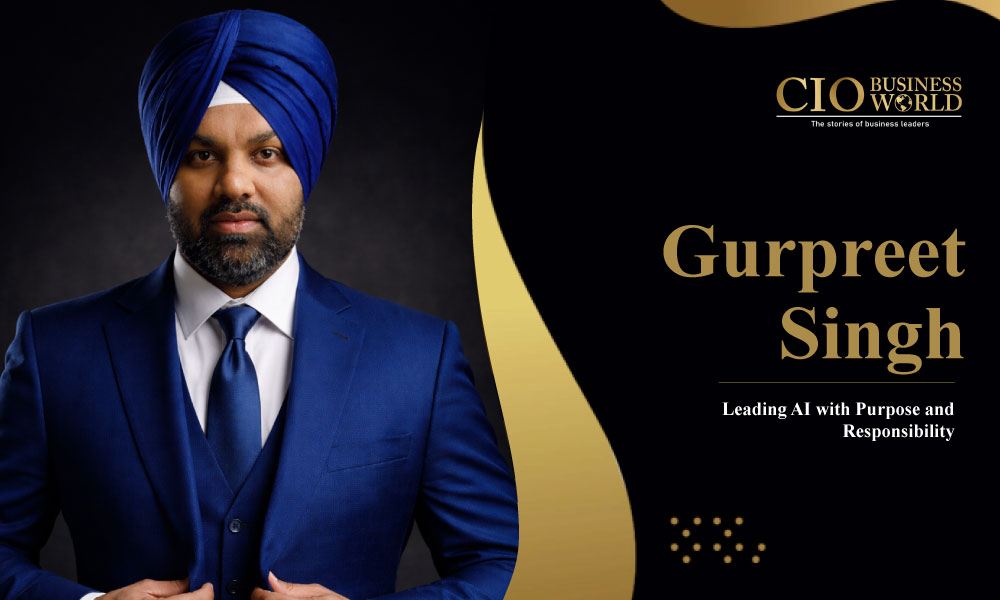
Every transformation begins with a question: How can technology create real impact? For Gurpreet Singh, the answer has never been about chasing the latest trends it has been about solving meaningful business problems. His journey began in enterprise technology, where he worked at the intersection of systems, strategy, and digital transformation. As Artificial Intelligence evolved, so did his vision. What started with modernizing businesses naturally progressed into harnessing AI to build intelligent, scalable, and human-centered solutions. Today, Gurpreet combines deep technical expertise, product thinking, and business strategy to help organizations move beyond AI experiments and create real-world value. His story is one of continuous learning, resilience, and a commitment to ensuring that technology remains practical, responsible, and centered on people.
A Journey of Innovation, Leadership, and AI-Driven Impact
Gurpreet’s journey into enterprise technology began with a strong technical foundation and a deep curiosity about how complex systems operate. Early in his career, he gained hands-on experience in software development, architecture, data, and large-scale technology platforms. As his career evolved, he realized that the true value of technology lies not in the systems themselves, but in the business outcomes they enable and the human problems they solve.
Over the years, he transitioned into product and technology leadership roles, where his responsibilities expanded beyond software delivery to include defining technology strategy, building high-performing teams, modernizing enterprise platforms, and leading digital transformation initiatives across industries such as healthcare, aviation, telecommunications, e-commerce, climate technology, and the public sector.
A defining moment in his career came when he chose to move beyond conventional technology leadership and focus on AI-led business transformation. This decision shifted his role from managing technology and platforms to helping organizations identify where Artificial Intelligence could create measurable business value. Working closely with founders, CXOs, business leaders, product teams, and engineers, he learned to bridge the gap between strategic vision and practical execution.
His experience across diverse transformation projects reinforced a key insight: successful digital transformation is driven not by technology alone, but by a clear understanding of business challenges, redesigned workflows, strong internal capabilities, and effective organizational adoption. This realization shaped his leadership philosophy and gave his work a greater sense of purpose.
As Artificial Intelligence rapidly evolved, Gurpreet recognized its potential to fundamentally transform decision-making, automate workflows, enhance customer experiences, and improve organizational productivity. At the same time, he observed that many AI initiatives failed to progress beyond proof-of-concept due to unclear business objectives, poor data readiness, weak governance, and limited adoption strategies.
Today, Gurpreet combines technical expertise, product thinking, and business strategy to help organizations move from AI ambition to practical execution. He focuses on identifying high-impact AI use cases, designing scalable solutions, and establishing the operating models required to transform AI initiatives from experimentation into sustainable, outcome-driven business transformation.
Navigating Challenges, Building the Future with AI
Throughout his career, Gurpreet has led transformation initiatives in environments where expectations were high, but systems, data, processes, and teams were not always prepared for change. Navigating legacy technologies, fragmented ownership, organizational resistance, and the constant pressure to deliver immediate results while building long-term capabilities became defining challenges of his professional journey.
One of the most valuable lessons he learned was balancing speed with sustainability. While launching AI pilots and demonstrating innovative concepts can be relatively straightforward, creating reliable, scalable solutions that organizations trust and adopt requires a far more disciplined approach. These experiences reinforced his belief in clearly defining business outcomes, challenging assumptions, and embedding governance and user adoption into every stage of transformation.
Working across diverse sectors including healthcare, aviation, telecommunications, e-commerce, climate technology, and the public sector also taught him the importance of continuous learning and collaborative leadership. Rather than relying solely on technical expertise, he believes in listening to domain specialists, empowering cross-functional teams, and aligning business priorities with technical realities.
These experiences have shaped Gurpreet’s leadership philosophy into one that is collaborative, execution-driven, and focused on delivering measurable outcomes. He believes in setting a clear strategic direction while empowering teams to take ownership, embrace ambiguity, and make informed decisions with transparency around risks and trade-offs. For him, leadership is not about having all the answers it is about creating clarity amid complexity and enabling people to move forward with confidence.
Looking ahead, Gurpreet believes the next five years will mark a fundamental shift from AI being viewed as an isolated technology to becoming an embedded operating layer across enterprises. Organizations will increasingly redesign workflows, products, and decision-making processes around intelligent systems rather than using AI solely for content generation or experimentation.
He sees tremendous potential in AI agents capable of coordinating complex, multi-step business processes across industries such as healthcare, finance, customer service, operations, and software engineering. Beyond task automation, these systems will increasingly execute workflows while operating under appropriate human oversight.
Another significant opportunity lies in transforming enterprise knowledge. By making information spread across documents, systems, emails, and organizational silos more accessible and context-aware, AI can empower employees to make faster, smarter, and more informed decisions.
Gurpreet also believes the next wave of innovation will come from industry-specific AI solutions tailored to unique workflows, regulatory environments, and domain expertise. Sectors such as healthcare, manufacturing, climate technology, education, and public services are particularly well-positioned to benefit from this evolution.
Equally transformative is the democratization of technology creation. AI-powered tools will increasingly enable business users to develop applications, automate workflows, analyze data, and prototype solutions without relying entirely on traditional software development cycles, significantly accelerating innovation across organizations.
However, Gurpreet emphasizes that long-term success will not belong simply to organizations that adopt AI first, but to those that establish strong data foundations, redesign business processes, implement effective governance, invest in workforce capability, and create clear accountability between human expertise and intelligent systems.
In his view, the coming years will be defined not by the adoption of individual AI tools, but by the reimagination of how enterprises operate. The greatest opportunity lies in building organizations that are more intelligent, adaptive, resilient, productive, and capable of responding to change with speed and confidence.
Turning AI Vision into Business Impact
Gurpreet believes that every successful AI initiative should begin with a business problem not the technology itself. Rather than adopting AI because it is a trend, he encourages organizations to first identify areas where they face high operational costs, slow decision-making, repetitive tasks, poor customer experiences, revenue leakage, or operational risks. According to him, AI should always be evaluated by the measurable business value it can create.
He emphasizes that readiness is just as important as ambition. Before implementing AI, organizations must assess the quality and accessibility of their data, the maturity of existing processes, integration requirements, internal capabilities, and governance frameworks. Even the most promising AI use case can fail if the underlying workflows are unclear or the available data is unreliable.
For organizations beginning their AI journey, Gurpreet recommends starting with a focused portfolio of high-impact use cases, prioritized according to business value, feasibility, implementation effort, and risk. Early projects should be small enough to deliver results quickly while demonstrating tangible business outcomes. Establishing clear success metrics before development begins is, in his view, essential to long-term success.
He also stresses that AI transformation cannot remain the responsibility of technology teams alone. Business leaders must own the desired outcomes, while technology, data, legal, risk, and operations teams collaborate throughout implementation. Equally important is planning for organizational adoption from the outset by redesigning workflows, training employees, defining appropriate human oversight, and preparing teams for evolving roles. The objective, he believes, is not simply to deploy AI tools but to build a repeatable organizational capability for implementing, governing, and scaling AI effectively.
When it comes to leadership, Gurpreet believes that today’s technology leaders must combine technical expertise with business acumen and strong people leadership. While technical depth remains essential, leaders must also understand how emerging technologies align with business priorities and be able to determine where AI creates value, where it introduces risk, and where it may not be the right solution.
He identifies systems thinking as one of the defining qualities of effective technology leadership. Since AI influences data, processes, governance, customer experience, operating models, and organizational culture, leaders must understand these interdependencies instead of viewing AI as a standalone technology initiative.
Another critical capability, according to Gurpreet, is the ability to lead through uncertainty. With AI evolving rapidly, leaders are often required to make informed decisions without complete information. This demands curiosity, adaptability, disciplined experimentation, and a strong focus on governance, accountability, and measurable outcomes.
Equally important is the ability to communicate across diverse stakeholders. Effective leaders must translate complex technical concepts into clear business implications for executives while helping engineering teams understand the broader organizational purpose behind what they build. Bridging strategy with execution remains one of the most valuable leadership skills in an AI-driven world.
Gurpreet also advocates for responsible and ethical technology leadership. He believes that considerations such as data privacy, security, fairness, reliability, cost, and human oversight should be integrated into AI initiatives from the very beginning. Rather than pursuing automation for its own sake, organizations should focus on designing intelligent systems that enhance human capabilities and deliver sustainable value.
Ultimately, Gurpreet believes the strongest technology leaders are those who build empowered teams rather than positioning themselves at the center of every decision. By creating clarity, encouraging continuous learning, fostering ownership, and balancing innovation with accountability, they enable organizations to embrace AI with confidence. In his view, the leaders who will shape the future are not simply experts in technology, but thoughtful decision-makers who align innovation with purpose, transform uncertainty into opportunity, and ensure technology creates lasting value for both businesses and society.
The Future Belongs to Human-Centered Leaders
Gurpreet believes that as Artificial Intelligence increasingly automates analytical, repetitive, and execution-oriented tasks, uniquely human capabilities will become the defining differentiators of successful professionals and leaders. While AI can identify patterns, generate insights, and recommend actions, it cannot replace human judgment. The ability to evaluate context, weigh ethical considerations, understand long-term consequences, and make sound decisions in uncertain situations will remain indispensable.
He also sees empathy as a critical leadership quality in the age of AI. Digital transformation is ultimately about people as much as technology, influencing roles, confidence, and organizational culture. Leaders who communicate with empathy, build trust, and guide teams through change with sensitivity will be better positioned to create lasting impact.
Critical thinking is another capability Gurpreet considers essential. As AI-generated information becomes increasingly accessible, professionals must be able to challenge assumptions, validate evidence, recognize bias, and distinguish meaningful insights from outputs that may appear convincing but lack accuracy or context.
Communication, too, remains a cornerstone of effective leadership. The ability to simplify complex ideas, align diverse stakeholders, and articulate the purpose behind transformation enables organizations to move forward with clarity and confidence. In his view, technical expertise alone is no longer enough; the ability to bridge technology and business through effective communication is equally valuable.
Gurpreet also emphasizes the importance of creativity and curiosity. While AI can accelerate execution and automate routine work, humans remain responsible for identifying the right problems, imagining new possibilities, and asking the questions that drive innovation. Adaptability and self-awareness are equally important as technologies, business models, and workforce expectations continue to evolve. Leaders who embrace continuous learning, remain open to feedback, and willingly challenge their own assumptions will be best equipped to thrive in an AI-driven future.
For Gurpreet, continuous learning is more than a professional necessity it is a personal philosophy. He believes that experience can become a limitation when it leads to certainty. As technology, business environments, and customer expectations evolve rapidly, especially in the era of AI, staying curious and open-minded becomes essential for meaningful leadership.
His curiosity extends beyond emerging technologies to understanding business models, organizational behavior, governance, operating models, and the broader societal impact of technological change. Working across diverse industries has reinforced the importance of approaching every new domain with humility listening to experts, understanding context, questioning assumptions, and learning before offering solutions.
Leadership itself serves as one of his greatest motivations to keep learning. He recognizes that organizations depend on leaders to provide direction during periods of uncertainty, and continuous learning enables him to make better decisions, ask more insightful questions, and guide teams with greater confidence and clarity.
Although his professional achievements have strengthened his experience, Gurpreet views every milestone as the beginning of a new learning journey rather than its conclusion. Each accomplishment reveals greater complexity and fresh challenges to solve. For him, learning is not simply about remaining relevant in a rapidly changing world it is about staying useful, adaptable, and capable of creating meaningful and lasting impact through responsible, human-centered innovation.
The Mindset Behind Continuous Growth
Gurpreet believes that staying current in the rapidly evolving world of Artificial Intelligence requires far more than simply following industry news. His approach combines structured learning, hands-on experimentation, and continuous engagement with practitioners across technology and business.
He regularly studies research papers, technical documentation, product releases, industry reports, and insights from leading technology organizations. However, he believes that reading alone is not enough. To truly understand emerging AI capabilities, he actively experiments with new models, tools, and frameworks through practical use cases, allowing him to evaluate their strengths, limitations, implementation challenges, scalability, and real-world business value.
Much of his learning also comes from leading live transformation initiatives. Real-world projects expose complexities that are often absent from demonstrations, including data quality issues, system integration challenges, governance requirements, user adoption, reliability, and return on investment. These experiences help him distinguish meaningful technological shifts from short-lived industry trends.
Gurpreet also values learning through conversations with engineers, entrepreneurs, researchers, business executives, and domain specialists. As AI increasingly influences strategy, operations, customer experience, workforce transformation, and organizational governance, he believes that diverse perspectives are essential for making informed decisions.
Rather than reacting to every new technological development, he adopts a disciplined and practical approach. He evaluates emerging innovations by asking fundamental questions: What business problem does this solve? Is it meaningfully better than existing approaches? Can it operate reliably at scale? What are the associated risks, costs, and trade-offs? For him, staying updated is not about consuming more information it is about developing a thoughtful learning system that combines credible knowledge, experimentation, reflection, and practical application.
Outside of his professional life, Gurpreet places great importance on spending quality time with his family, which he considers the most meaningful way to recharge and maintain perspective. Family helps him remain grounded and reminds him that professional success is most valuable when balanced with personal well-being.
He also enjoys travelling and exploring new places, cultures, and communities. These experiences broaden his perspective and often inspire fresh ideas by exposing him to different ways of thinking, working, and solving problems. Some of his most valuable insights, he notes, have emerged away from formal work environments.
His curiosity extends beyond technology into subjects such as business strategy, leadership, human behaviour, health, and emerging societal trends. Exploring diverse disciplines helps him develop a broader understanding of the world and prevents his thinking from becoming confined to a single domain.
Equally important to him is maintaining physical well-being and creating space for reflection. Rather than completely disconnecting from work, he believes in cultivating moments of balance that allow him to think clearly, remain present, and return with renewed energy and focus.
For Gurpreet, true balance comes from family, curiosity, continuous learning, meaningful experiences, and the willingness to occasionally slow down. Together, these pursuits keep him grounded, adaptable, and connected to a purpose that extends well beyond professional achievement.
The Legacy of Responsible Leadership
Gurpreet envisions his legacy in Artificial Intelligence and enterprise technology as one rooted in responsible, practical, and human-centered transformation. He believes that technology creates lasting value only when it improves the way organizations operate, enables better decision-making, and positively impacts the communities they serve.
While AI is often celebrated for its speed, scale, and technical sophistication, Gurpreet measures success differently. For him, the true value of AI lies not in the complexity of the models themselves, but in the reliability, accessibility, and real-world impact of the systems built around them. He advocates for an approach where innovation is driven by meaningful business and societal challenges rather than technology for its own sake.
He hopes to contribute to a more disciplined and sustainable model of enterprise AI one that begins with clearly defined problems, delivers measurable outcomes, and integrates governance, ethics, security, and human oversight from the very beginning. In his view, organizations should focus on building enduring capabilities, strong teams, and scalable operating models rather than relying on isolated experiments or individual expertise.
Beyond the enterprise, Gurpreet is passionate about applying AI to sectors such as healthcare, climate technology, education, and public services, where intelligent systems have the potential to improve lives and create meaningful societal impact. Making complex systems more transparent, inclusive, and effective remains one of his most important long-term aspirations.
Ultimately, Gurpreet hopes to be remembered not only for the technologies he helped build, but for the people he mentored, the teams he empowered, and the organizations he helped transform. His greatest aspiration is to leave behind stronger leaders, more capable institutions, and responsible technology ecosystems that continue creating value long after his own direct involvement has ended.