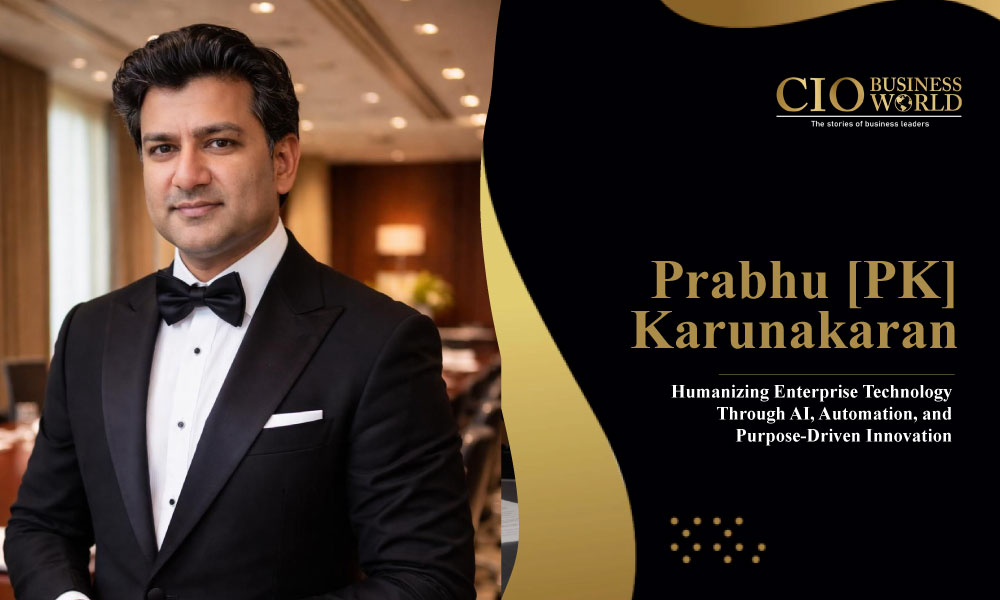
Prabhu [PK] Karunakaran Founder and CEO | Exterprise
Enterprise technology has long promised efficiency, scalability, and innovation. Yet for many organizations, the reality has often been far more complicated. Employees spend countless hours navigating fragmented systems, repetitive processes, and software environments that seem designed more for machines than for people. While technology has advanced at an extraordinary pace, the challenge of making enterprise systems intuitive, intelligent, and genuinely human-centered has remained unresolved for much of the corporate world.
Prabhu “PK” Karunakaran has spent his career trying to close that gap. As Founder and CEO of Exterprise, he has built a company around a direct premise: enterprise software should be an accelerator of human potential, not an obstacle to it.
Today, Exterprise works at the intersection of digital transformation, workflow automation, and Agentic AI. What began as a boutique consulting practice has grown into a ServiceNow Premier Partner with more than 550 professionals worldwide, including a ServiceNow practice of 75 or more certified specialists, operating across the United States, India, and Central America. In the third quarter of 2025, the company added Moveworks to its partner portfolio.
Building an Entrepreneurial Journey Rooted in Innovation
PK’s path into entrepreneurship began in 2009. He wanted to build teams, hire good people, and give them real opportunity: work that reached beyond a single country’s borders. What pulled him in from the start was the process itself: the challenges, the risk, and the reward of learning as he went rather than having every answer worked out in advance.
Before founding Exterprise, he built and exited two technology and BPO companies. Those experiences taught him a sharper understanding of what makes a company attractive to a buyer or investor, along with the patience to let a deal take the time it needs rather than rushing it.
The lesson he returns to most is broader than either of those. A company’s real value was never just its revenue. It was the team behind it, the intellectual property and technology it had built, and the culture holding it together. That conviction shaped exactly what he set out to build next.
Founding Exterprise
When PK founded Exterprise in 2015, the goal was direct: close the distance between what enterprise software could technically do and how difficult it actually was to use, day to day.
The path was not straightforward. Exterprise entered a market dominated by established legacy integrators with significant resources and longstanding reputations, and earning institutional trust took real proof. Every early client engagement was a chance to show that a leaner, more focused organization could outperform larger competitors through speed, dedication, and genuine value, not simply match their scale.
As cloud computing, automation, and artificial intelligence accelerated industry-wide, Exterprise evolved alongside them, moving from traditional cloud implementations into advanced automation, and eventually into the cognitive and autonomous systems the company works on today.
Eliminating the Software Tax on Human Creativity
PK has a name for what friction in enterprise systems actually costs: a software tax on human creativity. It shows up in the hours employees lose navigating inefficient systems, entering redundant data, and working around fragmented tools, time that could go toward real problem solving instead. He has also called it digital fatigue: the slow wear of adapting to software that was never built around how people actually think and work.
Every technology initiative at Exterprise is meant to start with the same question: how will this improve the experience of the person using it? That belief shows up most directly in UtterNow, Exterprise’s AI voice agent built specifically for ServiceNow environments. Rather than navigating a service portal, users can speak a request, log an incident, check a status, or trigger a workflow, and let the system carry it out. It sits alongside two of Exterprise’s own platforms:
ServOps, which brings incident management, configuration data, and playbooks into one system, and Omnitix, an AI-powered, omnichannel contact center built natively on ServiceNow.
Both run Exterprise’s own internal operations, its help desk, customer service, and telephony integrations with partners like Five9 and 3CLogic, before ever reaching a client. This demonstrates that the company practices what it recommends.
That same instinct shapes Exterprise’s work with nonprofits. Rather than stretching enterprise pricing and complexity to fit mission-driven organizations, the company has built lower-cost, purpose-made ServiceNow programs designed specifically for them, giving smaller teams access to tools usually reserved for far larger budgets.
A Family, Not a Workforce
One of the first things people notice about Exterprise is how PK talks about the people who work there. He refers to employees not as staff but as family, a philosophy that shows up in how the company actually runs: leadership built on trust and mentorship rather than a strict top-down hierarchy, and enough autonomy that high-performing professionals can take on complex problems without excessive oversight.
Failure, in that culture, is treated as information rather than a reason for blame. Mistakes become part of learning rather than something to hide, which the company credits with giving employees the confidence to take real risks. When someone on the team faces a hard time outside of work, colleagues tend to show up for them too, reinforcing a sense of belonging that carries directly into performance and loyalty.
Empathy shapes how the company treats colleagues, clients, and the nonprofit organizations it regularly supports through pro bono strategic consulting.
That instinct for detail, PK has said, traces back to something personal: his interest in horology, and the belief that the smallest details, in a watch or in a piece of client work, determine whether something holds up over time. Impact is the actual measure Exterprise uses to judge success, not revenue alone, but the outcomes a project creates for the people it touches. Ideas, in principle, are judged on merit rather than seniority. It’s part of an open culture PK has worked to build since the company’s earliest days.
Leading the Future of Agentic AI and Enterprise Automation
Looking ahead, PK sees Exterprise playing a growing role in enterprise technology’s next phase, continuing to push the boundaries of cognitive automation while advocating for AI development that stays accountable to the people it affects. He is especially engaged in mentoring the next generation of digital architects and entrepreneurs who will shape the industry in the years ahead.
The ambition is to become a global benchmark for Agentic AI and workflow orchestration, expanding beyond consulting into proprietary product development and intellectual property of its own, with an eye toward becoming a foundational technology partner for mid-market organizations specifically, rather than competing purely at the largest enterprise scale.
The near-term focus stays disciplined: managing complex deployments across its global teams, and helping organizations move from reactive automation toward proactive, autonomous workflows that free up time for higher-value work.
Finding Balance Through Family, Passion, and Perspective
Running a fast-growing company doesn’t leave much room to spare, but PK says balance isn’t about carving out hours. It’s about being fully present in the time he does have. Family sits at the center of that.
He calls his wife his greatest partner and supporter, and the two recently celebrated their twenty-fifth wedding anniversary during ServiceNow’s Knowledge conference in Las Vegas. He stays close to his son and daughter through travel, and regular visits to India keep him connected to his parents, sister, and extended family.
Outside of work, PK collects watches and cars, competes in high-performance driving events and track sessions, and has more recently taken up pickleball.
Advice for the Next Generation of Entrepreneurs
PK’s advice to aspiring entrepreneurs draws directly from his own path. Focus on solving problems that actually matter rather than chasing whatever trend is loudest. Treat entrepreneurship as an endurance rally rather than a sprint, since building anything worthwhile takes preparation, resilience, and a trusted support network.
Never lose empathy as the organization grows: supporting people and communities has to stay part of the culture, not something that gets cut once a company scales.
Success was never only about the financial outcome. It traces back to the same standard he applied when he sold his first two companies: measured less by the number on a term sheet and more by what was actually built.
Building a Future Where Technology Works for People
PK’s approach to enterprise technology has stayed remarkably consistent since 2009: software should serve the people using it, not the other way around. That belief carried him through two companies before Exterprise, and it has shaped every stage of Exterprise’s growth since, from a handful of early clients to a ServiceNow Premier Partner working across three continents.
As artificial intelligence continues to reshape the industry, his focus has not shifted. Technology, in his view, still comes down to a simple question: does this make someone’s work better?
Through Exterprise, and through the people and platforms he has built around that question, Prabhu “PK” Karunakaran continues to bet that the answer can be yes, one client, one workflow, one hire at a time.