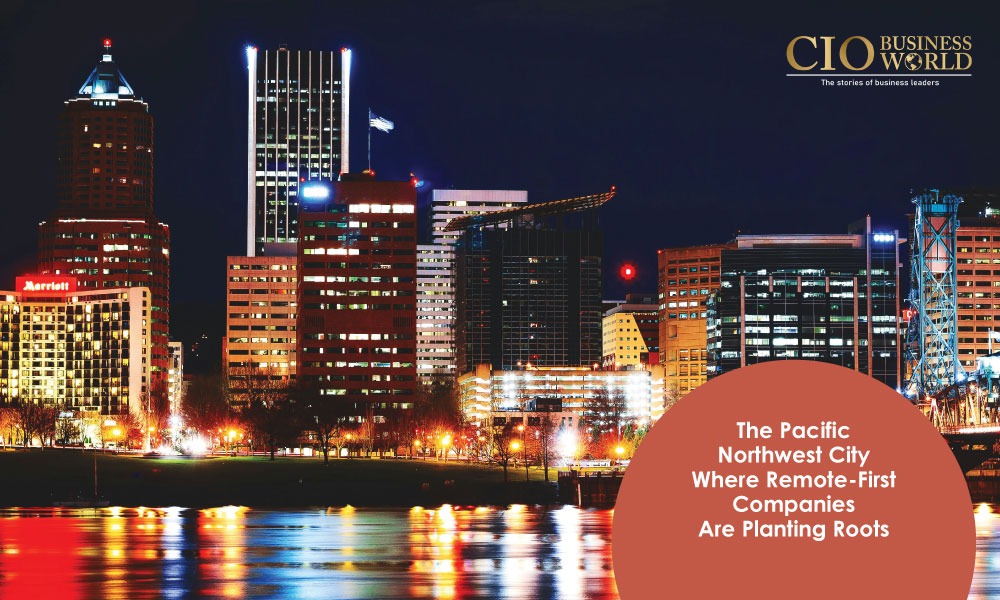
Portland, Oregon has emerged as an unexpected haven for remote-first companies seeking to establish their physical headquarters while maintaining distributed workforces.
The city’s combination of tech infrastructure, quality of life, and business-friendly environment is attracting companies that have reimagined how work gets done in the digital age.
The Silicon Forest Evolves Beyond Physical Presence
Long known as the “Silicon Forest” for its concentration of semiconductor and tech companies, Portland is experiencing a fundamental transformation.
The tech industry in Portland is booming in 2025, with an 8% growth rate in 2023, exceeding the national average.
But this growth looks different than previous decades. Rather than simply adding workers to crowded campuses, companies are establishing headquarters that serve as collaboration hubs rather than daily destinations for most employees.
Portland-based ConductorOne, founded by serial entrepreneurs and former Okta executives, has 40 engineers in SE Portland and nearly 200 employees worldwide.
The company exemplifies the new model where physical presence anchors corporate identity while the majority of work happens remotely. This arrangement allows companies to tap global talent pools while maintaining a strategic base in the Pacific Northwest.
Portland’s appeal for these relocating operations extends beyond simple cost calculations.
Portland is home to over 1,200 tech companies, and the city’s tech labor pool expanded by 28% from 2016 to 2021, with an estimated 73,100 new tech jobs expected by 2033.
The existing talent pipeline creates opportunities for in-person collaboration when needed while supporting predominantly remote operations.
Why Remote-First Companies Choose Portland
The decision to establish headquarters in Portland reflects careful strategic thinking by companies committed to distributed work. Unlike traditional tech hubs where high costs force companies to justify expensive office spaces, Portland offers a middle path. Companies can maintain a meaningful physical presence without the pressure to fill seats simply to justify real estate investments.
Average salaries range from $89,000 to $148,000, with roles in AI and cloud architecture commanding top compensation.
These figures represent genuine value propositions where employees can build comfortable lives without the crushing housing costs of San Francisco or Seattle. The same economic logic applies to companies establishing operations. Economic development initiatives in the region support businesses that contribute to the local economy without requiring massive workforce concentrations.
56% of companies offer hybrid work options, emphasizing employee satisfaction and innovation.
This statistic reflects a broader cultural shift in Portland’s business community. The city has become comfortable with flexible arrangements that previous generations of business leaders might have considered impractical.
Infrastructure Supporting Distributed Operations
Remote-first companies require different infrastructure than traditional businesses. Portland has adapted to meet these needs through investments in digital connectivity, coworking spaces, and occasional-use facilities.
The Seattle area concentration of experienced engineers from companies like Microsoft and Amazon who know how to “build and operate at massive scale” extends into Portland, where engineers have shipped real products at scale, not just written code.
The infrastructure extends beyond technology.
Portland added 1,435 people between July 2023 and July 2024, for an estimated population of nearly 635,750, according to the U.S. Census Bureau.
This stabilization after pandemic-era population loss signals renewed confidence in the region’s economic prospects.
Companies establishing headquarters in Portland benefit from the city’s position as a regional economic center with established business services, professional networks, and cultural amenities. The city offers the gravitas of a proper headquarters without requiring companies to compromise on their commitment to remote work.
The New Generation of Portland Tech Companies
The companies setting up shop in Portland represent diverse sectors unified by their embrace of distributed work models.
Portland-based Customer.io has a global team of 350 and has blown past $100M in ARR.
The company’s success demonstrates that remote-first operations can scale to significant size while maintaining Portland headquarters.
Portland-based Hydrolix has more than 200 employees, greater than 100% YoY growth, and $80M on the balance sheet, and is on track to surpass a $1 billion valuation.
These valuations rival companies with traditional concentrated workforces, proving the remote-first model’s viability for venture-backed growth companies.
Digital transformation strategies have become central to how these companies operate. Leadership teams in Portland embrace technology not just as a product but as the foundation of their operational model. This creates natural synergies between company missions and organizational structures.
Challenges and Opportunities Ahead
Portland’s emergence as a remote-first headquarters hub faces real challenges.
The region lost jobs last year while the national labor market grew substantially, and the losses were concentrated in high-paying sectors like manufacturing, professional services, and financial services.
The transition from traditional employment models creates friction even as new opportunities emerge.
In 2019, just under 8% of Portland’s workforce normally worked from home, and this decline seems to be a result of working from home approaching an equilibrium in negotiating the wants and needs between employees and employers.
This equilibrium represents a new normal rather than a temporary adjustment. Companies establishing headquarters in Portland must navigate this landscape where remote work is expected rather than exceptional.
The opportunity lies in Portland’s willingness to adapt. Unlike cities fighting to restore pre-pandemic norms, Portland is embracing its role as a center for companies that have fundamentally rethought how and where work happens.
The region was recently highlighted by Acara Solutions as “one of the country’s best at supporting fast-growth entrepreneurs”, indicating a healthy and supportive startup ecosystem.
Building Community in a Distributed World
Remote-first companies face unique challenges in building organizational culture and community connections. Portland’s compact downtown, vibrant neighborhoods, and strong sense of place provide natural gathering points when distributed teams need face-to-face interaction.
Workers in the Portland-Vancouver-Hillsboro area had an average hourly wage of $36.77 in May 2024, compared to the nationwide average of labor statistics data of $32.66.
Companies are discovering that maintaining a headquarters in Portland creates identity and connection points that purely virtual operations struggle to achieve. The physical space serves as a symbol and occasional gathering place rather than a daily requirement. This approach satisfies both the practical demands of distributed work and the human need for place-based identity.
The broader Portland community benefits when companies choose to establish roots rather than remaining entirely virtual. Local spending, civic engagement, and cultural participation all increase when companies maintain meaningful local presence even with predominantly remote workforces.
Portland’s transformation into a hub for remote-first companies reflects broader changes in how businesses operate and where they choose to establish themselves. The city offers a compelling combination of talent, infrastructure, quality of life, and cultural acceptance of distributed work models. As more companies embrace remote-first operations while recognizing the value of physical headquarters, Portland’s positioning as a Pacific Northwest anchor for this new model appears increasingly strategic. The companies planting roots here today are defining what headquarters means in an age when presence is optional but place still matters.