According to reports, China is considering export restrictions on important solar manufacturing equipment, a move that could alter global supply chains for renewable energy and increase rivalry with the United States. The possible limitations occur at a time when both economies are vying for control of the renewable energy industry, particularly solar technology, in which China already has a significant advantage.
A strategic change is indicated by the debate about restricting China’s exports of solar cells, sophisticated panel gear, and essential production tools. One of Washington’s key aims under its clean-energy strategy is the expansion of American solar manufacturing, which might be slowed down if these restrictions are put into place.
China’s Place in the World Solar Industry
China’s solar exports have influenced the world’s renewable energy scene for more than ten years. The nation accounts for about 80% of global production of:
Wafers for solar
Solar cells
Solar panels
Because of this supremacy, China’s exports of solar modules are vital to Asia as well as the US and Europe, where demand for solar installations is still rising.
China’s possible action is consistent with its larger plan to keep strict control over sectors deemed essential to the country’s competitiveness and energy security. Solar manufacturing equipment is becoming the newest tool of geopolitical leverage, much as China’s restrictions on the export of critical minerals, which upset international supply chains for semiconductors and electric car components.
The Reasons Behind China’s Export Limitations
Beijing seems driven by a number of factors:
1. Preserving its technological advantage
Chinese businesses have made significant investments in cutting-edge solar manufacturing technologies. This competitive advantage is maintained by restricting the export of high-precision machinery.
2. Reacting to growing pressure from the US
China’s hegemony has been called into question by recent US actions, such as import limitations and tax breaks for domestic solar manufacture. Export restrictions provide a tactical counterbalance.
3. Fortifying foundations for national security
China sees important technology as sensitive assets that need regulated worldwide access as solar energy becomes essential to economic resilience.
Effect on the US: Upcoming Supply Chain Stress
Despite significant federal efforts to localize clean-energy supply chains, the US is still largely dependent on Chinese solar production. There could be a number of repercussions if China places limitations on industrial equipment:
1. A slower rate of production of home solar panels
For large-scale production of wafers, cells, and modules, US firms rely on Chinese gear. Production schedules could go longer in the absence of reliable access.
2. Increased installation expenses
A limited supply chain might make solar installations more expensive nationwide, which could impede the country’s progress toward its renewable energy goals.
3. The need to expedite domestic production
To close the gap, the US might provide incentives for regional equipment producers, however it might take years to develop this competence.
The global market for renewable energy is at a turning point.
Industry experts warn that China’s action could have long-term effects on the world’s energy markets. Although some nations might go to other suppliers, it is very challenging to match China’s size and level of technological expertise.
If China’s manufacturing exports are restricted, developing countries that depend on inexpensive solar solutions may also experience delays or higher costs. Global progress toward climate action milestones may be hampered by this.
Industry Reaction and Strategic Prospects
US solar industry organizations contend that these limitations highlight how urgent it is to diversify supply chains. In response, policymakers could:
Increasing subsidies for domestic manufacturing Developing alliances with substitute suppliers in Vietnam, Malaysia, and India Investing more in R&D to lessen dependency on Chinese technology
The restrictions would strengthen China’s hold on the world solar market, but they might also hasten international efforts to reduce reliance on rare-earth materials.
What Will Happen Next?
The solar industry has turned into a battlefield for scientific and economic dominance as both nations expand their aspirations for clean energy. China’s possible export limitations represent a turning point that could either further solidify China’s dominance or encourage the globe to move toward more scattered manufacturing.
Manufacturers, markets, and politicians are currently keeping a careful eye on Beijing’s ultimate choice. The result may determine how renewable energy is developed globally over the next ten years.
Reliable testing methods are essential for guaranteeing compatibility, accuracy, and performance across industries in the rapidly changing field of Time-Sensitive Networking (TSN). VIAVI Solutions has become a reputable supplier, enabling businesses to successfully complete TSN testing with their M1 Appliance and TTworkbench software. These solutions, which are known for their Avnu-certified testing capabilities, expedite development cycles and simplify intricate testing procedures in a variety of industries, from industrial automation to automotive Ethernet testing.
The Significance of TSN Testing
In mission-critical settings, such as automotive, industrial, and audio/video systems, Time-Sensitive Networking is revolutionizing device communication. Real-time performance and operational dependability are made possible by deterministic networking, which guarantees that data packets arrive predictably.
Compliance and interoperability testing are critical for businesses implementing TSN-enabled equipment. VIAVI’s solutions and other certified test tools minimize errors, save time, and give assurance that goods fulfill strict industry standards.
Spirent Integration and VIAVI Solutions
In order to guarantee thorough TSN testing coverage, VIAVI Solutions has partnered with industry experts like Spirent Test Center. By integrating TTworkbench’s analytical capabilities with Spirent’s network emulation features, engineers may take advantage of VIAVI Spirent compatibility. Teams may more easily find any bottlenecks, latency problems, and compliance gaps thanks to this synergy in automotive Ethernet testing.
While VIAVI Solutions offices across the world, including those in Chandler and the UK, offer localized support and knowledge, organizations can quickly create reliable test environments with tools like Spirent Test Center Download.
Key Features of the M1 Appliance and TTWworkbench
For TSN components, VIAVI’s M1 Appliance and TTworkbench software provide high-precision testing capabilities:
Avnu-Certified Testing: Verifies that parts adhere to international interoperability standards.
Automated Test Suites: Cut down on errors and manual configuration time.
Comprehensive Reporting: Gives engineers and project managers useful information.
Flexible Deployment: Enables production and lab settings in a variety of industries.
Because of these features, TTworkbench and M1 Appliance are perfect for professional audio/video system developers, automakers, and industrial manufacturers who want to verify TSN readiness.
Worldwide Reach and Assistance
VIAVI Solutions, which has offices in Chandler, UK, and other key regions, offers clients adopting TSN testing programs comprehensive technical assistance and consultancy. Their HSE-certified instruments (VIAVI HSE) provide quality and safety in testing settings, strengthening trust in TSN compliance initiatives.
Integrating VIAVI TestCenter with Spirent or independent lab settings offers quantifiable productivity gains for companies looking to speed up product releases and optimize test cycles.
TSN Testing’s Future
The need for accurate, scalable, and dependable TSN testing solutions will increase as more sectors use deterministic networking. VIAVI Solutions keeps innovating by providing tools that not only satisfy current testing requirements but also foresee future demands, such as enhanced professional AV deployments, industrial IoT integration, and automotive Ethernet extension.
Organizations can implement high-performance, compliant networks with confidence, guaranteeing real-time communication and operational excellence, by unlocking the success of TSN testing.
For the networking sector, Unlocking TSN Testing Success with VIAVI Solutions is an important turning point. Businesses can confidently create dependable, high-performance TSN networks by utilizing Avnu-certified products like TTworkbench and M1 Appliance in conjunction with Spirent Test Center integration. VIAVI Solutions enables engineers to achieve strict requirements while accelerating innovation in a variety of fields, including professional AV systems, industrial automation, and automotive Ethernet testing.
By Dr. Channing L. Collins | Child Welfare & Public Policy Expert | Strategic Reform Leader | Founder, The Collins Institute for Child & Family Systems | Architect of the Family Systems Innovation Lab
Every year, policymakers introduce new reforms intended to modernize public systems, improve outcomes, and respond to urgent social challenges. The ideas are often well researched and widely supported. Yet far too often, even promising reforms fail to produce the results they were designed to achieve.
When failure occurs, the explanation usually centers on politics, funding, or resistance to change. Rarely do we confront a more fundamental issue: many reforms fail because we underestimate how difficult it is to implement change inside complex human systems.
Few systems illustrate this challenge more clearly than child welfare.
Child welfare agencies operate at the intersection of law, public policy, human behavior, and community services. Caseworkers make high-stakes decisions about child safety, family preservation, and placement stability under intense scrutiny and often with limited resources. Over the past two decades, policymakers have introduced numerous reforms intended to improve outcomes—expanding prevention services, modernizing data systems, and introducing new accountability measures.
Many of these reforms are thoughtful and necessary. Yet implementation often struggles.
The problem is not a lack of good ideas. It is the assumption that policy design alone will produce meaningful change.
In reality, policy is only the starting point. Execution is where reform succeeds or fails.
In child welfare, implementation challenges often emergeimmediately when policy meets practice. New laws may require agencies to expand prevention services, but local providers may lack the capacity to deliver those programs. Data systems may generate detailed dashboards, but frontline workers may not have the time or training to interpret them. Leadership may introduce new decision-making protocols, but existing organizational structures may not support consistent application.
These gaps are not simply administrative oversights. They reflect a broader systems problem.
Public systems—particularly those involving human services—are deeply interconnected. Technology platforms, workforce structures, policy mandates, and community relationships all interact in ways that cannot be easily separated. Changing one component without aligning the others can unintentionally create new barriers rather than solving existing ones.
This is why technology alone cannot solve systemic challenges.
In recent years, governments and organizations have invested heavily in data modernization, predictive analytics, and digital transformation initiatives. These tools hold significant promise. Improved data visibility can help leaders identify patterns, allocate resources more effectively, and respond to emerging risks.
But technology cannot compensate for structural misalignment within a system.
If frontline staff are overwhelmed by caseloads, new dashboards will not improve decision quality. If leadership structures slow decision-making, real-time data will not accelerate action. And if communities do not trust the institutions responsible for delivering services, even the most advanced tools will struggle to produce meaningful impact.
Technology can support reform, but it cannot substitute for systems design.
What complex systems require is an implementation strategy that aligns policy, workforce capacity, decision-making authority, and operational workflows. Without that alignment, even well-intentioned reforms risk becoming another layer of policy guidance that never fully translates into practice.
Child welfare systems across the country are currently navigating exactly this challenge. Federal legislation has encouraged states to expand prevention services and reduce unnecessary family separation, while also maintaining strong child safety protections. Achieving both goals simultaneously requires more than compliance with new rules—it requires rethinking how systems operate day to day.
That includes examining how cases are prioritized, how workers are trained and supported, how conflicts are resolved within decision-making processes, and how community voices are integrated into system design. It also requires acknowledging that implementation cannot be treated as an afterthought.
Too often, reform conversations focus heavily on policy design while devoting far less attention to the operational realities of implementation. Yet it is in those operational details—staffing structures, decision authority, workflow design, and community engagement—where reform either succeeds or fails.
This lesson extends far beyond child welfare.
Across sectors, organizations are confronting increasingly complex challenges that cannot be solved through policy announcements or technology investments alone. Whether addressing healthcare delivery, education reform, or social services modernization, leaders must recognize that meaningful change requires aligning multiple components of a system simultaneously.
Policy creates direction. Technology can provide tools. But implementation determines outcomes.
If we want reform efforts to succeed whether in child welfare or other complex public systems, we must begin treating implementation as the central challenge rather than the final step. That means investing not only in innovative ideas, but also in the organizational capacity, workforce support, and systems design required to carry those ideas forward.
Increasingly, this is where the conversation about reform must move from policy design to implementation strategy. Through my work with the Collins Institute for Child & Family Systems, I focus on exactly this intersection: helping leaders bridge the gap between policy ambition and real-world execution.
Concerns about inflation, supply security, and economic stability have once again surfaced due to oil prices above $100 per barrel. Many are wondering, “What does economy oil mean?” and “What does oil do to the economy?” as corporations and governments keep an eye on the surge. The explanation is straightforward: everything is shaped by oil.
Oil affects everything from industry and transportation to food logistics and energy systems, which in turn affects living expenses and the rate of global expansion. Economies must reevaluate resilience, efficiency, and alternatives like 100% sustainable fuel when prices spike.
Why It Matters for Every Economy When Oil Reaches $100
The most important commodity in the planet is oil. Fuel, shipping, and production costs all increase as a result of high prices. Because oil is both a gauge of geopolitical conflict and a catalyst for inflation, analysts often debate “what economy oil” represents.
Several economic repercussions could place when crude prices surpass $100:
Airlines, shipping, road freight, and individual mobility are all impacted by the rising cost of transportation. Manufacturing prices are rising, particularly for businesses that rely heavily on petrochemicals. Due to expensive transportation and supply lines powered by diesel, food costs are rising. National finances are strained as government subsidies increase.
Global Markets React: Pressure on Inflation Increases
Economies are pushed toward inflationary pressures when oil prices are $100. Governments try to stabilize markets, businesses hike prices, and households cut back on spending.
Economists caution that countries with insufficient oil reserves could face the following if high prices continue:
Deficits in trade
Reduced GDP growth
Depreciation of currency
Increased interest rates
While countries that export oil profit from higher revenue, emerging economies are more severely impacted.
Is There Any Use for $100 Oil?
“What is 100 oil good for?” is a common question. Expensive oil may appear detrimental, but it can also speed up:
Adoption of renewable energy
High costs force countries to switch to EVs, green hydrogen, advanced biofuels, and 100% sustainable fuel.
Innovation in transportation and business
Companies spend money on:
Manufacturing that uses less energy Fleets of electric vehicles Strategies for energy independence and low-carbon logistics
Countries increase reserves, diversify their supply chains, and lessen their reliance on imports.
Thus, $100 oil can indirectly accelerate long-term resilience and cleaner technology.
What Does the Future Hold for 100% Sustainable Fuel?
Global energy is changing due to the emergence of greener alternatives. Fuels that come totally from carbon-neutral, low-emission, or renewable sources are referred to as 100% sustainable fuels.
Examples consist of:
High-tech biofuels Artificial fuels Green hydrogen
By lowering reliance on unstable oil markets, these alternatives help lower emissions, provide energy security, and stabilize prices.
How Customers Can Adjust: Making the Most of a High-Oil World
Households need to reconsider fuel use when oil prices rise. People frequently inquire: “How might you cut costs and use less oil if it became extremely expensive?”
Among the useful tactics are:
Taking public transportation or carpooling
Changing to hybrid scooters or electric cars
Cutting back on long-distance travel
Making effective route plans
Maintaining automobiles to maximize fuel efficiency
Choosing gadgets that use less energy
Encouraging regional goods to reduce the impact of transportation
Personal expenses and the impact on the environment are decreased by even little adjustments.
Comprehending “100 Percent Oil Life”
“What does 100 percent oil life mean?” is a common misconception among consumers. When it comes to car maintenance, this indication indicates how long the engine oil will last—not that it is “full,” but rather that it is brand-new or recently changed. Keeping an eye on oil life guarantees fuel economy and safeguards engines during periods of high fuel costs.
A Pivotal Moment for World Energy
More than just a market phenomenon, oil exceeding $100 portends a future in which countries will need to invest in diversification, consumers will need to adopt more intelligent habits, and industry will need to develop more quickly than before. It is becoming necessary, not discretionary, to comprehend “what does oil do to the economy.” This might be the start of a long-term shift toward greater energy independence and economic stability as nations shift toward greener alternatives like 100% sustainable fuel.
Both domestic and international passengers will be impacted by new baggage policy changes announced by American Airlines. The airline is updating its rates, including those for checked and carry-on baggage, in response to growing operating costs and changing travel preferences. To avoid unpleasant surprises at the airport, travelers in Basic Economy and other fare classes should be aware.
Updates on American Airlines Checked Bag Prices
American Airlines will raise the cost of checked bags on domestic flights by $5 to $10 per bag starting this month, depending on the route and fare class. The cost of international flights varies according to the weight and location. “How much does American Airlines charge for international baggage?” is a common question from travelers. The first checked bag usually costs between $60 and $100, depending on the itinerary. Higher fees apply to additional bags and overweight items.
Travelers can save money by paying for their international luggage online in advance, which is typically less expensive than airport fees. To prevent unforeseen costs, American Airlines advises passengers to verify their baggage allowances prior to departure.
What You Should Know About Carry-On Baggage
American Airlines has more stringent carry-on baggage weight regulations for Basic Economy travelers. Passengers in Main Cabin are permitted to bring regular carry-ons, although Basic Economy passengers can be subject to limitations. “Does American Airlines charge for carry-on baggage basic economy?” is a common query. For Basic Economy, the airline permits one personal item; however, a full-size carry-on may cost extra.
The carry-on cost for Basic Economy travelers on American Airlines varies by route and can be between $30 and $50. Before taking a flight, it’s crucial to know your fare class and the relevant baggage regulations, particularly for foreign travel.
Limitations on Weight on Both Domestic and International Flights
It’s essential to comprehend American Airlines baggage weight restrictions in order to save extra costs. While international flights frequently permit up to 70 pounds per bag, depending on the destination, domestic checked baggage should normally not weigh more than 50 pounds. Before packing, passengers should confirm their American Airlines international baggage weight allowance because overweight and oversized bags are subject to additional fees.
The limit weight for carry-on luggage is typically forty pounds, though this can vary significantly based on the aircraft and route. Carry-ons that are too heavy could have to be examined at the gate, which would cost extra.
How to Reduce Baggage Charges
By making reservations online, inspecting their luggage in advance, and being aware of weight restrictions, travelers can cut expenses. Here are some pointers:
To save money, use American Airlines’ online international baggage payment service. To avoid exceeding the American Airlines checked bag pricing thresholds, pack effectively. If at all possible, combine products into a single bag to prevent additional fees. Participate in AAdvantage loyalty programs, which occasionally offer free luggage allowances.
Plan Ahead to Prevent Additional Charges
Almost all travelers, both domestic and foreign, are impacted by American Airlines’ attempt to raise luggage fees. Travelers can plan ahead and prevent last-minute costs by being aware of American Airlines carry-on baggage weight, American Airlines checked bag fee, and other regulations. Keeping yourself informed guarantees a more seamless travel experience and avoids unexpected airport expenses.
Singapore’s digital economy runs on critical infrastructure—energy, finance, healthcare, transport—systems that must remain secure, resilient, and always available. As cyber threats grow more sophisticated, regulators are raising the bar.
With the introduction of the Cybersecurity Code of Practice (CCoP) 2.0, the Cyber Security Agency of Singapore has made a decisive shift: cybersecurity is no longer just about compliance—it is about proven resilience.
For CIOs and CISOs, this changes everything.
The Shift from Compliance to Proof
CCoP 2.0, introduced in July 2022, builds on earlier frameworks but significantly expands both scope and expectations. It now covers a broader range of systems—including cloud, operational technology (OT), and emerging digital environments—while strengthening requirements across governance, risk management, and technical controls.
But the real transformation lies in how compliance is evaluated.
Historically, organizations focused on:
Implementing required controls
Documenting policies and procedures
Under CCoP 2.0, that is no longer sufficient.
Organizations must now:
Continuously validate controls
Demonstrate effectiveness in real-world conditions
Provide audit-ready evidence at any time
This represents a move toward evidence-based cybersecurity, aligning with global regulatory trends. In short, it’s no longer about whether controls exist—it’s about whether they work.
The Four Priorities CIOs Must Get Right
While CCoP 2.0 spans multiple domains, its requirements converge into four strategic priorities for leadership teams.
1. Cybersecurity as an Executive Responsibility
Cybersecurity governance is now firmly a leadership mandate.
Organizations must:
Define clear ownership across teams
Align cybersecurity strategy with business risk
Ensure consistent reporting to senior leadership
This elevates cybersecurity from a technical function to a core business discipline.
2. Continuous Risk Management
Annual audits and periodic assessments are no longer enough.
CCoP 2.0 requires:
Ongoing risk assessments
Continuous vulnerability identification
Rapid adaptation to new threats
Security must operate as a continuous lifecycle, not a checkpoint.
3. Identity and Access Control at the Core
Modern attacks increasingly target identities rather than infrastructure.
As a result, organizations must enforce:
Role-based access control (RBAC)
Multi-factor authentication (MFA)
Strict governance over privileged access
Identity is now the primary control plane for security.
4. Segmentation and Full Visibility
Especially in critical infrastructure, attackers rarely strike directly—they move laterally.
CCoP emphasizes:
Network segmentation (including OT environments)
Monitoring of all access and activity
Comprehensive logging for audit and investigation
Without visibility, compliance—and security—breaks down.
The Execution Challenge: Complexity
While the intent of CCoP 2.0 is clear, implementation often introduces a new problem: operational complexity.
In many organizations, compliance efforts result in:
Multiple overlapping security tools
Disconnected visibility across systems
Manual processes for access and approvals
Gaps between IT, OT, and database security
Ironically, the pursuit of compliance can create fragmentation.
This leads to a critical issue:
The more tools deployed, the harder it becomes to maintain consistent security—and prove compliance.
Why Even Mature Organizations Struggle
Even well-resourced enterprises encounter recurring obstacles when implementing CCoP.
Fragmented Security Architecture
Security controls are distributed across multiple systems that do not integrate effectively, leading to blind spots.
Privileged Access Risks
Many organizations secure networks and servers but overlook databases—where the most sensitive data resides.
Lack of Continuous Evidence
Audit preparation becomes reactive, requiring teams to gather logs and records from disparate systems.
Operational Overhead
Security teams spend more time managing tools than improving actual security posture.
These challenges highlight a key reality: compliance is not just a technical problem—it is an operational one.
A Unified Approach to CCoP Compliance
To address these challenges, organizations are increasingly moving toward consolidated security architectures.
Rather than relying on separate tools, a unified platform enables:
Access Control (CCoP 5.1–5.3) Centralized role-based access with enforced least privilege
Privileged Access Management Multi-factor authentication with approval workflows that eliminate self-approval risks
Network Microsegmentation (CCoP 5.5) Fine-grained segmentation across systems to prevent lateral movement
Secure Remote Access (CCoP 5.7) Encrypted, controlled access to critical systems and infrastructure
Database Activity Monitoring (CCoP 5.13) Full visibility into database queries and actions
Logging and Monitoring (CCoP 6.1–6.2) Centralized audit trails and anomaly detection
By consolidating these capabilities, Mamori.io helps organizations reduce complexity while improving both security posture and compliance readiness.
Turning Compliance into Advantage
Forward-looking organizations are beginning to treat CCoP 2.0 not as a regulatory burden, but as a strategic opportunity.
When implemented effectively, it delivers:
Stronger operational resilience
Faster detection and response to incidents
Improved audit readiness
Greater trust with regulators and stakeholders
In critical sectors, trust is not optional—it is foundational to business continuity.
A Practical Path Forward for CIOs
To navigate CCoP 2.0 effectively, CIOs should focus on execution, not just intent.
1. Conduct a Real Gap Assessment
Evaluate not just policies, but actual control performance and effectiveness.
2. Align Security with Business Risk
Prioritize controls that protect critical operations and services.
3. Reduce Tool Sprawl
Consolidate security functions where possible to eliminate blind spots.
4. Enable Continuous Validation
Implement ongoing monitoring and testing to ensure controls remain effective.
5. Unify Visibility Across Systems
Ensure consistent visibility across IT, OT, and data layers—especially databases.
Final Thought
CCoP 2.0 reflects a broader evolution in cybersecurity:
From asking, “Are you compliant?” to demanding, “Can you prove your defenses actually work?”
Organizations that embrace this shift—by simplifying their architecture, strengthening identity controls, and unifying visibility—will not only meet regulatory requirements.
They will build resilient, future-ready infrastructure capable of withstanding the next generation of cyber threats.
The world of business tech moves fast. Most companies will face new hurdles in how they stay online. Staying ahead of these changes helps avoid downtime.
It keeps teams working without interruptions. Every leader needs to think about the future today. Preparing early makes the transition easier for everyone involved. New tools will change how we share data across the globe.
Choosing The Right B2B Partner
Selecting a networking partner is a big decision for any firm. Whether you use Gamma Communications or a different B2B partner, the reliability of the link matters most. Every company needs a plan that scales.
Finding a provider that understands your specific goals is a key step. Trust forms the base of these relationships. You need a partner who communicates clearly about updates and outages. Transparency helps you plan your own business moves with confidence.
Shifting To Intelligent Connected Systems
Networks are changing from simple wires to smart setups. One industry report mentioned that the sector is moving from building networks to managing a connected system intelligently. It moves away from rigid hardware towards flexible software solutions.
Smart systems learn from user habits. They can adjust traffic themselves. This helps prevent slow speeds during busy hours. AI-driven tools can spot issues before a human even notices a lag. They provide a seamless experience for all employees.
Economic Gains From Better Access
Connectivity fuels more than just internal emails. An academic journal recently highlighted that a 10-percentage point rise in broadband penetration raised annual per-capita GDP growth by 0.9 to 1.5 percentage points. This shows how fast the internet helps the wider world. It creates jobs and opens up new markets for small firms.
Local economies thrive when businesses stay linked. Faster speeds lead to more sales. It allows for new types of digital trade. Communities with strong networks attract more investment from outside. This growth benefits everyone in the area.
High Scale Enterprise Platforms
Large firms need tools that can handle massive amounts of data. Recent software comparisons have noted that carrier-grade platforms excel in handling high scales for enterprise needs.
These systems keep things stable even when thousands of people log in at once. They are built to resist crashes during peak traffic times.
Stability is key for cloud-based work. High-scale platforms reduce the risk of crashes. They offer a solid base for growing firms. Redundancy makes sure that if one part fails, another takes over instantly.
Planning For Infrastructure Growth
Old cables can hold back even the fastest fiber links. Replacing dated gear is a smart move in 2026. It makes sure that every desk gets the full speed available. Physical upgrades are just as important as software updates.
Update all hardware to support 10-gigabit speeds.
Train staff on updated security protocols.
Review data usage patterns every month.
Invest in backup power for critical servers.
Test your disaster recovery plan twice a year.
Wireless tech is getting a big boost. Newer routers handle more devices at the same time. This is perfect for offices with many laptops and phones. Guest networks should be kept separate to keep your main data safe.
Security Standards For Next Year
Cyber threats are getting more complex every day. Protecting your data requires the latest encryption tools. These tools shield sensitive info from prying eyes. Using multi-factor authentication is a standard practice now.
Privacy is a top priority for customers. Strong security builds trust with your clients. It prevents costly data breaches. Insurance companies often require proof of high security before they offer a policy. Regular audits help you find weak spots in your defense.
Staying updated on emerging threats helps you adapt your defenses before issues arise. Employee training is important, as human error remains a common security risk. Implementing access controls guarantees that only authorized users can reach sensitive data.
Backup systems provide a safety net in case of ransomware or system failure. A proactive security strategy keeps your business protected and resilient in the face of evolving cyber risks.
Building For Remote Workforce Growth
Many teams now work from different locations. Connectivity must reach beyond the main office walls. VPNs provide a safe tunnel for data to travel through.
Video calls need high bandwidth to stay clear. Low lag helps meetings feel more natural. It keeps remote workers feeling like part of the team. Good audio and video quality reduces fatigue during long work sessions.
Flexible working is here to stay. Your network needs to support people moving between the office and home. Cloud-based apps allow staff to work from anywhere with an internet connection.
Businesses that adapt now will stay ahead of the curve. Making the right choices today leads to a stronger tomorrow.
Keep an eye on new tech as it arrives. Your network is the backbone of your success. Strategic planning makes sure that you are ready for whatever comes next.
Cryptocurrency has crossed a threshold. What began as a niche asset class confined to speculative retail portfolios is now a line item in corporate treasury reviews, a tool for cross-border payment optimization, and a technology layer being formally evaluated by CFOs and CIOs across industries. In 2026, the question for business leaders is no longer whether digital assets warrant attention — it is how to engage with them strategically.
The Institutional Shift Is Already Underway
The past three years have produced a measurable change in how enterprises approach crypto. Publicly traded companies have added Bitcoin to their treasury reserves as a hedge against fiat depreciation. Payment processors have integrated stablecoin rails to accelerate settlement and reduce intermediary costs. Asset managers have launched regulated crypto funds for institutional clients. These are not isolated experiments — they represent a structural recalibration of how organizations think about liquidity, currency exposure, and digital infrastructure.
In 2026, that recalibration is accelerating. Improved regulatory frameworks across major jurisdictions, the widespread adoption of proof-of-reserve standards, and the maturation of compliant trading infrastructure have collectively lowered the barrier to corporate adoption. For business leaders who have been observing from the sidelines, the calculus for waiting is becoming harder to justify.
Three Areas Where Crypto Creates Business Value
Treasury and Reserve Management. Holding a portion of corporate reserves in Bitcoin or dollar-pegged stablecoins offers a hedge against local currency depreciation and enables faster capital deployment across global operations. For companies with significant exposure to emerging market currencies, stablecoin positions provide a practical liquidity buffer without requiring conversion into a third-party fiat currency.
Cross-Border Payments and Settlement. Traditional international wire transfers carry fees of 3% to 8% (according to World Bank remittance data) and settlement windows of two to five business days. Blockchain-based payment rails can reduce both substantially — fees approaching zero, settlement near-instant. For organizations with international supplier networks, distributed payrolls, or high-volume cross-border transactions, this is a material operational improvement with a clear ROI calculation.
New Revenue and Customer Engagement. Businesses integrating crypto-native features — reward programs denominated in digital assets, embedded trading capabilities, or crypto-linked card products — are gaining measurable traction with a digitally fluent customer segment. The integration of crypto into loyalty and payments infrastructure is increasingly treated as a retention and acquisition lever rather than an experimental feature.
Evaluating Platform Infrastructure: What Enterprises Need
Executing on any of the above requires access to reliable, compliant trading and custody infrastructure. Enterprise evaluation criteria differ significantly from retail considerations. Regulatory standing, proof of reserves, fee structure, API reliability, and product depth matter more than interface design.
Platforms operating under registered compliance frameworks — including FinCEN MSB registration in the United States and AFSL licensing in Australia — provide the baseline that corporate legal and finance teams require before onboarding any digital asset counterparty. Published proof of reserves, verified periodically with over 1:1 asset backing, replaces trust with auditable data. Fee structure matters at scale: even small differences in maker and taker fees compound significantly across institutional-volume flows.
Security architecture is non-negotiable. Cold storage for the majority of assets, multi-party approval requirements for large transactions, enforced two-factor authentication, and wallet whitelisting are structural controls that separate credible platforms from those carrying operational risk that compliance teams cannot accept.
Enterprise Crypto Platform Checklist
Criterion
What to Verify
Why It Matters
Regulatory registration
FinCEN MSB, AFSL, or equivalent
Legal standing in operating jurisdictions
Proof of reserves
Independent verification, >1:1 backing
Auditable solvency, no hidden liabilities
Cold storage
>90% of assets offline
Protection against exchange-level breaches
API uptime SLA
99.9% minimum, redundant infrastructure
Reliable execution for automated strategies
Institutional fee tiers
Volume discounts, VIP arrangements
Cost efficiency at enterprise trading volumes
What Institution-Ready Infrastructure Looks Like in Practice
One platform that meets enterprise evaluation criteria across compliance, security, and product depth is BYDFi. Celebrating its sixth year of operation in 2026, BYDFi has grown from a 2020 launch into a globally recognized exchange serving over one million registered users across 190+ countries. In an industry still defined by high failure rates and regulatory uncertainty, a six-year operational track record without a major security incident is itself a meaningful data point for institutional due diligence.
Regulatory Standing and Compliance Infrastructure
BYDFi’s compliance posture is among the most clearly documented in the industry. The platform holds FinCEN Money Services Business registration in the United States and maintains AFSL licensing in Australia — two of the most demanding regulatory environments for digital asset businesses. Its membership in South Korea’s CODE VASP Alliance extends that compliance footprint into the Asia-Pacific market, providing regulatory backing for organizations with operations across multiple regions.
Compliance infrastructure extends beyond licensing. BYDFi operates KYC and AML procedures built to international standards, conducts regular compliance audits, and engages proactively with regulatory bodies. For corporate legal and finance teams, this translates directly into reduced counterparty risk and a shorter path to internal approval for onboarding.
Security Architecture and User Protection
BYDFi’s security model reflects institutional expectations rather than retail minimums. The platform stores the majority of assets in cold wallets with strict whitelisting requirements, enforces multi-party approval for large outbound transactions, and maintains mandatory two-factor authentication across all accounts. An 800 BTC User Protection Fund, established in 2025, provides an additional buffer against operational risk scenarios — a feature that compliance teams increasingly treat as a prerequisite rather than a differentiator.
Published Proof of Reserves, independently verified at over 1:1 asset backing, replaces trust-based assurances with auditable data. This matters particularly in the post-FTX environment, where institutional decision-makers now require verifiable reserve documentation before approving any exchange relationship. BYDFi’s periodic public reporting on reserves represents exactly the kind of structural transparency that enterprise counterparty risk frameworks demand.
The platform’s partnership with Ledger on a co-branded hardware wallet — announced in 2025 — signals a commitment to institutional-grade custody standards that extends beyond the exchange environment itself. For organizations that require self-custody options alongside trading access, this integration provides a coherent end-to-end solution.
Product Depth and Fee Structure
BYDFi’s trading infrastructure supports 600+ cryptocurrencies, 1,000+ spot trading pairs, and 500+ perpetual futures contracts — a product breadth that covers both mainstream institutional positions and access to emerging asset categories. Spot trading fees are set at 0.10%, with futures maker fees starting at 0.02% on USDT-margined contracts. At institutional trading volumes, the compounding effect of those fee differentials is material: a 0.08% difference in maker fees on USD 10 million in monthly futures volume represents USD 8,000 in cost savings per month, or nearly USD 100,000 annually.
The platform’s fee structure also includes volume-based tier discounts, providing additional incentives for high-frequency or high-volume business users. VIP-tier arrangements are available for organizations requiring customized fee schedules and dedicated account management.
Automated Strategies and Institutional Execution
For organizations that require systematic, rules-based execution rather than discretionary trading, BYDFi’s automated strategy suite covers the primary use cases. Grid trading bots handle range-bound market conditions by placing buy and sell orders at regular intervals — a framework directly applicable to treasury managers seeking to systematically accumulate or distribute positions without manual timing decisions. DCA bots enable programmatic position building over time, reducing execution risk for organizations deploying larger capital allocations.
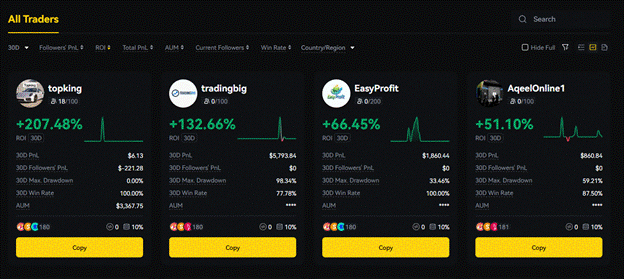
Smart Copy Trading allows organizations to mirror the strategies of vetted professional traders, providing automated market exposure without the need for proprietary quant infrastructure. For businesses that want systematic crypto exposure without building an internal trading desk, this offers a deployable solution with professional-grade oversight and a clear audit trail for internal governance purposes.
Enterprise-Relevant Product Launches: MoonX and BYDFi Card
Two 2025 product launches are directly relevant to enterprise strategy.
MoonX, BYDFi’s on-chain trading engine, brings centralized exchange-level speed and security to decentralized markets across Solana, BNB Chain, and Base. This is a practical implementation of the CeDeFi model that institutions have identified as most compatible with their compliance requirements — offering DeFi market access without the custody and execution risks associated with fully decentralized environments. For organizations that need to participate in on-chain liquidity or token markets while maintaining institutional-grade security standards, MoonX provides that bridge.
The BYDFi Card, a Visa-powered crypto debit card, enables direct spending of USDT, BTC, ETH, XRP, and other supported assets at any Visa-accepting merchant globally, with Apple Pay and Google Pay integration. For organizations evaluating crypto-native expense management — whether for vendor payments, employee benefits, or operational disbursements — the BYDFi Card represents deployable infrastructure rather than a development roadmap item. The Visa network’s global acceptance eliminates the conversion friction that has historically complicated crypto-to-commerce workflows.
Market Credibility and Track Record
Beyond the technical and compliance credentials, BYDFi’s market positioning reflects a level of institutional credibility that matters for organizations conducting counterparty due diligence. In 2023, Forbes recognized BYDFi among the Top 10 Global Crypto Exchanges — an acknowledgment of the platform’s standing at a time when the industry was still rebuilding trust following high-profile collapses. The platform’s designation as Official Cryptocurrency Exchange Partner of Newcastle United FC signals the kind of brand-level institutional partnerships that characterize exchanges operating at scale.
The combination of a six-year track record, zero major security incidents, multi-jurisdictional compliance, independently verified reserves, and institutional-grade product architecture positions BYDFi as one of a small number of exchanges that can pass the due diligence requirements of corporate finance and legal teams without significant qualification work.
Addressing the Complexity: What Internal Teams Should Prepare For
Enterprise adoption is not without complexity. Tax treatment of digital asset holdings varies by jurisdiction, accounting standards for crypto treasury positions remain inconsistent, and counterparty risk evaluation requires frameworks most finance teams have not yet formalized. Regulatory requirements around KYC and AML compliance add operational overhead that organizations must factor into deployment timelines. These are solvable problems — but they require deliberate internal planning before execution.
Building the Internal Case
The infrastructure for enterprise crypto engagement exists today. The compliance frameworks are maturing. The platforms with multi-year track records, verified reserves, and institutional-grade products are operational. What remains is the internal decision-making: assigning ownership, defining the use case, setting the risk parameters, and selecting the counterparties.
The business case in 2026 is not built on price speculation — it is built on payment efficiency, treasury optionality, compliance infrastructure, and customer experience. Those are arguments that belong in a board presentation, not a trading forum.
Organizations that begin building internal competency now — even at modest scale — will have the institutional knowledge to move quickly as adoption curves steepen across every sector they compete in.
Due to increasing geopolitical tensions between Iran and the United States, volatility pricing has returned, keeping global oil markets on edge. Iran’s claims that the U.S. breached the ceasefire accord have rekindled risk premiums on crude after a tentative agreement seemed to soothe some market anxiety. This development highlights growing U.S. warnings about instability ahead and has important ramifications for global energy supply lines, particularly through the critical Strait of Hormuz Dispute. Consumers, experts, and traders are now preparing for a potential long-term change in the dynamics of energy costs that might influence markets long after the current conflict is resolved.
Oil Market Price Volatility Resurges
Following the announcement of a two-week ceasefire between the United States and Iran, oil prices first plummeted, with West Texas Intermediate and Brent crude falling below the USD 100 per barrel mark as investors welcomed the potential easing of hostilities and the conditional reopening of the Strait of Hormuz. This relief, though, was fleeting. Oil Prices have increased once more as markets consider the increased danger of supply disruption due to renewed doubts about the truce’s sustainability, which have been strengthened by Tehran’s assertion that the United States violated the terms of the accord.
About 20% of the world’s oil and gas supplies typically pass through the Strait of Hormuz, which is still at the heart of the conflict. Shipping activity has been restricted and cautious as insurers and operators evaluate continued security risks, despite reports indicating a preliminary reopening. Because of this uncertainty, petroleum prices can fluctuate dramatically with every new geopolitical signal, making them susceptible to changes in headlines.
Market Reactions and U.S. Warnings
U.S. officials have warned that violations of the ceasefire deal might have serious repercussions for the world’s oil supply and economic stability in reaction to the escalating hostilities. Even if formal hostilities are temporarily suspended, attempts to resume regular shipping are hampered by unresolved conflicts over access and safety in the Strait, which is reflected in these warnings.
Global energy markets and Wall Street have responded appropriately. As investors balance optimism over diplomatic progress with caution about persistent volatility, stock futures have fluctuated. Particularly, energy equities have shown increased trade volatility, rising or falling in response to conflicting indications regarding future oil flows and pricing stability.
The Hormuz Strait Conflict Persists
Analysts and nautical specialists point out that shipping via the Strait of Hormuz is still restricted and well below normal levels, despite the ceasefire deal’s original promise. Only a few ships are currently passing through every day, and the cost of passage insurance is still high. This cautious pace is a reflection of the general uncertainty among shippers, who are hesitant to commit to large-scale operations unless they receive consistent and unambiguous safety guarantees.
Crude markets are susceptible to even little shifts in the supply forecast because of the protracted dispute over the status of the strait. Many observers warn that the armistice does not yet ensure long-term peace or a return to pre-conflict trade levels across the region, even though it provided a brief window of hope.
Long-Term Effects on World Energy
Looking ahead, these events may have a significant long-term impact on the energy markets. Significant disruptions in oil and gas shipments, especially in the Strait of Hormuz, could cause prices to rise sharply if hostilities rise again or the ceasefire breaks down. Market participants caution that shipping activity and production may take weeks or months to fully recover from the consequences of fighting and logistical obstacles, even with the current truce.
Furthermore, the crisis has wider ramifications for global risk assessment, inflation pressure, and energy security. Globally, rising fuel and commodities costs are a result of rising oil prices. which can add to inflationary pressures and weigh on economic growth. Countries heavily dependent on imported crude may feel particularly vulnerable if supply disruptions persist.
Running a company takes most of your time and energy. You pour your heart into daily operations to keep the doors open and the staff paid. Business success often leads to a surplus of cash that needs a safe place to grow.
Relying on a single source of income can feel risky in a changing economy. Real estate offers a way to grow your net worth outside of your primary venture. It provides a physical asset that holds value and produces income regardless of your company’s performance.
The Value Of Diversification
Every entrepreneur knows the danger of putting all their eggs in one basket. If your industry faces a slump, your personal finances might suffer too. Diversifying into property provides a safety net that operates independently of your main business.
Extra assets create a shield against market shifts that might impact your specific niche. You want your wealth to grow in multiple directions at once. It protects your lifestyle and your family’s future from unexpected downturns.
Assets like rental units or office spaces provide steady cash flow year-round. These extra streams of revenue help you weather thin months in your regular business cycle. Having money coming in from different sources reduces the pressure on your primary company to perform every single day.
Leveraging Your Current Assets
You might already have the capital needed to start without realizing it. Many owners use the value built up in their primary residence or commercial building, which lets them put their dormant equity to work in a productive way.
A recent insight from a property investment expert mentioned that banks often let you borrow 80% of your equity to fund a new purchase. Using these funds allows you to scale your portfolio faster than saving cash alone. It is a powerful way to expand your reach without draining your business accounts.
Using equity means you are putting your existing wealth to work for you. It turns a static asset into a tool for future growth and higher returns. You can build a large portfolio of properties by using the value you have already created in your current holdings.
Finding Community Support
Networking with other investors helps you avoid common pitfalls and expensive mistakes. You gain access to off-market deals and reliable contractors through these groups. Education is the fastest way to gain confidence in a new asset class.
Education is the fastest way to gain confidence in a new asset class. Joining a local group like REIA Dallas gives you the chance to learn from seasoned pros in the area. These meetings are where the real learning happens for new and veteran investors alike.
Building a circle of trusted peers makes the journey less lonely. You can bounce ideas off others who understand the local market trends and regulations. Having a support system in place gives you the confidence to take bigger steps toward your financial goals.
Commercial Versus Residential Options
Deciding between a house and a warehouse depends on your goals and budget. Residential properties often feel more familiar to people who already own their own homes. They are usually easier to finance and manage if you are just starting.
Commercial buildings can offer longer leases and higher rental yields in many markets. They require a different approach to management and maintenance than a single-family home. The tenants are often businesses themselves, which can change the dynamic of the landlord relationship.
Exploring both paths lets you see which one fits your personality and risk tolerance. Some owners prefer the stability of a 5-year commercial lease over a yearly residential one. Each option has its own set of pros and cons that you should weigh carefully.
Tax Benefits Of Real Property
Real estate is known for being one of the most tax-efficient ways to build wealth. The government provides various incentives to encourage people to provide housing and office space. These rules help you keep more of the money your properties earn.
You can deduct expenses like mortgage interest, property taxes, and regular maintenance costs. Depreciation allows you to lower your taxable income even when the property value goes up. It is a unique benefit that few other investment types can offer to the average owner.
Smart owners work with a CPA to maximize these legal benefits every year. These savings add up over time and significantly boost your return on investment. Taking full advantage of the tax code is a key part of long-term success in this field.
Managing Properties Without Stress
Being a landlord does not mean you have to fix toilets at midnight. You can hire professional managers to handle the daily tasks and tenant issues. Their expertise keeps your properties running smoothly without taking up all your free time.
Outsourcing the work keeps your focus on growing your main business. These professionals handle everything from the start of the lease to the final move-out inspection.
Screening potential tenants for background and credit history.
Handling emergency repairs and routine property upkeep.
Collecting rent payments and managing any legal notices.
Using a pro allows you to enjoy the profits without the headaches of daily management. They act as a buffer between you and the technical side of the rental business. The freedom allows you to enjoy the profits without the worry of daily tenant demands.
Cash Flow Versus Appreciation
Investors usually look for two main types of profit in the real estate market. Some focus on the monthly check that comes after all the bills are paid. The cash flow provides immediate funds that you can use for your business or personal life.
Others look for properties in areas where prices are likely to skyrocket over the next decade. Balancing these two goals is the key to a healthy and resilient portfolio. You want some assets that pay you today and others that will pay you big in the future.
Monthly income provides immediate lifestyle benefits or extra capital for your business. Long-term growth builds the massive wealth needed for an early and comfortable retirement. Focusing on both helps you achieve financial freedom much faster than focusing on just one.
Diversifying into property is a logical step for any successful business owner. It provides the security and growth that a single income stream cannot offer on its own. You have already shown you can run a company, so you have the skills to manage a portfolio.
Take the first step by researching your local market and talking to experts. Your future self will be grateful that you looked beyond your business to build lasting wealth. The journey to financial independence is a marathon – not a sprint – but it is one worth taking.