Artificial intelligence is transforming industries at remarkable speed, but an equally profound technological shift is quietly taking shape alongside it. Quantum computing, once confined to research laboratories and academic discussion, is steadily moving toward practical enterprise applications. Together, quantum computing and AI promise to redefine how organisations solve complex problems, from accelerating scientific discovery and optimising global supply chains to reshaping healthcare through predictive intelligence and precision medicine. As these technologies mature, the greatest challenge is no longer imagining their potential but determining how to apply them responsibly to real-world problems.
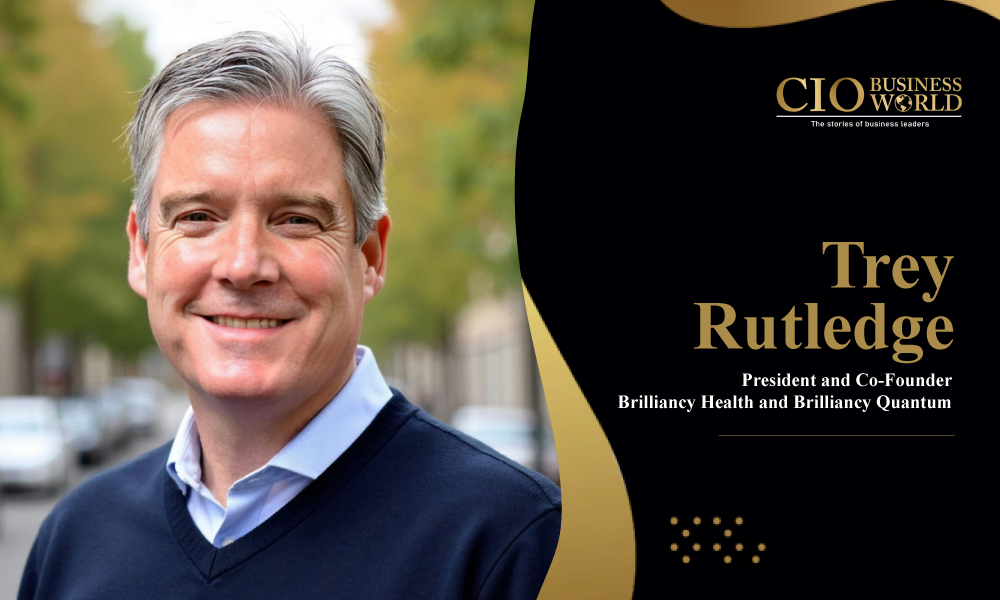
For Trey Rutledge, President and Co-Founder of Brilliancy Health and Brilliancy Quantum, this transition represents an opportunity that cannot be postponed. Rather than waiting for perfect technological maturity or complete market certainty, he believes organisations must begin building practical solutions today. Through the development of the Luminous Decision Intelligence Architecture, strategic collaborations with IBM, IonQ, IQM, D-Wave and the establishment of the Quantum AI Innovation Lab at KU Innovation Park, Trey is leading an effort to bridge frontier technologies with practical enterprise and healthcare applications. His vision extends beyond technological advancement itself, focusing on creating intelligent systems that strengthen human decision-making, improve patient outcomes, and enable organisations to navigate increasingly complex environments with greater confidence.
Recognising the Moment to Build
Every transformative company begins by recognising an opportunity before it becomes obvious to everyone else. For Trey, that moment arrived when quantum computing crossed an important threshold from experimental research into practical accessibility. The emergence of IBM’s Heron processors and IonQ’s trapped-ion quantum systems demonstrated that organisations no longer needed to wait for hypothetical future breakthroughs before exploring meaningful quantum applications. Combined with rapid advances in agentic AI and complexity science, these technologies had already become capable of addressing problems involving molecular modelling, optimisation under uncertainty, and secure enterprise decision-making.
Rather than viewing remaining hardware limitations as a reason to delay innovation, Trey saw them as an invitation to lead. Waiting for perfect hardware maturity or universal market readiness would have meant surrendering the opportunity to influence how quantum technologies are applied across healthcare and enterprise environments. That conviction became the foundation for Brilliancy Quantum and Brilliancy Health, organisations established not merely to study emerging technologies but to translate them into practical solutions capable of creating measurable value today.
This philosophy also guided the creation of the Quantum AI Innovation Lab at KU Innovation Park, where new architectures, technologies, and collaborative research can be validated before entering broader enterprise adoption. Through the Luminous Decision Intelligence Architecture, the company seeks to combine quantum computing, artificial intelligence, and systems thinking into an integrated framework that helps organisations solve increasingly complex challenges while remaining grounded in practical implementation rather than theoretical possibility.
Preparing Organisations for the Next Computing Revolution
Trey believes that organisations delaying quantum adoption risk missing far more than another technology trend. As computational challenges become increasingly interconnected, many problems already exceed the practical limits of classical computing. High-dimensional optimization, sophisticated molecular simulation, predictive healthcare, cybersecurity resilience, and real-time enterprise decision-making all require computational capabilities that traditional systems struggle to deliver efficiently.
By leveraging direct access to IBM’s and IonQ’s quantum platforms, Brilliancy is already exploring ways to accelerate drug discovery, improve molecular research, strengthen predictive treatment pathways, enhance cybersecurity against emerging post-quantum threats, and create more resilient healthcare and supply-chain operations. Each application reflects a broader objective of enabling organisations to solve problems that become exponentially more difficult as systems grow in scale and complexity.
For Trey, postponing adoption carries consequences beyond slower innovation. Organisations also risk losing competitive advantage, delaying scientific progress, increasing operational vulnerability, and missing the opportunity to influence the ethical standards and governance frameworks that will shape the future of quantum technologies. Those who begin integrating quantum computing alongside agentic AI today gain experience that compounds over time, positioning themselves to lead rather than react as the technology matures.
Balancing Vision with Disciplined Execution
Operating at the frontier of emerging technologies requires balancing ambitious vision with disciplined execution. Trey approaches this challenge by maintaining a clear long-term objective while advancing through carefully structured milestones that reduce uncertainty without slowing innovation.
His vision remains centred on creating human-focused intelligence that enhances professional expertise rather than replacing it. Achieving that vision depends upon practical execution through verified quantum access, controlled experimentation within the Quantum AI Innovation Lab, partnerships that contribute complementary capabilities in areas such as blockchain, data-mesh architectures, and agentic AI, and continuous measurement against real-world outcomes.
Rather than pursuing technological breakthroughs for their own sake, every stage of development is evaluated according to its ability to generate meaningful impact for healthcare providers, enterprises, and the people they ultimately serve. This combination of bold ambition and measured progress enables Brilliancy to move confidently through an industry where rapid innovation must always be balanced by technical validation and responsible implementation.
Leading Through Uncertainty in Frontier Technologies
One of the defining lessons throughout Trey Rutledge’s career has been that breakthrough innovation rarely emerges under perfect conditions. Working across distributed ledger technologies and deep-tech partnerships, he repeatedly witnessed promising ideas lose momentum because organisations chose to wait—for regulatory certainty, mature infrastructure, or widespread market validation. By the time those conditions arrived, the opportunity to shape the market had often passed.
Those experiences fundamentally influenced his leadership philosophy. In rapidly evolving industries, uncertainty is not an obstacle to avoid but an environment that leaders must learn to navigate. The organisations that define new markets are rarely those with complete information; they are the ones prepared to move responsibly, learn continuously, and refine their approach as technology evolves. For Trey, the greater risk has never been making decisions amid uncertainty but allowing hesitation to become irrelevant.
That perspective continues to guide Brilliancy’s growth. Every strategic decision is approached with careful evaluation, yet without expecting every variable to be resolved in advance. Progress is achieved through disciplined experimentation, continuous learning, and the confidence to adapt as new discoveries emerge. Rather than chasing certainty, the organisation focuses on building resilient systems capable of evolving alongside an increasingly dynamic technological landscape.
Transforming Healthcare Through Quantum Decision Intelligence
Healthcare represents one of the most promising applications for the convergence of quantum computing and artificial intelligence. While many healthcare systems continue operating reactively, Trey believes the future lies in creating intelligent environments capable of anticipating challenges before they become critical.
Through Brilliancy Health, that vision is becoming increasingly practical. By combining access to IBM’s and IonQ’s quantum systems with the Luminous Decision Intelligence Architecture, the company is developing solutions that unify fragmented healthcare information, strengthen predictive analysis, and support more informed clinical and operational decisions. Rather than disrupting existing medical workflows, these technologies are designed to integrate with established healthcare environments while enhancing the quality and speed of decision-making.
The same infrastructure also supports advances in molecular and systems modelling, creating opportunities to accelerate precision medicine and scientific discovery. Beyond patient care, Brilliancy is applying decision intelligence to strengthen hospital operations, improve enterprise planning, and increase organisational resilience across increasingly complex healthcare ecosystems.
At the centre of this transformation remains an unwavering commitment to human judgment. Technology serves as an intelligent partner that equips clinicians, administrators, and researchers with deeper insight while ensuring that final decisions continue to rest with experienced professionals. For Trey, the future of healthcare is not defined by replacing expertise but by giving experts better tools to navigate growing complexity with confidence and transparency.
Creating Purpose-Driven Innovation
Building organisations at the forefront of quantum computing presents challenges that extend well beyond technology itself. Developing market understanding, attracting specialised talent, forming strategic partnerships, and securing investment within a capital-intensive industry all require sustained leadership and long-term commitment. Among these, Trey considers the greatest challenge to be bridging the gap between frontier capability and enterprise readiness.
Helping organisations understand the practical value of quantum-AI solutions requires patience, education, and measurable outcomes rather than ambitious promises alone. Equally important is assembling teams capable of translating emerging technologies into reliable enterprise applications while maintaining realistic expectations about what can be delivered today.
These experiences have reinforced an important lesson about leadership. Success in deep technology is not achieved by having every answer but by creating clarity when uncertainty is unavoidable. It requires building trusted partnerships, maintaining focus on measurable human outcomes, and exercising the discipline to delay ideas that remain technically exciting but are not yet ready for practical deployment.
That same philosophy shapes Brilliancy’s internal culture. Recruitment focuses on individuals who are equally committed to scientific excellence and meaningful societal impact. Every initiative is evaluated against a simple but demanding standard: whether it delivers genuine value for patients, healthcare professionals, enterprise leaders, or broader communities. Technological breakthroughs are celebrated only when they improve decision-making, accelerate discovery, or contribute to better outcomes.
Transparent system architectures, strong ethical guardrails, and continuous alignment around purpose ensure that innovation never becomes disconnected from the people it is intended to serve. Within Brilliancy, technology is viewed not as the destination but as the vehicle through which lasting human impact can be achieved.
Building Resilient Organizations for the Future
As Brilliancy Quantum and Brilliancy Health continue expanding their capabilities, Trey Rutledge’s ambitions extend well beyond technological innovation. He envisions a future where quantum computing, agentic AI, and decision intelligence become foundational tools that help organisations solve problems previously considered too complex for conventional systems. Among the breakthroughs he hopes to accelerate are quantum-powered molecular and systems modelling that significantly reduces discovery timelines in medicine and advanced materials, alongside intelligent decision platforms capable of giving leaders reliable, auditable guidance in high-stakes environments.
He also sees enormous potential in creating integrated agentic systems that strengthen hospital operations, enterprise processes, and global supply chains. As organisations become increasingly interconnected, resilience will depend on the ability to anticipate disruption, evaluate multiple scenarios, and respond with greater speed and precision. By transforming uncertainty from an operational liability into a manageable strategic advantage, Brilliancy aims to help enterprises make more confident decisions while maintaining transparency and accountability throughout the process.
condition of frontier innovation. Teams are encouraged to conduct controlled experiments, share early findings openly, and view every iteration as an opportunity to strengthen future outcomes rather than simply validate existing assumptions.
Maintaining this balance depends on pursuing two complementary horizons simultaneously. Near-term projects must deliver measurable value for customers and partners, while long-term initiatives continue strengthening the architectural foundations that will support future innovation. Regular alignment around the organisation’s broader purpose ensures that every experiment, partnership, and product contributes to lasting improvements in healthcare and enterprise decision-making. Combined with a culture of psychological safety, this approach enables bold thinking without sacrificing operational discipline.
Turning Ambitious Ideas into Enduring Enterprises
Reflecting on the lessons learned throughout his entrepreneurial journey, Trey believes that successful deep-tech companies are built by solving meaningful problems rather than showcasing impressive technologies. While breakthrough innovations naturally attract attention, lasting organisations distinguish themselves by addressing challenges that carry genuine significance for industries and society.
For aspiring entrepreneurs entering frontier technologies, he emphasises the importance of securing meaningful capabilities early, whether through quantum infrastructure, proprietary data, strategic partnerships, or specialised expertise. Equally important is building systems that remain modular, explainable, secure, and capable of evolving as technology advances. Rather than attempting to solve every challenge independently, Trey advocates forming collaborative ecosystems where complementary strengths accelerate innovation far more effectively than isolated efforts.
He also encourages founders to resist waiting for ideal market conditions. Progress comes from moving with discipline, measuring outcomes rigorously, and remaining prepared to adapt whenever new evidence demands change. At every stage, technological ambition must remain anchored to measurable human benefit. Organisations that endure are those capable of combining technical excellence with integrity, adaptability, and an unwavering commitment to solving real-world problems.
A Legacy Beyond Technology
When Trey reflects on the long-term legacy of Brilliancy Quantum and Brilliancy Health, his aspirations extend far beyond creating another successful technology company. He hopes the organisations will be remembered for making advanced quantum AI and decision intelligence practical, trustworthy, and genuinely useful for the people responsible for solving society’s most complex challenges.
Whether supporting clinicians making critical patient decisions, researchers accelerating scientific discovery, or enterprise leaders navigating increasingly uncertain business environments, the goal remains the same: empowering better decisions through intelligent technology while preserving human judgment at every stage. Success will not be measured solely by technological achievements but by the tangible improvements those technologies create in healthcare, scientific research, and organisational performance.
Ultimately, Trey Rutledge’s leadership reflected a broader belief that the future of innovation belongs to organisations willing to act before certainty arrives, while remaining disciplined enough to build responsibly. At the Brilliancy Health Summit, leaders including Senator Roger Marshall, Chuck Brooks, Dr Keeper Layne Sharkey, Katie Arrington, Nardo Manaloto, and others served as esteemed speakers at KU Innovation Park at the University of Kansas.
Through Brilliancy Quantum and Brilliancy Health, we are helping shape an ecosystem where quantum computing and artificial intelligence work together to strengthen, rather than replace, human expertise. By combining scientific ambition with ethical leadership, strategic collaboration, and an unwavering focus on practical impact, we are contributing to a future where advanced technologies become trusted partners in solving the world’s most complex problems and improving lives on a meaningful scale.